


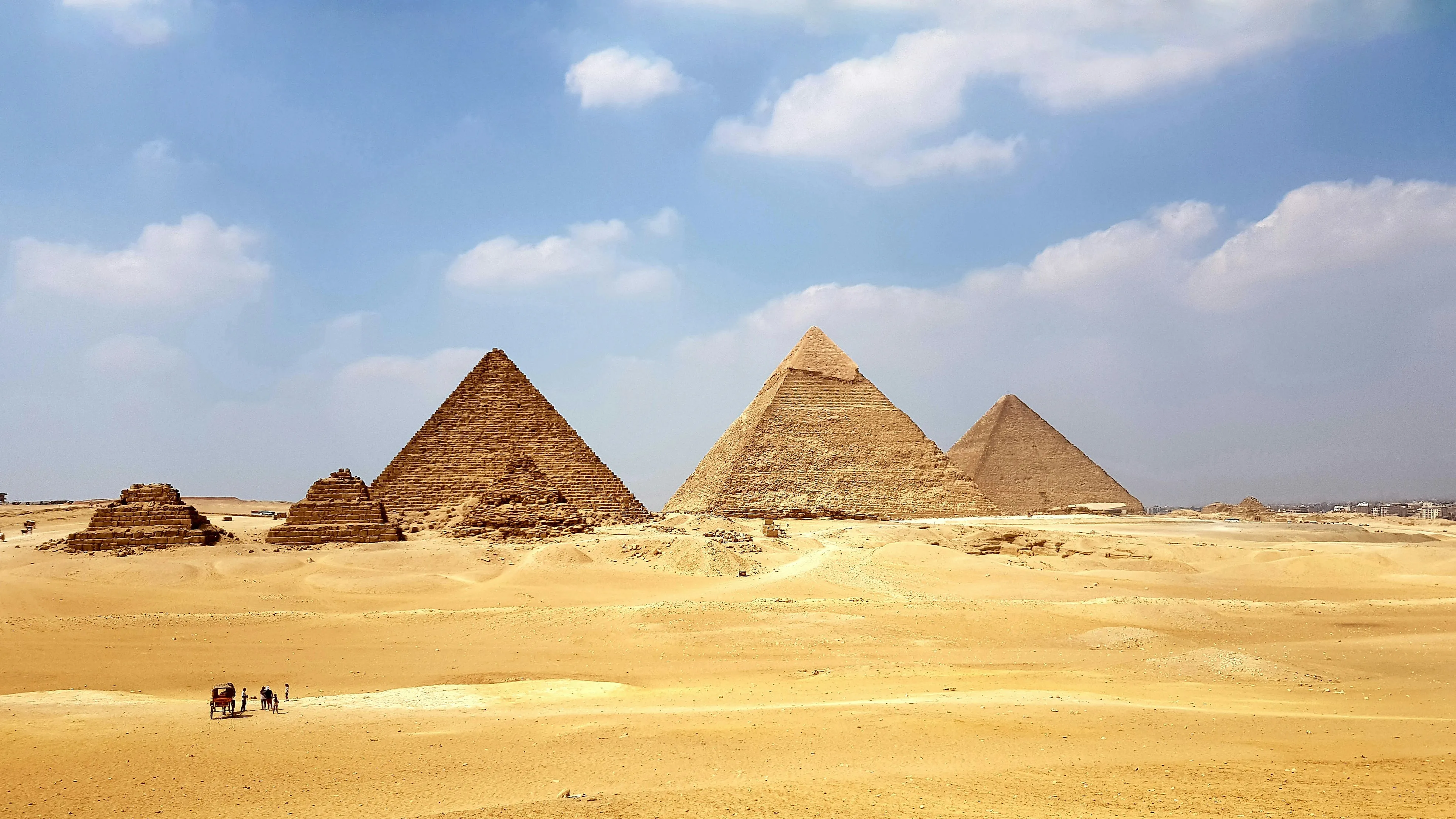
Egypt
Discover the cradle of ancient civilizations, where iconic pyramids and majestic temples on the banks of the Nile offer a fascinating historical and cultural journey.
Quick Facts
- Capital
- Cairo
- Language
- Arabic
- English, French
- Currency
- Egyptian Pound (EGP)
- Best time to visit
- From October to April, avoiding the extreme heat of summer.
- Budget per day
- $30 - $120 per day
- Climate
- Desert climate characterized by very hot summers and mild winters, with almost non-existent rainfall in most of the territory.
- Connectivity
- medium
- Very easy to obtain at airports and official phone shops.
- Electricity
- Type C / F (220V)
- Local transport
- acceptable
- Card usage
- cash is used more
- Tipping
- yes
🌎 Introduction
Egypt unfolds as a strip of life following the course of the Nile, where the green of the riverbanks abruptly meets the warmth of the desert. In this corner of northeast Africa, days usually pass under a constant sun that, especially during mild winters, invites you to traverse its landscapes calmly. It is not only the legacy of past civilizations that defines its identity, but also the pulse of its markets, the aroma of spices, and the sound of conversations that stretch over mint tea at sunset.
Daily life moves between the vibrant rhythm of cities like Cairo and the serenity of the southern villages, offering a contrast that is perceived in every corner. From the Mediterranean influence in Alexandria to the tranquility of the Red Sea coasts, the country displays a varied geography where rooted traditions coexist with a modernity seeking its own space. The local gastronomy, with simple dishes like koshary or freshly baked bread, reflects that blend of influences that have shaped a hospitable culture full of nuances.
🛡️ General safety
Egypt is a country that gives a very high priority to the safety of visitors, as tourism is one of the fundamental pillars of its economy. In general terms, traveling to Egypt is safe, as long as established tourist routes are followed and an attitude of basic prudence is maintained.
- The safety level for tourists is considered medium-high in the areas of greatest interest, such as Cairo, Luxor, Aswan, and the Red Sea resorts.
- There is a strong police and military presence in hotels, monuments, and roads, which usually generates a sense of tranquility in the traveler.
- The country has the Tourist Police, a specialized unit dedicated exclusively to assisting and protecting foreign visitors.
Crime and common risks
Violent crime against tourists is extremely infrequent in Egypt. However, as in any mass destination, there are minor risks worth knowing:
- Theft and pickpocketing: Can occur in crowded places, such as markets (souks) or public transport stations. It is recommended to wear backpacks on the front and not to display highly valuable objects.
- Scams and swindles: This is the most common risk. It usually manifests through unofficial guides, vendors who do not indicate the final price of a product, or people who offer “disinterested” help only to later demand a payment (tips or baksheesh).
- Commercial harassment: Vendors in the pyramid or temple areas can be very persistent. A firm and polite “La shukran” (no, thank you) is usually sufficient.
- Infrequent risks: Serious safety incidents are unusual on the main tourist routes due to strict access controls and surveillance.
Safety in cities and tourist areas
Safety varies slightly depending on the area of the country the traveler is in:
- Urban centers (Cairo and Alexandria): They are vibrant and safe cities at almost any hour, although traffic and population density can be overwhelming. It is recommended to walk along well-lit and busy streets.
- Archaeological zones: Places like the Valley of the Kings or the Pyramids of Giza have security checks with scanners similar to those at an airport, ensuring a very controlled environment.
- Beach areas (Red Sea): Locations like Sharm el-Sheikh or Hurghada are considered safety “bubbles,” with restricted access and a very relaxed and westernized atmosphere.
- Recommendation: Avoid participating in demonstrations or political gatherings that may arise spontaneously in large squares.
Transport safety
Transport in Egypt is a fundamental aspect of the travel experience:
- Public transport: The Cairo metro is safe and efficient; it has exclusive carriages for women. Public buses can be more complicated to use due to the language barrier.
- Taxis and VTC: It is highly recommended to use apps like Uber or Careem in large cities, as the price is fixed and the journey is recorded by GPS, avoiding arguments over the meter.
- Rental cars: Renting vehicles to drive within cities is not recommended if you do not have experience in chaotic traffic environments. In Egypt, you drive on the right.
- Nile Cruises: They are one of the safest and most organized means of transport in the country, with international safety standards.
Natural and climatic risks
Egypt’s geographical environment presents challenges mainly related to its desert location:
- Extreme heat: During the summer months (June to September), temperatures in Luxor and Aswan can exceed 45 °C. Constant hydration and avoiding the central hours of the day for visits is vital.
- Sandstorms (Khamasin): These occur mainly in spring. They can reduce visibility and affect people with respiratory problems.
- Flash floods: Although rare, brief torrential rains can occur in areas of the Sinai or Upper Egypt, causing floods in dry riverbeds (wadis).
- Earthquakes: Egypt is in a zone of moderate seismic activity, although large-magnitude earthquakes are unusual.
Local legislation and norms
Egypt is a country with rooted traditions and laws that can be stricter than those in Western countries:
- Photography: It is strictly forbidden to photograph or record military installations, police stations, bridges, or government buildings. Doing so can lead to detention and the confiscation of equipment.
- Drones: The use of drones is prohibited without a special prior permit, which is almost impossible for tourists to obtain. Bringing them into the country can result in the seizure of the device at customs.
- Drugs: Possession, consumption, or trafficking of illegal substances is punished with very severe prison sentences, including life imprisonment or the death penalty in serious cases.
- Social behavior: It is recommended to dress modestly, especially when visiting mosques or traditional neighborhoods (shoulders and knees covered), to avoid uncomfortable looks or lack of respect.
Safety for specific groups
- Solo female travelers: Egypt is safe for women, although persistent comments or stares are frequent. Traveling in a group or using female-only metro carriages increases comfort. Dressing discreetly helps minimize unwanted attention.
- LGTBIQ+ travelers: Although homosexuality is not explicitly criminalized, “debauchery” or “public morality” laws are used to prosecute incidents. It is essential to maintain maximum discretion and avoid public displays of affection, regardless of sexual orientation.
- Children and the elderly: Egyptians are very hospitable toward families and the elderly. The main risk for these groups is heat exhaustion and irregular surfaces in ancient temples.
Emergencies and assistance
In case of needing help, these are the basic protocols:
- Emergency Police: 122.
- Tourist Police: 126 (especially useful for problems in archaeological zones or with tourist services).
- Ambulance: 123.
- Fire Department: 180.
- Operation: The Tourist Police usually have English-speaking agents in the main areas. It is essential to always carry a copy of your passport and your travel insurance contact at hand.
Tip: Always use bottled water even for brushing your teeth and avoid ice in drinks to prevent stomach upsets, which are the most common safety “incident” among travelers.
📝 Country entry requirements
To undertake a journey to this historical destination, the fundamental document every traveler must carry is a passport. It is essential that it has a minimum validity of usually six months from the date of arrival in the territory. It is advised that the document be in perfect condition and have enough free pages for the corresponding entry and exit stamps that authorities will place at border controls.
In most circumstances, international visitors require a tourist visa. This permit usually allows a maximum stay of thirty days, which provides an ample margin to see the main monuments and regions of the country. The procedures to obtain this document are usually simple, and in many cases, it can be managed upon arrival at the airports themselves or through official digital platforms before starting the journey.
Upon entry, immigration officials may request a return ticket or continuation ticket to another destination, as well as proof of accommodation for the first nights. Although not systematically required at all entries, it is also prudent to be in a position to demonstrate financial solvency to cover the expenses derived from the tourist stay.
Regarding customs regulations, there are strict regulations on the introduction of certain items. The transport of medications for personal use must be duly justified, preferably with a medical prescription, as some substances common in other countries may be subject to rigorous controls. Likewise, the use of advanced technological equipment, such as drones or professional video cameras, usually requires special permits obtained in advance. As for food, it is recommended to avoid fresh products and opt only for vacuum-packed or industrially processed products.
From a health prevention perspective, there are usually no vaccines considered mandatory for all traveler profiles, except for those coming from geographical areas with specific public health risks. However, it is considered a highly recommended practice to visit an international vaccination center to receive advice on recommended vaccines and general preventive measures. Having travel insurance with broad coverage is usually a wise choice to ensure peace of mind throughout the experience.
- Passport: Must be valid for at least six months from entry into the country.
- Tourist visa: Generally necessary for most travelers, with a standard duration of one month.
- Exit documentation: Recommended to have your return ticket and hotel reservations at hand.
- Luggage restrictions: Special attention to prescription medications and a general ban on drones without prior permission.
- Financial funds: Ability to demonstrate sufficient resources for the stay if required by authorities.
- Health recommendations: Prior consultation on suggested vaccines and possession of international medical insurance.
🏥 Basic health considerations
When preparing your suitcase for Egypt, health is one of those points that should be clear to enjoy the trip without worries. You will find that the healthcare system in large cities like Cairo or Alexandria has modern and well-equipped private hospitals. These centers are the ones you will use if necessary, as public healthcare usually has different standards than what you might be used to. The cost of private medicine can be high, so it is essential to have financial backing. Regarding language, you will not have problems in private clinics, where staff usually speak English fluently.
Taking out travel medical insurance is not a mandatory legal requirement to enter the country, but it is entirely recommended for any tourist. You should ensure that your policy includes broad coverage for hospitalization, medical transfers, and repatriation. If you plan to engage in activities like diving in the Red Sea, check that your insurance also covers these types of specific sports, as specialized treatments can have very high costs.
Regarding vaccines, for a conventional tourism trip, there are no mandatory vaccines in general, unless you are coming from a zone with a risk of yellow fever transmission, in which case they will ask for an international certificate. The most prudent thing is to have your official vaccination schedule up to date. Some travelers choose additional protection against hepatitis A or typhoid fever, something you can consult at a specialized medical center before leaving home.
If you need to carry personal medication, ensure you always transport it in its original packaging. It is very important to carry the medical prescription translated into English or a report signed by your doctor. Egypt has very strict laws regarding certain drugs, especially potent painkillers or psychotropic substances that are common elsewhere, so having the official documentation will prevent any misunderstanding at security checks.
The climate will be your main health challenge. Extreme heat and environmental dryness can cause dehydration or heatstroke, especially if you visit archaeological sites during the central hours of the day. It is also frequent to suffer some mild digestive upset due to a change in diet or sensitivity to local bacteria. It is usually nothing serious, but it is convenient to carry some gastric protector and maintain constant hydration with mineral salts if you feel unwell.
Regarding hygiene and consumption, you will see that it is vital to always drink bottled water and ensure that the bottle’s seal is intact. Avoid ice cubes in drinks and be cautious with fruits that you cannot peel yourself or raw vegetables. Street food is a fascinating part of local culture, but I recommend choosing stalls that have a high turnover of people and where you see that the food is cooked to order at high temperatures.
In case of a real emergency, the telephone number you should dial to call an ambulance is 123. You should keep in mind that traffic in Egyptian cities is usually very dense, so emergency services can sometimes take time to arrive. In non-life-threatening situations, it is often much faster to request private transport to go directly to the nearest private clinic recommended by your insurance.
As final practical recommendations, remember to always carry hand sanitizer gel and use it frequently, especially after touching cash. Do not forget to apply high-factor sunscreen repeatedly and wear light clothing made of natural fabrics to protect your skin. With these basic precautions, you can focus on enjoying the ancient history found in every corner of the country.
🚌 Transport within the country
Moving around Egypt offers several alternatives that adapt to different distances and needs. For long journeys between major cities, the train is one of the most common options, along with domestic flights that quickly connect the most distant points of the territory. Scheduled buses also cover much of the national geography, while in river areas, the ferry or boats on the Nile River are common means of travel to cross from one bank to another or visit specific points.
In urban centers and areas with a higher influx of visitors, signage is usually present in both Arabic and English, which facilitates orientation. However, buying tickets and understanding routes may require some adaptation, as the organizational system varies depending on the mean of transport. While in the large capitals the network is more structured, in rural areas, transport is usually more informal and depends on smaller vehicles that do not always have rigid schedules or conventionally marked stops.
The use of taxis and transport services managed through mobile apps is a widespread and useful practice for travelers. These services allow for agile movement through cities, although it is fundamental to keep in mind that heavy traffic usually dictates the pace of urban journeys. In the capital, the metro presents itself as a functional alternative to avoid street crowds, connecting key points of the city directly and simply for the international user.
The sense of comfort and reliability is linked to the category of the chosen transport. Higher-tier services and upper classes on trains are usually punctual and offer adequate standards for tourism. Generally speaking, the transport system is capable of taking the visitor to the main monuments and centers of interest, although it is always convenient to consider travel times with a sufficient margin due to the magnitude of the distances and traffic intensity in metropolitan areas.
“Tip”: It is recommended to always confirm the exact location of the station or departure terminal, as large cities may have different departure points depending on the direction of the journey or the type of transport.
🤵 Culture and etiquette
Egyptian society places great importance on hospitality and interpersonal relationships, so treatment is usually friendly and welcoming to visitors. When greeting, it is common to use courtesy formulas that demonstrate respect, especially toward older people or those in positions of authority. In daily encounters, greetings can be leisurely, and it is frequent to dedicate an initial time to exchanging courtesy phrases about general well-being before moving on to the main reason for the conversation.
In public spaces, discretion and moderation in physical displays of affection are valued, especially between people of different sexes. The volume of voice in conversations is usually lively and the use of gestures is frequent to emphasize ideas, reflecting the communicative and expressive nature of their culture. Regarding punctuality, there is a somewhat more flexible conception of time in social contexts and informal meetings, where personal interaction often takes precedence over strict adherence to the schedule.
The culture of food and drink is a fundamental pillar of coexistence; accepting an invitation for tea or coffee is considered a gesture of courtesy that facilitates social connection. Regarding services, the practice of tipping (known locally as baksheesh) is a deeply rooted custom and is understood as a way to thank for the attention received in various fields, from dining to small daily favors. It is a common social mechanism to recognize others’ effort and maintain the flow of service relationships.
Respect for religious traditions and places of worship is essential for moving around naturally. When visiting mosques or churches, the visitor is expected to maintain a serene behavior, speak in a low tone, and observe dress guidelines that cover shoulders and knees, in addition to removing shoes before entering prayer spaces. Observing the rhythm of local life with attention, especially during festivities or prayer times, allows the traveler to integrate from a position of consideration and appreciation for the environment.
“Tip”: When making a purchase or hiring a service where there is no fixed price, haggling should be understood as a social interaction based on dialogue and patience, where the objective is to reach a satisfactory agreement for both parties while always maintaining cordiality.
🍛 Typical gastronomy
The gastronomy of Egypt is a reflection of its millennial history, combining influences from the Mediterranean, the Middle East, and Africa. Its cuisine is characterized by the generous use of legumes, vegetables, and cereals, especially wheat, which is the base of aish baladi, the traditional flatbread that accompanies almost all meals. Being a mainly agricultural country thanks to the Nile valley, fresh products from the land are the main protagonists of its tables.
Egyptian flavors are aromatic but generally mild. The use of spices such as cumin, coriander, garlic, and cinnamon provides a characteristic depth without resorting to excessive spiciness. It is very common to start meals with a variety of mezze, small portions of creams and salads, among which hummus and baba ganoush stand out, always served with freshly baked bread to facilitate consumption.
Regarding social habits, food is an act of hospitality and coexistence. Schedules are usually later than in other destinations; lunch, which is the main meal, is usually served in the mid-afternoon, while dinners can extend late into the night. It is common to share from the center of the table, and although cutlery is used in restaurants, in traditional settings, bread is used as a tool to pick up food.
Regarding drinks, tea (shai) is the national drink and is consumed at any time of the day, usually very sweet and in small glasses. Karkadé, a hibiscus flower infusion that can be taken hot or cold, is also very popular. Coffee, prepared in the Turkish style with grounds and spices, is another widespread option to finish meals or socialize in local cafes.
| Dish | Description | Main ingredients | Where to try it | Tip |
|---|---|---|---|---|
| Koshary | Considered the national dish, it is an energetic mix of several grains. | Rice, lentils, chickpeas, macaroni, and spicy tomato sauce. | Street stalls and specialized spots in Cairo. | Mix it well before eating so the crispy onion is integrated. |
| Ful Medames | The traditional breakfast par excellence, slow-cooked over a low flame. | Cooked fava beans, olive oil, garlic, cumin, and lemon juice. | Breakfast carts and popular restaurants throughout the country. | Try it accompanied by a hard-boiled egg and freshly made pita bread. |
| Ta’ameya | The Egyptian version of falafel, greener and fluffier than that of other countries. | Mashed fava beans (instead of chickpeas), coriander, and parsley. | Fast food stalls and local markets. | It is ideal for a light lunch inside a flatbread sandwich. |
| Mahshi | A selection of stuffed vegetables that demonstrate the patience of local cuisine. | Zucchini, eggplants, or peppers stuffed with rice and aromatic herbs. | Home-style and traditional cuisine restaurants. | The versions wrapped in vine leaves are especially delicate. |
| Om Ali | A comforting traditional dessert whose name means “Mother of Ali.” | Layers of puff pastry, milk, nuts, raisins, and coconut. | Traditional cafes and dessert restaurants. | Enjoy it hot to better appreciate the creamy texture of the puff pastry. |
📷 Areas and places to visit
Egypt is a destination where millennial history and contemporary life are constantly intertwined in every one of its corners. The capital, Cairo, functions as the cultural epicenter of the country, offering a marked contrast between its modern areas and its historical neighborhoods. In this great city, the Giza plateau area stands out, where the Pyramids of Cheops, Khafre, and Menkaure are located, along with the imposing figure of the Great Sphinx. Exploring the Coptic Quarter or getting lost in the alleys of the Khan el-Khalili market allows for an understanding of the city’s evolution over the centuries. Additionally, the capital houses highly relevant institutions such as the Egyptian Museum in Tahrir Square and the Grand Egyptian Museum, which guard one of the most important collections of antiquities in the world.
Following the course of the Nile River south, the landscape transforms to give way to the regions with the highest archaeological density. The city of Luxor acts as a true open-air museum, divided by the river into two strips with different historical meanings. On the East Bank are the Karnak and Luxor temple complexes, formerly connected by the Avenue of Sphinxes. On the West Bank, the environment becomes more arid and mountainous, housing the Valley of the Kings and the Valley of the Queens, where the tombs of ancient rulers are found, in addition to the Temple of Hatshepsut and the Colossi of Memnon. This area is ideal for trips in traditional boats or contemplating the crops that border the riverbed.
Further south is Aswan, an area that stands out for its river landscapes dotted with islands and granite rock formations. Here, it is common to visit the Philae Temple, dedicated to the goddess Isis and located on an island, as well as the Aswan Dam, a modern engineering work that transformed the geography of the region. In this part of the country, Nubian culture takes on a special prominence, visible in its colorful villages and the local way of life. A bit further away, though accessible from this city, is the Abu Simbel complex, with its temples carved into the rock that were moved to prevent them from being submerged under the waters of Lake Nasser.
The country also offers a strong natural contrast through its coasts. The Red Sea region is internationally known for its seabeds and coral reefs. Locations like Sharm el-Sheikh, Hurghada, or Marsa Alam are reference points for those seeking activities like diving or snorkeling. These areas combine leisure infrastructure with the possibility of excursions through the surrounding desert. On the other hand, the Mediterranean coast houses Alexandria, a city with a different atmosphere, marked by its Greco-Roman past and its iconic modern Bibliotheca Alexandrina, which pays homage to the ancient institution of antiquity.
For those interested in nature and isolation, the Western Desert oases, such as Siwa or the White Desert, present unique geological landscapes. Limestone formations and water springs in the middle of the dunes offer a different vision of Egyptian territory, moving away from the more urban or river circuits. These places allow for experiencing a more rural and traditional way of life, where mud architecture and date palms define the environment.
Tip: You cannot miss visiting the Pyramids of Giza, the most iconic place in the country.
✈️ Best season to travel
Egypt is a destination that can be visited year-round, although the travel experience varies considerably according to the calendar due to its predominantly desert climate. Temperatures are the determining factor for deciding when to tour the archaeological complexes or navigate the Nile, as the contrast between seasons marks the pace of outdoor activities and comfort in travel.
Most travelers opt for the months with more moderate temperatures to explore the historical monuments leisurely. However, coastal areas maintain a constant appeal for those seeking water activities, offering different conditions in each period that allow for adapting the trip according to whether you prefer to avoid crowds or ensure a cooler climate for walks.
| Season | Months | Typical climate | What to expect | Tourist influx |
|---|---|---|---|---|
| Spring | Mar – May | Warm and dry, with temperatures rising gradually. | Clear landscapes and the possibility of occasional desert winds (Khamasin). | ⭐⭐⭐ (Medium) |
| Summer | Jun – Aug | Very intense and dry heat, especially in the south of the country. | Long days, ideal for diving in the Red Sea and visiting air-conditioned museums. | ⭐ (Low) |
| Autumn | Sep – Nov | Temperatures dropping to very pleasant levels. | Optimal conditions for Nile cruises and walks through valleys and necropolises. | ⭐⭐⭐⭐ (High) |
| Winter | Dec – Feb | Mild and sunny days with cool or cold nights in the desert. | The most comfortable time for monument viewing; lively atmosphere in the cities. | ⭐⭐⭐⭐⭐ (Very high) |
🗣️ Basic vocabulary
Although it is common to find people who speak English or even some Spanish in the tourist areas of Egypt, knowing a few expressions in Egyptian Arabic will help you move around more easily. Using basic words in daily life facilitates common situations such as greeting, thanking for a service, or asking for a price, allowing for smoother communication with local residents.
Learning these courtesy formulas is usually very well received and proves very practical for moving through markets, restaurants, or when using public transport. It is not necessary to master the grammar; it is enough to memorize a few key terms that will serve you throughout your stay.
- Salam / Ahlan: Hello.
- Shukran: Thank you.
- Min fadlak (to a man) / Min fadlik (to a woman): Please.
- Aywa: Yes.
- La: No.
- Bekam?: How much does it cost?
- Affuan: You’re welcome / Excuse me.
- Tamam: Good / Okay.