


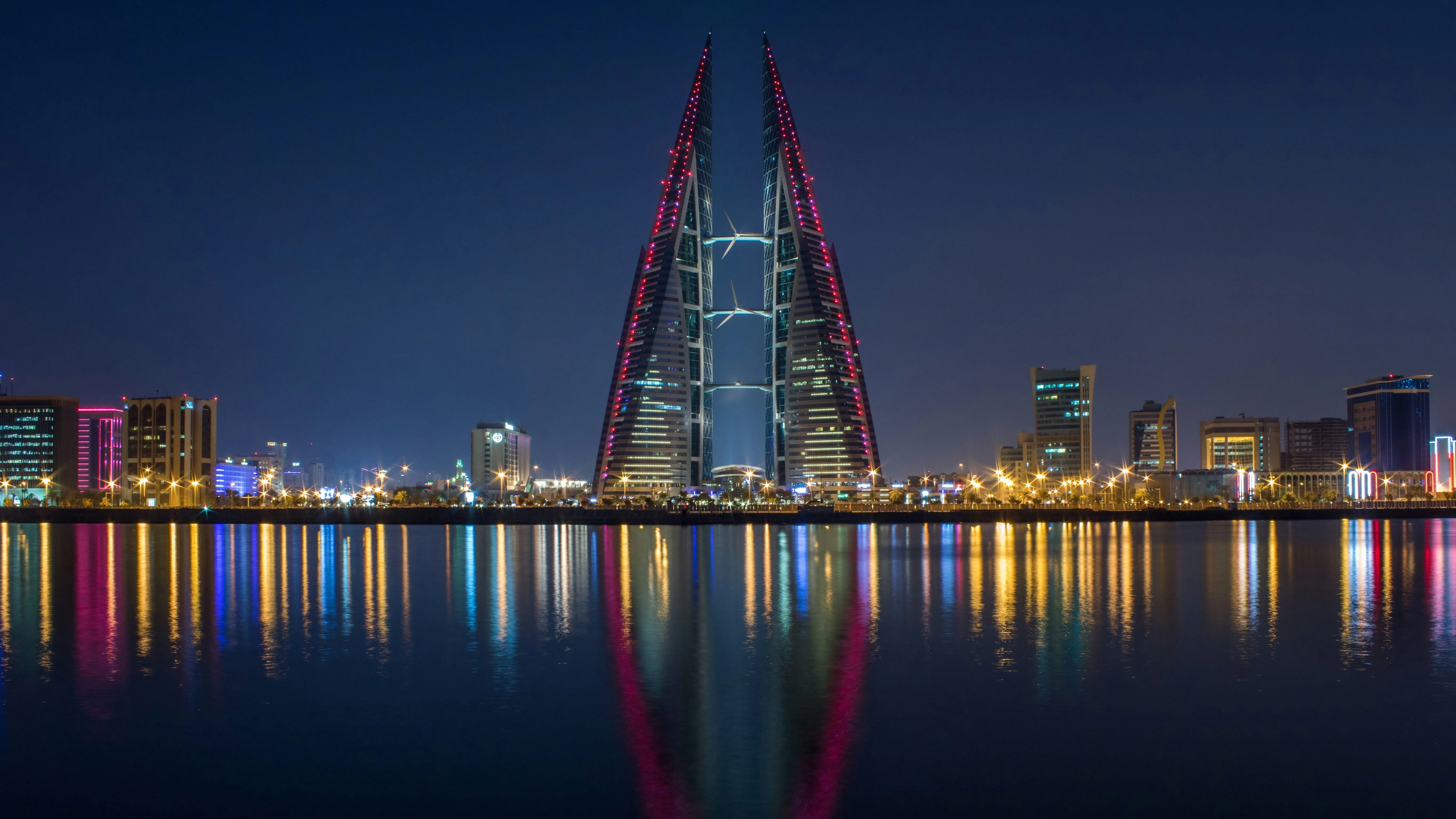
Bahrain
An archipelago that merges the modernity of its skyscrapers with rich millenary traditions, offering an authentic and welcoming cultural experience in the Persian Gulf.
Quick Facts
- Capital
- Manama
- Language
- Arabic
- English
- Currency
- Bahraini Dinar (BHD)
- Best time to visit
- From November to March, when temperatures are more pleasant for walking.
- Budget per day
- $70 - $250 per day
- Climate
- Arid climate with extremely hot summers and mild, dry winters, with sparse annual rainfall concentrated in a few days.
- Connectivity
- good
- Very easy to obtain at the international airport and official mobile phone stores.
- Electricity
- Type G (230V)
- Local transport
- acceptable
- Card usage
- very widespread
- Tipping
- optional
🌎 Introduction
Bahrain unfolds as an archipelago where the sea breeze softens the arid character of the environment, creating a space of coexistence between millenary tradition and a cosmopolitan present. In its streets, the aroma of coffee with cardamom mixes with the salinity of the Gulf, a reminder that for centuries these waters were the epicenter of the search for natural pearls. It is a corner where modern glass buildings share the horizon with the ancient mud walls of forts and the alleys of the souqs, where the pace of life pauses as the sun sets.
The country’s identity is perceived in the small daily details, such as the bustle of the markets at dusk or the hospitality that accompanies every encounter. As the seasons change, the landscape transforms; mild winters invite you to enjoy the outdoors and a gastronomy rich in nuances, spices, and local products. It is a destination that shows itself with serenity, offering a balanced mix of living history, clear horizons, and a culture that, true to its roots, maintains a constant dialogue with the outside world.
🛡️ General safety
Bahrain is considered one of the safest and most stable destinations in the Persian Gulf region for international travelers. The country stands out for its hospitality and a general environment of tranquility, allowing tourists to enjoy their stay with a high sense of confidence.
General safety level
- The safety level in Bahrain is high. It ranks as one of the countries with the lowest crime rates in the world, offering a very favorable environment for tourism.
- Compared to other international destinations, the risk of suffering violent incidents is extremely low. The police presence is visible but discreet, contributing to an environment of order and control.
- The context for the traveler is that of a modern country that deeply values tourism and mutual respect, where the coexistence between local tradition and a cosmopolitan mentality facilitates a pleasant stay.
Crime and common risks
- Property crimes, such as pickpocketing or theft, are infrequent. However, as in any tourist destination, small thefts due to carelessness can occur in crowded areas.
- Tourist scams are not common, although it is always recommended to agree on prices for unregulated services or in markets (souks) to avoid misunderstandings.
- An infrequent risk but one worth mentioning is credit card fraud; it is recommended to use ATMs in secure locations such as banks or shopping malls.
Safety in cities and tourist areas
- Urban centers, especially Manama (the capital) and residential areas like Adliya or Juffair, are very safe for walking even at night.
- Public transport and areas of cultural interest, such as forts or museums, have surveillance and a very family-friendly atmosphere.
- There are no critical safety differences between neighborhoods, although it is always advisable to stay informed about local news and avoid any type of demonstration or political gathering if one should occur.
Transport safety
- Public transport in Bahrain is limited but safe. However, most tourists opt for taxis or private transport applications (such as Uber or Careem), which are reliable and have regulated rates.
- In Bahrain, people drive on the right, just like in most of Europe and America.
- If you decide to rent a vehicle, you should know that the road infrastructure is of excellent quality. However, local driving can be fast and sometimes somewhat aggressive, so caution is recommended at entries and roundabouts.
- It is essential to strictly respect speed limits and the zero-tolerance policy for drinking and driving, for which penalties are very severe.
Natural and climatic risks
- The most significant natural risk in Bahrain is extreme heat. During the summer months (especially from June to September), temperatures can exceed 45°C with very high humidity.
- Sandstorms or dust storms can occur occasionally, reducing visibility and affecting people with respiratory problems.
- To prevent climate-related risks, it is vital to maintain constant hydration, use high-factor sunscreen, and avoid outdoor activities during the central hours of the day in the summer season.
Legislation and local norms
- Bahrain is an Islamic country and, although it is one of the most liberal in the region, there are laws and customs that tourists must respect. It is recommended to dress discreetly and respectfully, especially in government buildings, traditional markets, and places of worship (shoulders and knees covered).
- Alcohol consumption is allowed in licensed establishments (specific hotels and restaurants), but showing symptoms of intoxication or consuming alcohol in public is strictly prohibited.
- The use, possession, or trafficking of drugs carries extremely high prison sentences and severe fines.
- Excessive public displays of affection may be frowned upon or even sanctioned depending on the context and location.
Safety for specific groups
- Female travelers: Bahrain is a safe destination for women traveling alone. Harassment problems are uncommon, although dressing modestly is recommended to avoid unwanted attention.
- LGTBIQ+ travelers: Although Bahrain does not criminalize homosexuality as strictly as some neighboring countries, society remains conservative. It is recommended to maintain a discreet attitude and avoid public displays of affection, as they could lead to incidents for “indecency.”
- Travel with children and the elderly: The country is ideal for families. The infrastructure is modern, there are numerous shopping malls with top-level medical services, and parks and attractions usually meet high safety standards.
Emergencies and assistance
- The main emergency number in Bahrain for police, ambulance, and fire is 999.
- Emergency services are efficient and usually have staff who speak fluent English.
- In case of any incident or loss of documentation, it is recommended to contact local authorities and, subsequently, inform the corresponding consular representation. Private medical care is of high quality, so it is essential to travel with medical insurance that has broad coverage.
Tip: Always maintain a respectful attitude toward local customs and carry a digital copy of your passport; Bahrain is a welcoming country where common sense is your best ally for a perfect stay.
📝 Entry requirements
To visit the Kingdom of Bahrain, most international travelers require a passport with a minimum validity of six months from the intended date of arrival. It is essential that the document is in good condition and has free pages for the entry and exit stamps that migration authorities usually apply during the border control process.
Most visitors usually need an entry authorization or visa, which in many cases can be processed electronically before the trip or, in certain circumstances, upon arrival at main access points such as the international airport. The usual tourist stay period typically ranges between two weeks and one month, although there are mechanisms to request extensions if you wish to extend the visit for leisure or rest purposes through the corresponding offices.
It is common for border controls to ask tourists to present a return or onward ticket to a third country, as well as proof of sufficient financial funds to cover all expected expenses during the stay in the territory. Likewise, having a confirmed accommodation reservation for the first nights usually facilitates the admission process by immigration officers, who conduct brief and routine interviews.
Regarding customs regulations, there are general restrictions on the import of certain products that travelers should be aware of. It is recommended to be cautious with the introduction of medications, and it is advisable to carry the original medical prescription translated into English. On the other hand, the entry of products that may be considered contrary to local culture or sensitive printed materials is usually supervised. The transportation of alcohol and tobacco is subject to specific quantity limits that should be respected to avoid any type of mishap.
From a health point of view, specific vaccines are not usually required to enter the country generally, unless the traveler comes from areas with a risk of transmission of certain diseases. However, it is suggested to keep the international vaccination schedule up to date and to have travel insurance that provides broad coverage, as medical services for foreigners can have high costs if private protection is not available.
- Essential documentation: Valid passport and, usually, a visa processed according to the modality corresponding to the traveler’s profile.
- Proof of stay: Documentation proving departure from the country and financial capacity for maintenance during the visit.
- Security controls: Routine baggage inspections at airports and other land border points.
- Customs restrictions: Limitations on the entry of certain foods, alcoholic beverages, and material that may be considered inappropriate.
- Health and prevention: Verification of basic vaccines and recommendation to possess an international health assistance policy.
- Medication regulation: Need to carry a medical prescription for personal-use medications containing substances under regulatory control.
🏥 Basic health considerations
When planning your trip to Bahrain, you will discover that this country has one of the most modern and efficient health systems in the Gulf region. You will find a wide network of hospitals and clinics, especially in the capital, Manama, where care standards are very high. While a public system exists, as a tourist it is most common for you to use private healthcare, which stands out for its speed and for having the latest technology. Medical staff are usually highly qualified and, for the most part, are international professionals who speak fluent English, so it will be very easy for you to communicate and explain any symptoms you have.
You should keep in mind that medical services for foreigners are not free and prices can be quite high. For this reason, it is fundamental that you take out travel medical insurance before leaving home. Although it will not always be mandatory to enter the country, it is a necessary investment to avoid unforeseen expenses. Make sure your policy includes broad coverage for hospitalization, ambulance transfer, and medical repatriation, as these services usually have very high costs in the Bahraini private sector.
Regarding vaccines, you will not find mandatory vaccination requirements to enter Bahrain, unless you come from a country where yellow fever is endemic, in which case they will ask for the corresponding certificate. In general terms, it will be enough to have your official vaccination schedule updated. It is generically recommended to be protected against hepatitis A and B, as well as tetanus, but it is not necessary to carry out specific preventive treatments for tropical diseases, as they are not common in this archipelago.
If you need to travel with your own medication, it is important to be cautious. Bahrain is very strict with the entry of certain drugs, especially those containing narcotic or psychotropic substances. You can take your personal treatment as long as you keep it in its original container and carry a detailed medical prescription or a report from your doctor, preferably written in English. This will save you any inconvenience at customs controls when arriving at the airport.
The main health risk you will face in this destination is the climate. You will find extreme heat and very high humidity during much of the year, which can cause dehydration, sunstroke, or heatstroke if you do not take precautions. There are no significant risks of mosquito-borne diseases and, being a mostly flat country, you will not have problems related to altitude either. Most minor incidents among tourists are usually related to sudden temperature changes between the outdoor heat and the strong air conditioning indoors.
Regarding water and food, you will notice that hygiene levels are excellent throughout the country. You can try the local gastronomy in both luxury restaurants and small establishments with total peace of mind. Tap water is usually desalinated and, although technically potable and safe for brushing teeth, you will see that most residents and tourists prefer to consume bottled water due to the mineralized taste of the public network. You will find bottles of water at very low prices in any establishment.
In case you find yourself in a medical emergency situation, the telephone number you should dial is 999. This service centralizes emergencies and will send an ambulance if necessary. Emergency services are effective and units are equipped with everything necessary to stabilize a patient before reaching the hospital.
To make your stay perfect, I recommend that you drink fluids constantly even if you don’t feel thirsty and that you always use high-factor sunscreen. If you travel in the hottest months, try to do your walking tours during the early hours of the morning or at sunset, taking advantage of the central hours of the day to enjoy museums or shopping malls, where you will be safe from the harshest temperatures.
🚌 Transport within the country
Moving around the Bahrain archipelago is a simple experience due to the small size of the territory. The car is the predominant means of transport, as the road network is modern and quickly connects the main points of interest. Although there are no train or metro networks, the country has a system of public buses that covers much of the main island, linking the capital with other important towns.
The use of public transport is quite accessible for visitors. Signage at stops and inside vehicles is usually available in both Arabic and English, which facilitates orientation. The system for purchasing tickets is intuitive, allowing the traveler to move autonomously without needing deep knowledge of the technical operation of the service.
Taxis and transport services via mobile applications are very frequent and represent one of the most comfortable options for tourists. They are especially useful for direct door-to-door journeys, avoiding waiting in the sun. These services operate in a regulated manner and offer a constant sense of safety and reliability at any time of the day.
There is a clear difference between the capital area and the more peripheral or rural areas. While in urban centers the frequency of service is higher, in less populated areas it is more advisable to opt for renting a vehicle or using taxis. To visit some of the smaller islands, there are ferry services that regularly connect different points on the coast with more isolated destinations.
In general terms, transport in the country stands out for its comfort and good condition of the vehicles. The road infrastructure is designed to support fluid traffic, allowing travel to be fast and efficient, meeting punctuality expectations in most services available to the traveler.
Tip: It is convenient to check public transport routes in advance to confirm which stops are closest to the points of interest you wish to visit.
🤵 Culture and etiquette
Bahraini society is characterized by a deep-rooted tradition of hospitality and kind, measured interpersonal treatment. In daily interactions, the greeting is an important moment that usually begins with a cordial verbal exchange. When greeting, it is customary to use the right hand for physical contact, while in encounters between people of different sexes, it is most common to wait for the other person to initiate the gesture or, failing that, to perform a slight nod as a sign of courtesy and respect.
Behavior in public spaces is usually governed by discretion and decorum. It is positively valued to maintain a moderate voice volume, avoiding unnecessary noise or loudness that could disturb the peace of the environment. Regarding physical contact, public displays of affection are not a common practice, with a reserved attitude being preferred to reflect respect for the personal space of others. Regarding time, punctuality is appreciated in professional settings, although there is usually greater flexibility in social contexts, where the quality of interaction is prioritized over scheduling rigor.
In the context of meals and visits, generosity is a constant norm. If you receive an invitation to share coffee or food, it is considered a gesture of good manners to accept at least a small portion as a sign of gratitude. It is relevant to remember the preferred use of the right hand both for eating and for giving or receiving objects from another person. In service establishments, such as restaurants or hotels, tips are well-received as a voluntary recognition of good service, although there is no strict rule regarding their obligation.
Respect toward religious sites and cultural traditions is a fundamental aspect of coexistence. During visits to mosques or when passing near places of worship, it is important to maintain calm behavior and observe the requested conduct and dress codes. Likewise, the social structure gives a place of special consideration to elderly people and hierarchies, who are usually given priority or the floor as a natural gesture of deference that facilitates smooth integration into the local environment.
“Tip”: When participating in social or commercial encounters, remember that always using your right hand to greet, eat, or hand over any object is a simple gesture that shows great sensitivity toward local customs and helps create a positive impression.
🍛 Typical gastronomy
The cuisine of Bahrain is a true reflection of its history as a strategic enclave on the trade routes of the Persian Gulf. Its culinary identity has been forged through the fusion of Arabic tradition with Persian, Indian, and Mediterranean influences, resulting in a proposal where spices and fresh products are the fundamental pillars. Rice, lamb, and fish caught in local waters constitute the base of most recipes, which are characterized by great intensity of flavor without being excessively spicy.
The aromatic profile of its dishes is defined by the generous use of ingredients such as dried black lemon (loomi), saffron, cardamom, cinnamon, and cloves. These elements not only provide color but also grant a unique complexity to stews and rice dishes. Additionally, dates occupy a place of honor at the table, present in both sweet preparations and as a welcoming gesture to visitors, representing a symbol of hospitality and courtesy deeply rooted in the local culture.
Regarding eating habits, food is understood as a social and community act. It is common for dishes to be presented on large platters to be shared among diners. Meal times are flexible in urban areas, although lunch is usually the main meal of the day. In local restaurants, etiquette is simple and welcoming; although the use of cutlery is widespread, in more traditional environments, the use of the right hand is valued. To accompany the food, Arabic coffee (gahwa), infused with cardamom and saffron, and sweet black tea are the most frequent and traditional options.
| Dish | Description | Main ingredients | Where to try it | Tip |
|---|---|---|---|---|
| Machboos | National dish consisting of spiced rice with meat or fish. | Basmati rice, meat (chicken or lamb), loomi, and spice mix. | Traditional restaurants in Manama and souqs. | Combine it with daqus sauce if you prefer a spicier touch. |
| Muhammer | Sweet rice traditionally served accompanying savory dishes. | Rice, dates, sugar, and rose water. | Seafood establishments in coastal areas. | It is the perfect accompaniment for local fried fish due to its contrast of flavors. |
| Qoozi | Slow-roasted lamb, stuffed and served on a bed of rice. | Lamb, rice, boiled eggs, onion, and nuts. | Traditional cuisine restaurants and celebrations. | Since it is a very generous portion, it is recommended to order it to share. |
| Gabout | A kind of dumplings or dumplings cooked in a meat stew. | Flour dough, minced meat filling, and spiced tomato sauce. | Eateries and stalls in local markets. | It is a very nutritious and comforting dish, ideal for days with milder weather. |
| Halwa Bahraini | The most famous sweet in the country, with a gelatinous texture and vibrant color. | Starch, saffron, cardamom, and nuts (pistachios or cashews). | Specialized shops in the Muharraq Souq. | Always taste it alongside a cup of Arabic coffee to balance its sweetness. |
📷 Areas and places to visit
Bahrain presents itself as an archipelago where the modernity of skyscrapers lives in harmony with the traces of millenary civilizations. The capital, Manama, is the ideal starting point to understand this duality. In its heart, the contrast between the avant-garde structures of the financial district and the traditional flavor of the Manama Souq stands out. Crossing the historical gate of Bab Al Bahrain, the visitor is immersed in a network of streets where the aromas of spices and commercial bustle evoke past eras. Nearby, the Al Fateh Mosque stands as a notable example of contemporary architecture, allowing for a close look at local culture and spirituality in an environment of great serenity.
For those looking to delve deeper into the historical legacy, the Bahrain National Museum offers a detailed journey through the island’s history, from the ancient Dilmun civilization to the oil era. The country’s archaeological importance becomes evident when visiting the Dilmun Burial Mounds, which dot the landscape and tell of centuries of ancestral rites. Another point of great interest is the Muharraq area, the former capital, where you can walk the Pearling Path. This internationally recognized itinerary allows you to stroll among restored traditional houses that show the relevance the pearling industry had for the economy and identity of the region before modern urban development.
Defensive heritage has its greatest exponent in Qal’at al-Bahrain, also known as the Bahrain Fort. This stone fortification rises in front of the coast and offers a unique panoramic view where historical ruins are framed by the modern skyline of the city in the background. It is an ideal place to walk at sunset and observe the layers of human occupation that have defined this strategic enclave over the centuries. Other castles, such as Arad or Riffa, complement this vision of military architecture and provide different perspectives on the evolution of the territory.
Toward the south of the country, the landscape transforms into a desert expanse where nature shows its capacity for resilience. In the middle of this plain is the Tree of Life, a solitary specimen that has survived for centuries without a visible water source around it, becoming a symbol of the island. In this same area is the Sakhir region, known not only for its arid environment but also for hosting important motor-dedicated facilities and major events that attract visitors from all over the world, showing the nation’s most dynamic and cosmopolitan side.
Marine experiences are fundamental in a country composed of islands. The Hawar Islands offer a natural refuge where it is possible to observe migratory birds and diverse marine fauna in a much quieter environment than in urban areas. On the other hand, the beaches of the west coast and excursions to nearby sandbanks allow you to enjoy the warm waters of the Gulf. In these coastal areas, practicing activities related to the sea, such as rides in traditional boats or observing the coast from the water, constitutes a relaxed way to get to know the island geography.
Cultural and social life is also manifested in its festivals and temporary exhibitions, which usually take place in cultural centers distributed across the island. Walking through the most modern neighborhoods allows you to discover contemporary art galleries and a gastronomic offer that reflects the mix of international influences. Bahrain thus manages to balance its historical roots with an open vision, offering the traveler a variety of environments ranging from the stillness of the desert and the tradition of old neighborhoods to the dynamism of a constantly growing metropolis.
Tip: You cannot miss visiting Qal’at al-Bahrain, the most emblematic place in the country.
✈️ Best time to travel
The climate of Bahrain is characterized by being arid, with two well-differentiated seasons: a very hot summer and a mild and pleasant winter. The choice of when to travel significantly conditions the type of activities that can be performed, as the extreme temperatures of the central months of the year usually limit visits to air-conditioned indoor spaces.
For those looking to explore archaeological sites, walk through souqs, or enjoy the coast, the months between late autumn and early spring offer a much more favorable environment. During this period, the archipelago allows for a dynamic urban life and outdoor excursions without the difficulties imposed by the intense heat of the desert.
| Season | Months | Typical weather | What to expect | Tourist influx |
|---|---|---|---|---|
| Spring | Mar – May | Warm and pleasant temperatures that are on the rise. | Motor sports events, clear skies, and boat trips around the islands. | High (⭐⭐⭐⭐) |
| Summer | Jun – Aug | Intense heat, often exceeding 40°C, with high humidity. | Nighttime social life, visits to museums, and air-conditioned shopping malls. | Low (⭐) |
| Autumn | Sep – Nov | Heat gradually subsides and nights become cool. | Reopening of outdoor terraces, cultural festivals, and water activities. | Medium (⭐⭐) |
| Winter | Dec – Feb | Mild and temperate climate, with some very light occasional rain. | Exploration of historical forts, gentle hiking, and traditional markets. | High (⭐⭐⭐⭐) |
🗣️ Basic vocabulary
Although English is commonly spoken in most tourist and commercial establishments in Bahrain, knowing a few words in Arabic facilitates communication with local residents. Using basic expressions in everyday life is a simple way to show respect for the local culture and usually helps the treatment be more personal during your stay.
These phrases and words will be useful for navigating daily situations, such as greeting when entering a shop, thanking for a service, or asking for prices in traditional markets.
- Salam alaykum: Formal greeting of welcome that translates as “peace be upon you.”
- Shukran: Thank you.
- Min fadlak: Please.
- Afwan: You’re welcome or excuse me.
- Na’am: Yes.
- La: No.
- Kam?: How much does it cost?
- Ma’asalaama: Goodbye