


Tunisia
Tunisia captivates with its Roman ruins, labyrinthine medinas, golden Mediterranean beaches, and the vast Sahara Desert, offering a rich cultural heritage and fascinating history.
Quick Facts
- Capital
- Tunis
- Language
- Arabic
- French
- Currency
- Tunisian Dinar (TND)
- Best time to visit
- Spring (March to May) and autumn (September to November)
- Budget per day
- $30 - $110 per day
- Climate
- Mediterranean in the north with mild winters and hot summers, evolving into an arid and desert climate towards the south.
- Connectivity
- medium
- Very easy to get at airports and local phone shops
- Electricity
- Type C / E (230V)
- Local transport
- acceptable
- Card usage
- cash is used more
- Tipping
- optional
🌎 Introduction
Overlooking the Mediterranean, this strip of North Africa unfolds a landscape where light and history intertwine naturally. Its cities combine contemporary dynamism with the stillness of medinas, places where the scent of jasmine and the sound of artisan workshops are part of the daily routine. From the shores of calm waters to the arid expanses of the interior, the environment changes its physiognomy with ease, offering everything from centuries-old olive groves to clear horizons where sand and wind take center stage.
Tunisian identity is perceived in small daily gestures, such as the tea ritual or the simplicity of a gastronomy that takes advantage of the products of the land and the sea. During the warm months, the rhythm adapts to the search for the sea breeze, while the cooler seasons allow for a calm tour of the remains of ancient civilizations that still dialogue with the present. It is a territory of balanced contrasts, where traditions are kept alive in local celebrations and in the hospitality of its people, forming a diverse and accessible cultural mosaic.
🛡️ General Safety
Tunisia is a country that, in general terms, offers a safe and welcoming environment for international travelers. The country has made great efforts to ensure the protection of visitors, especially in areas of greatest cultural and beach interest.
General safety level
- The general safety rating in Tunisia is at a medium-low risk level, comparable to other popular Mediterranean destinations.
- The country maintains a visible police presence in the main tourist arteries, hotels, and monuments, which contributes to a sense of tranquility for the traveler.
- The current context is one of stability, although it is always recommended to maintain an informed attitude and follow the recommendations of local authorities during the stay.
Crime and common risks
- The most common crimes are minor thefts, such as pickpocketing or mobile phone theft, especially in places with large crowds.
- Tourist scams are common in the medina areas. Some individuals may offer themselves as fake guides or indicate that a monument is closed to divert the tourist to a specific shop.
- Bag snatches from motorcycles are rare but can occur; it is recommended to wear your bag across your body and away from the side of the road.
- It is advisable to avoid showing high-value objects or ostentatious jewelry in non-tourist public places to avoid attracting unnecessary attention.
Safety in cities and tourist areas
- Urban centers such as Tunis (the capital), Sousse, or Hammamet are safe during the day and early evening hours in their main areas.
- In the Medinas (old towns), it is easy to get disoriented due to their narrow streets; although not dangerous, it is recommended to visit them in daylight for greater comfort.
- Public transport, such as the light metro in the capital, is safe, although belongings should be watched during peak hours due to crowds.
- It is recommended to avoid nocturnal travel through non-tourist peripheral neighborhoods or industrial zones that have no interest for the visitor.
Transport safety
- In Tunisia, people drive on the right, just like in most of Europe and America.
- Yellow taxis are the most common and safest way to get around the city. It is important to ensure that the driver activates the meter (compteur) at the start of the journey.
- The use of rental vehicles is feasible, although local driving can be somewhat unpredictable or chaotic in large cities. Main roads are in good condition, but secondary ones may lack lighting.
- The “Louages” (shared vans) are a popular and economical way to travel between cities; they are safe, although drivers tend to drive at high speeds.
Natural and climatic risks
- The most relevant natural risk is extreme heat, especially during the months of July and August, when temperatures can exceed 40°C, particularly in the south and desert areas.
- Sandstorms can occur in regions near the Sahara, which can affect visibility and the respiratory tract if precautions are not taken.
- Flash floods after torrential rains, although uncommon, can occur in autumn and affect traffic in low-lying areas.
- Constant hydration and avoiding direct exposure to the sun during the central hours of the day are recommended to prevent heatstroke.
Legislation and local norms
- Tunisia is a predominantly Muslim country with legislation that combines civil and traditional norms; respect for local customs is fundamental.
- It is strictly forbidden to photograph government buildings, military buildings, or police checkpoints, as well as drones without a very difficult-to-obtain prior permit.
- The consumption of alcohol is permitted, but it must be done in licensed establishments (hotels, specific bars) and never on public roads.
- Drug trafficking and consumption carry very severe prison sentences, without distinction between personal consumption or sale.
Safety for specific groups
- Female travelers usually have a safe experience, although they may receive unwanted attention or comments in the street. It is recommended to dress discreetly, especially when visiting rural areas or places of worship, to avoid discomfort.
- Regarding LGTBIQ+ travelers, it is important to know that homosexuality is illegal in Tunisia and can be subject to criminal prosecution. Maximum discretion is recommended, and public displays of affection should be avoided to ensure personal safety.
- Traveling with children and the elderly is very common; Tunisians are usually very friendly and protective of families, and most hotels have services adapted for them.
Emergencies and assistance
- In case of need, the main emergency numbers in the country are:
- Police assistance: 197.
- Civil Protection (firefighters and rescue): 198.
- Medical emergencies (SAMU): 190.
- Emergency services are usually efficient in cities, although in remote desert areas assistance can be considerably delayed.
- In case of loss of documents or serious incidents, you should go to the nearest police station to process the necessary report (constat) for any subsequent procedures.
”> Tip: Before accepting any unsolicited help or getting into a taxi, always confirm the price or ensure the meter is on to avoid economic misunderstandings at the end of the trip.”
📝 Entry Requirements
To undertake a trip to Tunisia, the primary document that every traveler must carry is a valid passport. It is generally recommended that this document has a residual validity of at least six months from the moment of entry into the territory, to avoid any inconvenience during border control procedures.
Regarding the management of permits, a large part of international visitors traveling for tourism purposes enjoy a visa exemption for short-term stays. This permit usually allows a maximum stay of up to 90 days, a period considered sufficient to get to know the country’s main attractions. However, it is advisable to verify the specific situation before departure, as some travelers might need a prior authorization managed at the corresponding consular representations.
During the entry process, immigration authorities may request complementary documentation to justify the nature of the trip. It is common to be asked to show a round-trip flight ticket, as well as proof of accommodation reservation or evidence of possessing sufficient financial means to cover the stay. Controls at airports are usually agile, although routine inspections are carried out to ensure the safety of all passengers.
In the area of customs, there are clear regulations on the goods that can be brought in. The entry of personal items and photography equipment for private use is permitted, but the entry of professional material or drones usually requires special prior permits. Regarding medications, it is advisable to carry them in their original packaging and accompanied by a medical prescription if they are specific treatments. A very important point is the regulation on local currency, as its import or export is restricted, and it is preferable to exchange currency once inside the country.
From a health perspective, mandatory vaccinations are not usually required to enter the territory, unless the traveler comes from an area with a risk of transmission of certain tropical diseases. Even so, it is recommended to keep the general vaccination schedule up to date and to have travel insurance that offers broad coverage for any medical eventuality during the tour through the different Tunisian regions.
- Travel documentation: Use of a passport with extended validity, preferably exceeding six months, is essential.
- Stay permits: Tourists usually have an authorization to stay for up to three months without the need for complex prior procedures.
- Travel proof: Presentation of a hotel reservation and a return ticket from the country may be required at border posts.
- Customs controls: There is special monitoring regarding the export of national currency and the import of undeclared advanced technological devices.
- Health and prevention: Although there are no strict health entry requirements, traveling with private medical protection is advised for greater peace of mind.
- Restricted products: Travelers should be cautious with the amount of tobacco or alcohol and carry medical proof for any medication used continuously.
🏥 Basic Health Considerations
When you prepare for your trip to Tunisia, you will see that the country has an acceptable health system, especially in the more touristy areas and in the capital. You will find that private healthcare is the best option for travelers, as clinics in cities like Tunis, Sousse, or Hammamet have modern equipment and highly qualified staff. Although prices are lower than in many Western countries, for a tourist, costs can rise quickly if a serious unexpected issue arises. In terms of communication, you will notice that most doctors and nurses speak French fluently, and in private centers, it is common to find staff who can manage well in English.
Taking out travel medical insurance is not mandatory to enter the country, but it is something you should consider as essential. Ideally, your policy should cover care in private clinics and medical repatriation in case of need. This will give you the peace of mind of knowing that, in the face of any health problem, you will receive the best possible care without having to pay large sums of money out of your own pocket.
In the vaccine section, you will be happy to know that there are no mandatory vaccines to enter Tunisia. As a general recommendation, it is enough to have your routine vaccination schedule up to date. However, it is always a good idea to consult with a travel medicine center in case they suggest additional protection against hepatitis A or typhoid fever, depending on how far you plan to go off the main routes.
If you need to take your own medication, remember to always carry the drugs in their original packaging and accompanied by their corresponding medical prescription or a signed report from your doctor. This will avoid unnecessary complications at customs controls. In cities, you will find well-stocked pharmacies, but if you use very specific medicines, it is best to take enough with you for all the days of your stay.
Regarding common risks, the climate will be your main factor to consider. The intense heat during the summer months can cause dehydration or heatstroke, so you will have to drink fluids constantly and protect yourself from the sun. There are no serious tropical diseases you should worry about, but it is common to suffer an episode of traveler’s diarrhea if your stomach is not used to changes in diet or local spices.
To avoid digestive problems, the most important thing is to always drink bottled water and ensure that the seal is intact when opening it. You will see that it is easy to find mineral water in any shop. Avoid ice in drinks and try to consume foods that are well-cooked. Regarding general hygiene, standards in hotels and tourist restaurants are good, but it never hurts to carry a hand sanitizer gel to use before eating if you are on an excursion.
In case you suffer a serious medical emergency, the number you should dial is 190, which corresponds to the SAMU (Service d’Aide Médicale Urgente). In large cities, ambulances operate efficiently, although in rural or remote areas response times may be longer. If you are in a hotel, the fastest way is usually to ask reception to call a trusted doctor or to arrange a transfer to the nearest private clinic.
As final tips for your trip to be perfect, try to avoid the central hours of the day for physical exertion, always use high-factor sunscreen, and don’t forget to pack a small first-aid kit with pain relievers, gastric protectors, and plasters. With these basic precautions, you will be able to enjoy everything Tunisia has to offer with total safety.
🚌 Transport Within the Country
Moving around the country is possible thanks to a network that connects the main urban centers and areas of interest. The train is one of the frequent means to travel between coastal cities, offering a regular service. For journeys to the interior or small towns, the bus and shared taxis are the common options. In the capital, the light metro facilitates internal movements, while the plane connects the capital with distant points and ferries allow access to the islands.
Signage in stations and on roads usually appears in several languages, making it easier for visitors to understand. Buying tickets is managed simply at the counters of main stations or at authorized points of sale. Although staff may not always speak multiple languages, managing transfers is usually intuitive for international tourists.
In large cities, the transport offer is varied and frequent. However, in rural areas, availability may be lower and schedules less rigid. In these environments, shared transport is a common solution, where the vehicle usually departs when its passenger capacity is full, which requires a patient attitude from the traveler.
The use of taxis is widespread throughout the country, especially for short trips within municipalities. They are easy to identify and hail on public roads for quick urban travel. Additionally, in some metropolitan areas, there are transport services managed through mobile applications, which allow for direct transfer requests.
Comfort and punctuality are acceptable on the main lines, although they can vary depending on traffic conditions or the type of vehicle. Rail transport is usually more predictable in its schedules, while road transport offers greater flexibility to reach almost any point on the map with reasonable reliability.
“Tip”: Maintaining some flexibility in schedules allows for a more relaxed transfer experience consistent with the local pace.
🤵 Culture and Etiquette
Tunisia is a country where hospitality and courtesy are fundamental pillars of daily life. Social interactions are based on mutual respect, and it is considered very appropriate to initiate any contact, whether in a shop or an informal setting, with a calm greeting. The use of a handshake is the most common way to greet people of the same gender, while in mixed interactions it is common to wait for the other person to initiate the gesture or, failing that, to place the right hand over the heart as a sign of affection and deference.
Communication in the country is usually warm and expressive. It is common for the volume of voice to be high during everyday conversations, which reflects enthusiasm rather than a confrontational attitude. Regarding personal space, the physical distance is usually less than in other cultures, although great discretion is maintained in public spaces regarding displays of affection between couples. On the other hand, punctuality in social gatherings tends to be flexible, prioritizing the flow of conversation and the well-being of those present over the rigor of the clock.
Respect for traditions and family hierarchy is very relevant, especially towards the elderly. When visiting religious sites, such as mosques, it is essential to dress discreetly and follow local indications, such as removing shoes before entering. During the month of Ramadan, although tourist establishments usually operate normally, it is positively valued for visitors to be discreet when eating or drinking in outdoor public spaces during daylight hours as a gesture of cultural consideration.
In the gastronomic sphere, sharing a table is considered an act of generosity and trust. If an invitation to have tea or coffee is received, accepting it is interpreted as a sign of gratitude and good manners. Regarding tips, known locally in some contexts as gratitude services, they are a common and appreciated practice in the service sector, restaurants, and transport, functioning as recognition for the treatment received.
Tip: Always prioritize the initial greeting and dedicate a few moments to courtesy formulas before making any inquiry or purchase; this facilitates much more fluid and cordial communication with the local population.
🍛 Typical Gastronomy
The cuisine of Tunisia is defined as a meeting point between Mediterranean traditions, Berber roots, and Arabic influence. The use of olive oil, wheat in various forms, and a wide variety of spices are the fundamental pillars of its table. Unlike other countries in the region, Tunisian gastronomy stands out for its vibrant character and moderate use of heat, represented mainly by harissa, a red pepper paste used to give depth and aroma to numerous stews.
On the Tunisian table, couscous is the central element, prepared in multiple ways according to the region, whether with meat, vegetables, or fish in coastal areas. Bread also occupies an essential place, frequently used as an accompaniment and as a tool to taste sauces and appetizers. Meals are usually moments of quiet socialization, where it is common to start with fresh or cooked salads before moving on to the main course.
Regarding customs, meal times are similar to those of other Mediterranean countries, with lunch as the main meal. In restaurants, the atmosphere is usually hospitable and relaxed. Regarding drinks, mint tea, often served with pine nuts, is the symbol of welcome par excellence, while coffee with orange blossom water is a common choice after the meal. The consumption of bottled mineral water is common among travelers.
| Dish | Description | Main Ingredients | Where to try it | Tip |
|---|---|---|---|---|
| Couscous | National dish consisting of steamed wheat semolina. | Semolina, lamb or fish, chickpeas, and seasonal vegetables. | Traditional restaurants throughout the country. | In coastal areas, try the version with fish for a different experience. |
| Brik | Thin, crispy fried pastry turnover with a triangular shape. | Malsa pastry, a whole egg, tuna, parsley, and capers. | Street food stalls and family restaurants. | It is traditional to eat it with your hands and try to keep the egg yolk liquid. |
| Ojja | Dense and tasty stew usually served in a clay pan. | Tomato, peppers, eggs, harissa, and often merguez sausages. | Small local food places and market areas. | Use pieces of fresh bread to dip directly into the sauce and eggs. |
| Lablabi | Very popular, dense, and nutritious pulse soup, ideal for winter. | Chickpeas, pieces of dry bread, cumin, garlic, and olive oil. | Establishments specializing in soups and popular markets. | It is usually customized to taste by adding more harissa, tuna, or an egg according to preference. |
| Tunisian Tajine | Unlike the Moroccan version, it is a type of baked savory omelet or cake. | Eggs, minced meat, cheese, potatoes, and spices. | Home-cooked food restaurants and local buffets. | It is perfect as a cold or hot appetizer and is very practical for a light meal. |
📷 Areas and Places to Visit
Tunisia is a destination that stands out for its ability to combine a millenary historical past with natural landscapes that vary from the Mediterranean blue to the golden sands of the desert. The capital, Tunis, is the ideal starting point to understand this duality. Its Medina, declared a World Heritage Site, invites you to walk through a network of narrow streets where traditional markets or souks coexist with old mosques and palaces. A short distance away is the Bardo National Museum, internationally recognized for housing one of the most complete and detailed collections of Roman mosaics in the world, reflecting the splendor of the civilizations that inhabited the region over the centuries.
Following the coastline to the north, you will find two of the most representative places for their historical and aesthetic value. The archaeological site of Carthage allows you to contemplate the remains of one of the most influential powers of antiquity, including the Baths of Antoninus and its ancient ports. Nearby, the village of Sidi Bou Said offers a relaxed atmosphere with its characteristic architecture of white facades and blue doors, situated on a cliff that provides clear views of the gulf. It is a very popular area for quiet walks, visiting small art galleries, or simply enjoying the traditional aesthetic in a coastal setting.
Towards the center of the country, the landscape transforms and gives way to impressive Roman vestiges and spiritual centers. The El Jem Amphitheatre rises imposingly in the middle of the plain, being one of the best-preserved structures of this type and one that best allows one to imagine the magnitude of Roman architecture. In this same region, the city of Kairouan stands as the religious center of the country, where the Great Mosque stands out for its sobriety and historical relevance. On the other hand, the site of Dougga, located in a rural setting of hills, offers one of the most complete views of a well-preserved Roman city, far from modern urban centers.
Southern Tunisia represents the gateway to the Sahara Desert and landscapes of geological contrasts. In the cities of Tozeur and Nefta, immense palm groves and traditional brick architecture define the oasis landscape, while the large salt lake of Chott el Djerid surprises with its salt expanses that create reflections under the sun. The Matmata area is famous for its troglodyte dwellings, constructions excavated beneath the surface of the earth that show an ingenious system of adaptation to the climate. These regions are ideal for excursions in all-terrain vehicles or hikes that allow you to get to know life in the most arid areas of the country up close.
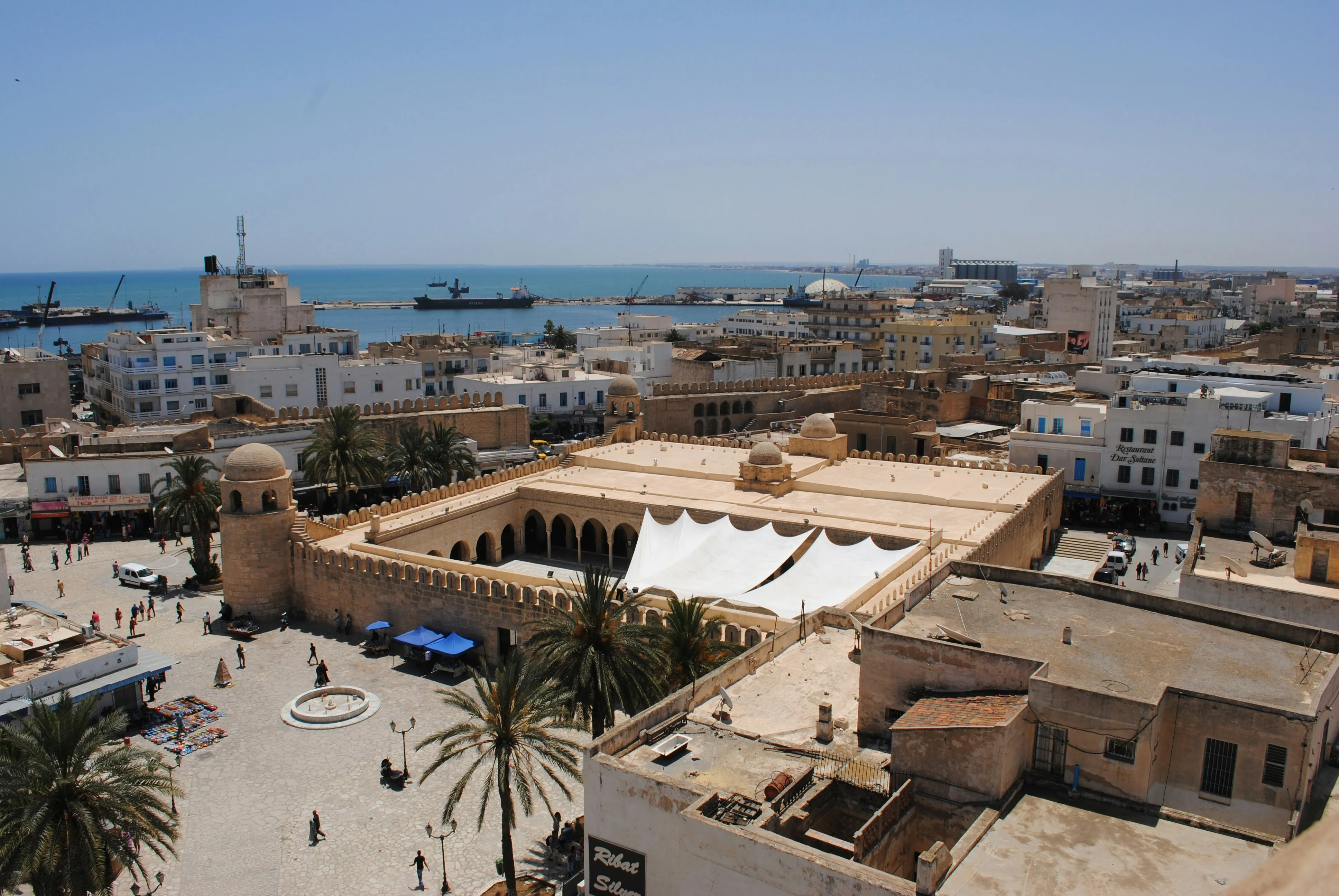
For those looking for a combination of heritage and coast, the cities of Sousse, Monastir, and Hammamet offer walled historical enclosures facing the sea. Their Medinas and Ribats, or defensive fortresses, are prominent examples of Islamic military architecture and allow for walking along walls with views of the Mediterranean. Finally, the island of Djerba constitutes a particular enclave where multicultural heritage blends, visible in its craft markets and in the El Ghriba synagogue, surrounded by light sand beaches that complete the diversity of options for the visitor traveling through Tunisian territory.
”> Tip: You cannot leave without visiting the archaeological site of Carthage, the most symbolic place in the country.”
✈️ Best Season to Travel
Tunisia offers a remarkable variety of experiences depending on the time of year it is visited. For those looking to explore both the Mediterranean coast and the interior and Sahara Desert areas, the transition months usually offer a suitable thermal balance. During these periods, temperatures facilitate tours through archaeological sites and the discovery of natural spaces without the rigors of extreme weather.
The summer months are marked by a warm atmosphere, ideal for the coast, while winter allows for a quieter and cooler side of the country. Each season modifies the environment, from the green of the north in the less hot months to the clarity of the skies in the southern regions during the winter, allowing the trip to be adapted to the particular interests of each visitor.
| Season | Months | Typical Climate | What to Expect | Tourist Influx |
|---|---|---|---|---|
| Spring | Mar – May | Mild temperatures (18-25°C), sunny days, and sparse rain. | Green landscapes, flowering in the north, and ideal conditions for visiting Roman ruins. | Medium (⭐⭐⭐) |
| Summer | Jun – Aug | Intense heat and dry environment. Temperatures often exceed 30°C. | Nautical activities, nocturnal cultural festivals, and a lively atmosphere on the beaches. | High (⭐⭐⭐⭐) |
| Autumn | Sep – Nov | Warm and pleasant temperatures (20-28°C). The sea maintains a good temperature. | Date harvesting in the oases, clear skies, and very comfortable urban walks. | Medium (⭐⭐⭐) |
| Winter | Dec – Feb | Cool on the coast (12-18°C) with moderate rain. Cold in the desert at night. | Routes through the Sahara, cultural visits without waiting, and a quiet atmosphere in the medinas. | Low (⭐⭐) |
🗣️ Basic Vocabulary
Learning some basic notions of Tunisian Arabic, known locally as derja, will help you connect better with the local residents during your stay. Although French and English are frequently used in tourist areas, using a few words in the local language is a gesture of courtesy that often facilitates interactions in shops, markets, or transport.
These expressions are easy to remember and will be very useful for navigating everyday situations, allowing you to show respect for the country’s culture while you carry out your visits.
- Aslama: Hello.
- Beslama: Goodbye.
- Shokran: Thank you.
- Min fadlak: Please.
- Aywah: Yes.
- La: No.
- Bekadesh?: How much does it cost?
- Samahni: Sorry or excuse me.