


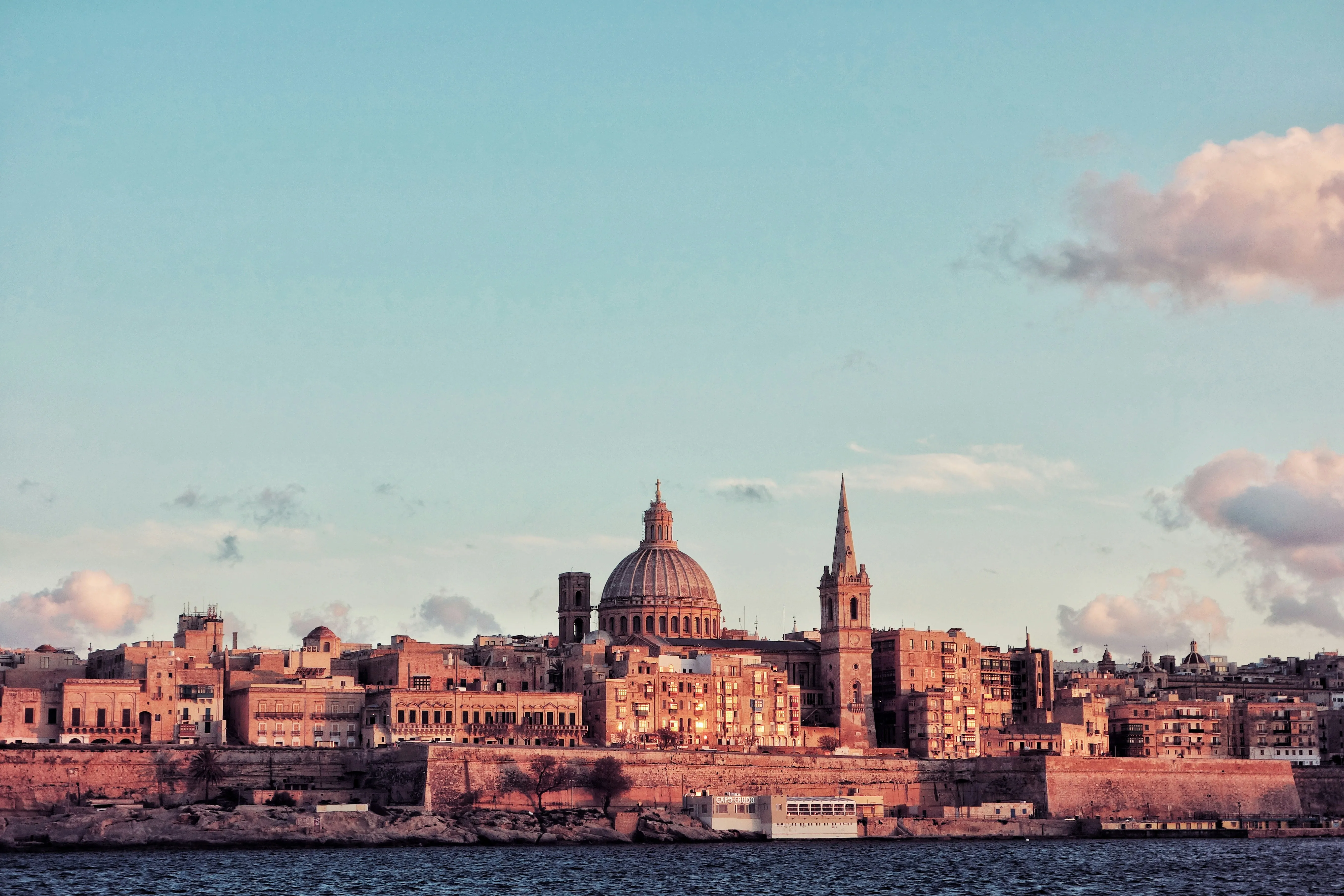
Malta
Mediterranean archipelago combining ancient temples, turquoise waters, and historic fortresses, offering a unique cultural experience under a radiant sun all year round.
Quick Facts
- Capital
- Valletta
- Language
- Maltese
- English and Italian
- Currency
- Euro (EUR)
- Best time to visit
- From April to June and from September to October to avoid extreme heat.
- Budget per day
- $60 - $180 per day
- Climate
- Mediterranean with hot, dry summers and very mild winters. It enjoys more than three hundred days of sunshine a year.
- Connectivity
- good
- Very easy to purchase at the airport, phone shops, or via eSIM.
- Electricity
- Type G (230V)
- Local transport
- acceptable
- Card usage
- widespread
- Tipping
- optional
🌎 Introduction
In the middle of the Mediterranean, where the waters turn a deep blue, emerges a small archipelago that seems sculpted from limestone. Its warm and constant light bathes the honey-colored facades, creating a landscape where land and sea coexist closely. It is a corner where time seems to move at a different pace, marked by the sound of church bells and the gentle sway of colorful boats resting in its fishing ports.
Daily life unfolds among narrow alleys and squares where neighbors share the afternoon. During the hot months, popular festivals fill the air with the burst of fireworks and the aroma of traditional sweets, while the cooler months invite walking among ancient temples and fortresses that hold centuries of history. The local gastronomy, with its crossing influences, offers everything from simple bites of artisanal bread to sea and mountain dishes that speak of an identity forged by multiple cultures.
As you approach the neighboring island of Gozo, the environment becomes greener and more rural, offering a tranquil counterpoint to the pulse of the main hubs. This blend of British, Italian, and Arabic heritage is perceived in every detail, from the language to the architecture of the wooden balconies, forming a character of its own that is both familiar and unique. It is, in essence, a mosaic of compact experiences under a sun that rarely rests.
🛡️ General Safety
Malta is unanimously considered one of the safest destinations in Europe and the world for travelers. The country enjoys remarkable social and political stability, which translates into a very welcoming environment for international tourism.
- The general safety level is high, standing significantly above the global average.
- Although it is a very safe country, travelers should maintain the usual common sense they would apply in any other international destination.
- The context for the visitor is one of absolute tranquility, allowing them to enjoy its streets and monuments at almost any time of the day or night.
Common Crime and Risks
Despite the excellent safety indices, there are minor incidents that, although infrequent, are worth knowing to avoid setbacks during the holidays.
- Petty theft or pickpocketing is the most common crime, especially in crowded areas.
- It is recommended to watch belongings on crowded beaches if they are left unattended while swimming.
- Minor scams can occur in very touristy environments, such as overcharging for services not previously agreed upon, although this is not the general rule.
- Risks of physical violence are extremely low and rarely affect tourists.
Safety in Cities and Tourist Areas
Malta’s urban centers and historical hearts are generally very safe and well-monitored. However, dynamics vary slightly depending on the area visited.
- In Valletta, Sliema, and St. Julian’s, safety is constant due to the presence of visitors and local police.
- Paceville (in St. Julian’s) is the nightlife area par excellence. Because it concentrates a large number of clubs and bars, it is the place where it is most advisable to be attentive to belongings and avoid potential altercations resulting from excessive alcohol consumption.
- Public transport is very safe, although at the main bus stops in Valletta, it is recommended to watch backpacks and bags when there are crowds to board the vehicle.
- Residential areas and inland villages are extremely quiet, with virtually zero crime levels.
Transport Safety
Moving around the archipelago is simple, but requires adapting to some local particularities that affect road safety.
- In Malta, people drive on the left, a British legacy that can confuse drivers used to driving on the right.
- Roads tend to be narrow and traffic in the urban areas of the main island is very dense, so extreme caution is recommended if choosing to rent a vehicle.
- Public transport (buses) is the safest and most reliable option for traveling between towns.
- The use of taxis and private transport services (VTC/ride-hailing) is very safe and is regulated by mobile applications that allow you to know the price and route beforehand.
Natural and Climatic Risks
Malta does not suffer from major natural disasters, but its location in the central Mediterranean entails certain climatic conditions that tourists should anticipate.
- Extreme heat is the main risk during the months of July and August, with temperatures that can exceed 40 degrees and high humidity levels.
- Constant hydration and the use of high sun protection are essential to avoid heat stroke or burns.
- During the autumn, intense Mediterranean storms can occur, generating occasional flooding in low-lying areas due to the island’s topography.
- Risks of earthquakes or serious geological phenomena are statistically very low.
Legislation and Local Norms
Compliance with local laws is fundamental to avoid problems with authorities, who tend to be strict regarding public order.
- The consumption and possession of illegal drugs carry severe penalties. Although there is specific regulation for cannabis, its consumption in public spaces remains prohibited.
- Respectful behavior must be maintained in places of worship. Malta is a country with deep religious roots, and access to churches requires dressing decorously (shoulders and knees covered).
- Alcohol consumption on public roads may be restricted in certain urban areas outside of authorized terraces.
- Failure to comply with traffic or coexistence regulations can result in immediate financial fines.
Safety for Specific Groups
Malta stands out for being an inclusive and progressive destination, facilitating the stay for all types of travelers.
- For female travelers, Malta is one of the safest destinations in the world, allowing them to walk alone at night in most of its areas without a sense of insecurity.
- For the LGTBIQ+ community, Malta is a world leader in rights and legal protection, being an extremely “gay-friendly” and respectful country.
- Traveling with children or the elderly is ideal, as Maltese society is very family-oriented and public services are adapted, although some old stone streets may present mobility challenges.
Emergencies and Assistance
If help is needed, Malta’s response system is efficient and professionals usually speak English fluently.
- The unified emergency number is 112, which provides access to police, ambulances, and firefighters.
- The tourist police usually patrol the most crowded areas and are easily located to report small incidents or request information.
- In case of an incident, it is recommended to go to the nearest police station to formalize a “police report,” which is necessary for any subsequent claim to travel insurance.
Tip: Always use official applications to request taxis or private transport vehicles, so you have a record of the trip, the driver, and the fixed price from the first moment, avoiding any misunderstanding about the fare.
📝 Entry Requirements
To access Malta, most international travelers require a valid passport with validity covering the entire planned stay. It is common for the document to be required to be valid for at least several months after the scheduled departure date. The archipelago is part of a free movement zone with other nearby countries, which facilitates transit for those coming from certain geographical regions without the need for additional procedures prior to the trip.
Regarding residence permits, many tourists can visit the islands for recreational purposes without the need to process a prior visa, provided the stay is of short duration. The usual maximum period allowed for tourism is around ninety days within a specific timeframe. It is advisable to have the necessary documentation proving the reason for the trip and accommodation plans during the stay.
During transit through airport or seaport controls, local authorities may request the presentation of a return ticket or departure ticket to a third destination. Likewise, it may be necessary to demonstrate that sufficient financial funds are available to cover personal expenses during the visit, whether through cash, credit cards, or bank statements.
Customs restrictions in Malta follow standard international guidelines to protect the environment and the local economy. Travelers must declare any amount of cash that exceeds established limits and be cautious with the transport of animal or plant products, which are usually restricted. In the case of medications, it is suggested to carry them in their original packaging and accompanied by a medical prescription if they are specific treatments to avoid delays at entry points.
From a health point of view, mandatory vaccinations are not usually required to enter the country, unless coming from areas with a risk of very specific diseases. However, it is considered good practice to be up to date with the general vaccination schedule and to have travel medical insurance that offers broad coverage, thus guaranteeing a peaceful and safe stay against any medical eventuality that might arise during the journey through the islands.
- Identity document: Passport with recommended minimum validity during the stay.
- Stay permit: Visa exemption for short-term tourist stays in most cases.
- Length of stay: Generally up to a maximum of ninety days.
- Proof of exit: Possible requirement of a return plane or boat ticket.
- Financial means: Justification of financial solvency for the visit period.
- Customs control: Regulations on tobacco, alcohol, and the prohibition of introducing certain foods.
- Health recommendation: Travel insurance with medical coverage and prescriptions for personal drugs.
🏥 Basic Health Considerations
When you prepare for your trip to Malta, you will see that the archipelago has a high-quality healthcare system, both in its public and private sectors. You will find that the main hospital has advanced technology and very well-trained professionals. Although care is excellent, as a tourist it is in your interest to know that private services can have high costs if you do not have adequate coverage. You will be able to communicate without problems with doctors and nurses, as healthcare staff speak English with total fluency, which greatly facilitates any procedure or medical consultation you need to perform during your stay.
Taking out travel medical insurance is totally recommended for your peace of mind. It is not a mandatory requirement to enter the country, but having a policy will save you from unforeseen expenses that could be very high. Ensure your insurance includes fundamental coverage such as hospitalization, medical transfer, and repatriation if necessary. Having this backing will allow you to enjoy Maltese coves and cities knowing that, in the face of any setback, you will have guaranteed assistance without your budget being affected.
Regarding vaccinations, you will not find any mandatory vaccines for visiting the islands. In general, it is sufficient to have your usual vaccination schedule up to date, following the basic health recommendations applied internationally. Malta is a very safe destination from an epidemiological point of view and does not require special medical procedures before landing, so this point should not cause you any concern when organizing your suitcase.
If you take any specific medication, it is best to take it with you in its original packaging. You will find pharmacies easily in urban areas and tourist centers, but for very specific medications, they might ask for a local medical prescription. Therefore, it is very useful to carry a copy of your prescription or a medical report in English. This will make things easier both at customs control and if you need to replace any drug at a Maltese pharmacy during your holidays.
The main health risk you might encounter is related to the climate, especially the strong sun and high temperatures of summer. You could suffer from dehydration or heat stroke if you do not protect yourself properly. Otherwise, there are no significant risks of insect-borne diseases or altitude sickness. On some beaches, you might find jellyfish at certain times of the year, so it is advisable to check the indications of the authorities in bathing areas before entering the water.
Regarding the consumption of water and food, tap water is potable and totally safe for human consumption, although you will notice it has a somewhat different taste because it comes mostly from desalination processes. For this reason, you will see that many people prefer to buy bottled water for drinking. Hygiene in food establishments is very rigorous, so you can try the local gastronomy at street stalls and restaurants with total confidence in food safety.
In case you find yourself in a medical emergency situation, the emergency number is 112. This free service centralizes all calls for help and works efficiently. Ambulances are prepared to attend to you quickly and transfer you to the emergency medical center if the situation requires it.
As final tips for your trip to be perfect, I suggest you always carry a hat and high-factor sunscreen, drink water constantly to maintain hydration, and keep a digital copy of your insurance policy in your email or mobile phone. By following these simple steps, your stay in Malta will be as healthy as it is pleasant.
🚌 Transport Within the Country
Moving around the Maltese archipelago is simple due to its small dimensions. The bus is the main means of public transport and connects practically all points of interest on the island of Malta and also on Gozo. For travel between islands or to cross quickly between certain coastal towns, the ferry is a common alternative and widely used by visitors, allowing a fluid connection between urban centers and the rest of the territory.
Using public transport is accessible for tourists, as signage is usually clear and language is not a barrier, since instructions usually appear in both Maltese and English. Ticket purchasing is simple, done directly when boarding the vehicle or at specific points of sale, which facilitates mobility through the islands without the need for complex prior arrangements.
In urban areas and the busiest population centers, the frequency of buses is constant, although traffic density can occasionally affect punctuality. Conversely, in rural areas or areas further from the coast, trips are less frequent, so it is advisable to check route schedules to avoid long waits at less busy stops.
Car rental is a frequent option for those seeking greater autonomy, although it requires adapting to driving on the left. On the other hand, taxis and ride-hailing services are available throughout the territory, being a convenient solution for direct trips or for nighttime travel when the public transport network reduces its usual activity.
Tip: It is advisable to keep in mind that traffic on main roads can be intense at specific times of the day, so it is worth planning trips with sufficient time.
1. 🤵 Culture and Etiquette
Maltese culture is characterized by a harmonious coexistence between Mediterranean traditions and a diverse historical heritage that influences its current customs. In daily interactions, a friendly and open attitude prevails, although respect for personal space and basic rules of etiquette is deeply valued. When starting a conversation or entering a commercial establishment, it is common to exchange a polite greeting, which facilitates fluid and pleasant interaction with local residents.
Regarding communication, it is common to observe an expressive style and a notable volume of voice in public spaces. This dynamism is part of the communicative nature of the island and should be understood as a display of enthusiasm or emphasis, without necessarily implying a lack of courtesy or conflict. Punctuality is appreciated in professional contexts, transport services, and scheduled appointments, while social gatherings usually have a slightly more flexible margin of courtesy.
Social life in Malta places great importance on places of worship and traditional festivities. When visiting churches, basilicas, or cathedrals, it is considered essential to maintain a respectful attitude and follow appropriate dress codes, making sure to keep shoulders and knees covered. During patron saint celebrations, known as festas, the atmosphere is one of shared celebration, so integrating with discretion and respect into these public activities allows for a better appreciation of the place’s identity.
In the gastronomic and service fields, courtesy follows international standards of hospitality. In catering establishments, if the service has been satisfactory, it is a common practice to leave a tip of between 5% and 10% of the total bill amount. In daily interactions, the frequent use of thank-you words and simple polite formulas reinforces goodwill and helps establish a cordial bond with those offering public service.
Physical contact in initial introductions is usually limited to a firm and brief handshake. As greater trust is established, greetings may become closer, always observing the reaction of the interlocutor to ensure mutual comfort. In general terms, society values discretion and moderation in public behavior, especially in quieter urban centers and inland villages, where the pace of life invites a peaceful coexistence.
“Tip”: Before taking photographs inside religious buildings or portraying people in their private sphere, it is advisable to ask for permission politely to ensure that the privacy and solemnity of the environment are respected.
🍛 Typical Gastronomy
Malta’s cuisine is a true reflection of its Mediterranean history, presenting itself as a fusion gastronomy where Sicilian, Arabic, and British influences converge. It is a rustic cuisine, based on seasonal and local products, where flavors are direct and dishes tend to be quite nutritious. The use of olive oil, sun-ripened vegetables, and aromatic herbs defines the base of most of its traditional recipes.
Rabbit is the most emblematic ingredient of the island, considered the national dish and the star of family gatherings. Alongside it, fresh fish occupies a privileged place, especially local catches that vary according to the season. Maltese bread, with a very crunchy crust and airy crumb, is another essential element that accompanies almost any meal, whether as a garnish or as a base for informal preparations.
Regarding social customs, the Maltese usually follow European schedules, with lunches between 12:00 and 14:00 and dinners from 19:00 or 20:00. The culture of the street snack is very common, thanks to numerous small shops known as pastizzerijas, which allow for a quick and cheap bite at any time of the day. In restaurants, the atmosphere is usually relaxed and it is common for portions to be generous.
To accompany the meal, it is frequent to opt for locally produced wines, which have gained recognition for their quality in recent years. Herbal and citrus drinks with a bitter touch are also very popular, as are local craft beers. Coffee usually marks the end of meals, typically accompanied by small sweets made with nuts or dates.
| Dish | Description | Main Ingredients | Where to Try It | Tip |
|---|---|---|---|---|
| Pastizzi | Small savory pastries very popular as a quick snack. | Puff pastry, filled with ricotta cheese or pea puree. | Pastizzerijas and street stalls in any town. | Consume them freshly baked to appreciate the crunchy texture of the dough. |
| Stuffat tal-Fenek | Traditional rabbit stew slow-cooked for hours. | Rabbit meat, tomato, red wine, garlic, and bay leaf. | Traditional cuisine restaurants in Rabat or Mdina. | It is the ideal dish for a quiet cultural immersion dinner. |
| Ftira | Traditional ring-shaped flatbread, served as a robust sandwich. | Sourdough bread, tuna, capers, olives, tomato, and onion. | Artisanal bakeries and cafes in Valletta. | Perfect as a packed lunch during a day of sightseeing. |
| Lampuki Pie | Baked fish pie, very typical of home cooking. | Lampuki fish, spinach, cauliflower, olives, and shortcrust pastry. | Restaurants in fishing villages like Marsaxlokk. | It is a seasonal dish, so it is worth asking if it is fishing season. |
| Imqaret | Traditional deep-fried sweets with clear Arabic influence. | Flour dough and a dense filling of dates and spices. | Outdoor market stalls and local fairs. | Try them while they are still hot so the filling is tender. |
📷 Areas and Places to Visit
Malta presents itself as an archipelago where history and nature converge in a compact space, allowing the traveler to go from walled cities to coastal landscapes in a very short time. The heart of the country is Valletta, its capital, a fortified city that stands out for its grid layout and Baroque architecture. Walking through its streets allows you to discover St. John’s Co-Cathedral, which houses works of great artistic value, and the Upper Barrakka Gardens, from where you get panoramic views of the Grand Harbour. It is an ideal place for cultural visits, attending theater events, or simply observing the transit of vessels from its bastions.
Opposite the capital are the so-called Three Cities: Vittoriosa, Senglea, and Cospicua. These towns offer a quieter and more authentic view of Maltese life, with narrow alleys, historic churches, and a waterfront promenade that reflects the island’s naval past. It is common to see local residents here in their daily routines, away from the more intense bustle of other tourist areas, allowing for a serene atmosphere while exploring their ancient forts.
Toward the center of the island, the old capital, Mdina, known as the Silent City, transports the visitor to medieval times. Its streets are pedestrianized and lined with the palaces of noble families. Right next to it is Rabat, where you can visit St. Paul’s Catacombs and various museums that narrate the transition from the Roman to the Christian era. This area stands out for its leisurely atmosphere and its local craft shops, where blown glass and silver filigree are the stars.
The southern zone of Malta offers a more traditional profile linked to the sea. The village of Marsaxlokk is famous for its market and for the luzzu, typical boats painted in bright colors with the eye of Osiris on their prow. Nearby, history lovers can explore the megalithic temples of Hagar Qim and Mnajdra, stone structures that are among the oldest in the world. For those seeking nature, the Blue Grotto offers a spectacle of crystal-clear waters and rock formations that can be toured in small boats.
The island of Gozo, accessible by ferry, proposes a much more rural and green environment. Its capital, Victoria, is crowned by an imposing Citadel that offers 360-degree views over the entire island. In Gozo, you also find the Ggantija temples and unique coastal areas such as Ramla Bay, known for its reddish sand. It is a favorite destination for those looking for hiking routes, diving, or simply enjoying a slower pace of life in contact with the region’s agricultural traditions.
Finally, the small island of Comino, located between Malta and Gozo, is an almost uninhabited enclave that attracts for its natural environment. Its main draw is the Blue Lagoon, an area of turquoise waters ideal for swimming and snorkeling during the months of good weather. Although small, the island has trails that allow you to walk its coast peacefully, discovering small coves and watchtowers that once protected the archipelago from pirate raids.
Tip: You cannot miss visiting Valletta, the most emblematic place in the country.
✈️ Best Season to Travel
Malta enjoys a Mediterranean climate that allows it to be visited at any time of the year, although the experience varies notably according to the chosen season. The choice of the ideal time depends mainly on the traveler’s preferences: whether they seek to enjoy the beaches and the vibrant summer atmosphere or if they prefer to explore the historical heritage and natural landscapes with more moderate temperatures and greater tranquility.
Spring and early autumn are usually considered the most balanced periods to get to know the archipelago. During these months, the weather is warm enough for outdoor activities without the rigors of the summer heat, and the landscape shows its greenest side before the dryness typical of the middle months of the year. For its part, winter offers a different perspective, ideal for cultural tourism and for those looking to avoid crowds.
| Season | Months | Typical Weather | What to Expect | Tourist Influx |
|---|---|---|---|---|
| Spring | Mar – May | Mild and pleasant, with temperatures between 15°C and 23°C and scarce rain. | Green and flowery landscapes, hiking routes, and traditional Easter celebrations. | Medium ⭐⭐⭐ |
| Summer | Jun – Aug | Hot and dry, with temperatures frequently exceeding 30°C and high humidity. | Long sunny days, water sports, village festivals (festas), and a lively nightlife. | High ⭐⭐⭐⭐⭐ |
| Autumn | Sep – Nov | Warm at the beginning and cooler at the end, with the possibility of occasional rain starting in October. | The sea water maintains a pleasant temperature for swimming, ideal for cultural visits and events like Notte Bianca. | Medium ⭐⭐⭐ |
| Winter | Dec – Feb | Cool and somewhat humid, with temperatures ranging between 10°C and 16°C. It rarely freezes. | Quiet atmosphere, relaxed visits to museums and megalithic temples, and Christmas markets in December. | Low ⭐⭐ |
🗣️ Basic Vocabulary
Although English is an official language in Malta and is spoken practically everywhere, knowing some words in Maltese will help you connect better with local residents. Using simple expressions in daily situations, such as when entering a small shop or greeting in a restaurant, is a gesture of courtesy that is usually very well received by the Maltese.
Maltese is a language with Arabic roots and influences from Italian and English. It is not necessary to delve into its complex grammar to get around the island, but having these basic formulas at hand will help you manage with more ease and show respect for the local culture during your stay.
- Bonġu: Good morning.
- Bonswa: Good afternoon or evening.
- Grazzi: Thank you.
- Jekk jogħġbok: Please.
- Iva / Le: Yes / No.
- Skużani: Sorry or excuse me.
- Saħħa: Health or goodbye (frequently used as a form of farewell).