


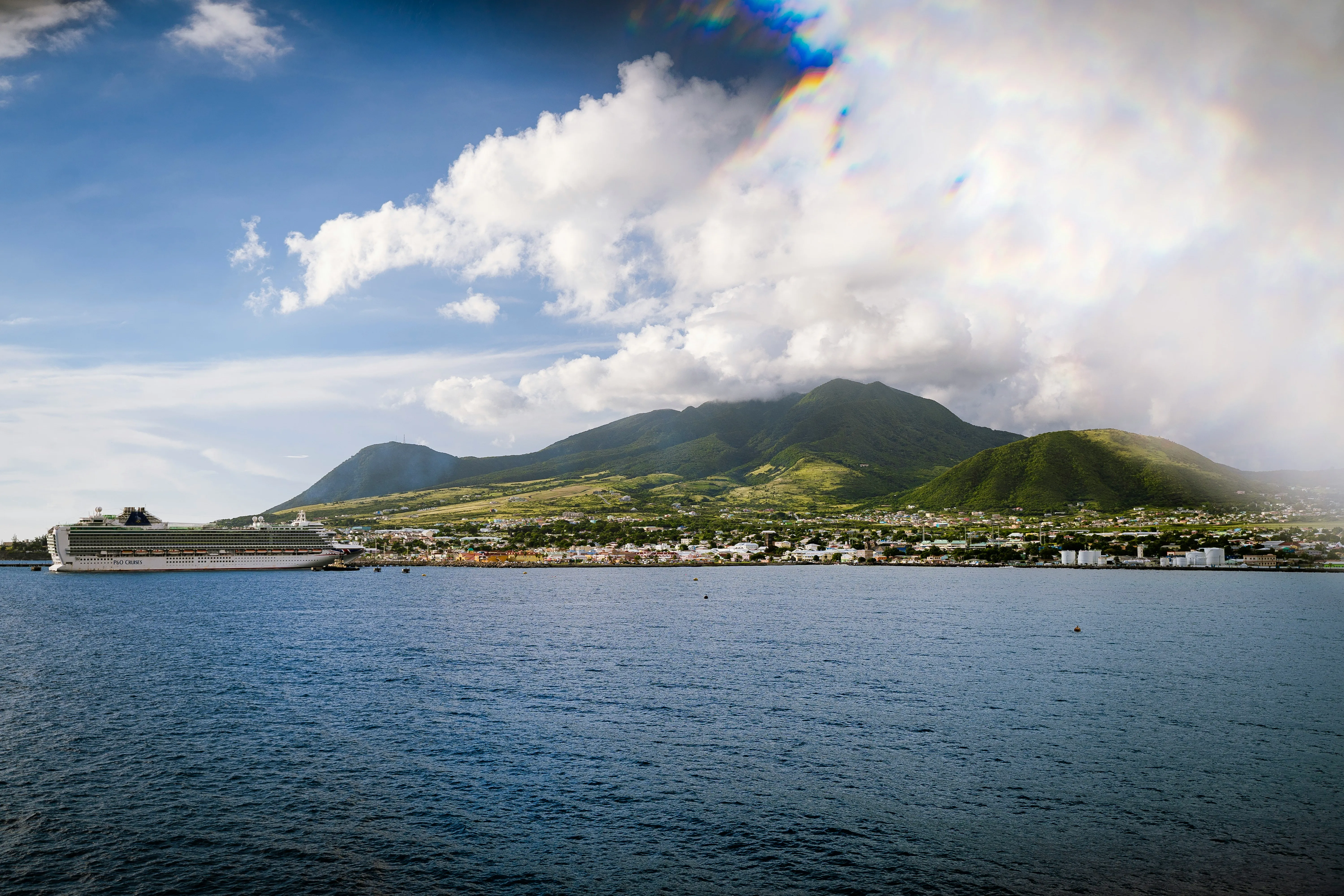
Saint Kitts and Nevis
Discover a Caribbean archipelago where colonial history intertwines with pristine beaches, lush tropical rainforests, and genuine, welcoming local hospitality.
Quick Facts
- Capital
- Basseterre
- Language
- English
- Saint Kitts Creole
- Currency
- East Caribbean Dollar (XCD)
- Best time to visit
- From December to May, during the dry and cool season.
- Budget per day
- $120 - $350 per day
- Climate
- Warm and humid tropical climate throughout the year, with a rainy season and possible hurricanes between June and November.
- Connectivity
- medium
- Easy to get at the airport or local shops, with eSIM options available.
- Electricity
- Type A/B/G (230V)
- Local transport
- acceptable
- Card usage
- acceptable
- Tipping
- optional
🌎 Introduction
In the heart of the Lesser Antilles, the islands of Saint Kitts and Nevis unfold like a mosaic of natural contrasts and historical heritage. While the silhouette of Mount Liamuiga dominates the horizon with its dense tropical vegetation, the coasts are dotted with old sugar plantations that are now part of the daily landscape. The rhythm here is set by the breeze that sweeps across the volcanic hills, creating an environment where nature coexists with an uncommon calm.
Life in this corner of the Caribbean takes place between tradition and the simplicity of small details. It is common to encounter the warmth of its people during the Carnival festivities, known as Sugar Mas, where music and color flood the streets, or to perceive the colonial influence in the stone architecture of urban centers like Basseterre. The gastronomy, with its fresh fish dishes and local products, reflects an identity that has managed to preserve its roots despite the passage of time.
Exploring its trails or looking out at the coastline allows one to understand the distinct personality of each island. Nevis, with its slow-paced atmosphere and imposing central peak, offers a different tranquility than its neighbor Saint Kitts, which is somewhat more dynamic and open. It is a duality that defines the essence of the archipelago: a place that shows itself as it is, without artifice, where the history of ancient stone fortifications coexists with the everyday life of an afternoon facing the sea.
🛡️ General Safety
Saint Kitts and Nevis is a destination characterized by being, in general terms, safe for international tourists. The country relies heavily on tourism, so local authorities strive to maintain a welcoming and protected environment for those visiting the islands.
- Safety level: The risk level is considered low, especially when compared to other destinations in the Caribbean region. However, this does not imply a total absence of incidents, so it is recommended to maintain the common sense that would be applied on any other trip abroad.
- Context for the traveler: Most visits occur without incident. The atmosphere on the islands is relaxed and residents are usually hospitable. Incidents affecting tourists are usually minor in nature and occur mainly due to oversight in crowded areas.
Crime and common risks
Although serious violence rarely targets visitors, minor crime exists and is the most common risk a tourist faces.
- Thefts and robberies: Crimes of opportunity, such as pickpocketing or bag snatching, can occur on crowded beaches, markets, or areas with a high flow of cruise passengers.
- Robberies in accommodations: Isolated cases of theft have been reported in low-end hotel rooms or vacation rentals that do not have surveillance. It is recommended to always use the safe to store passports and valuables.
- Scams: They are not frequent, but it is wise to be wary of people offering unofficial tourist services or excessively low prices that have not been previously agreed upon.
- Precautions: It is advised to avoid walking in isolated areas or lonely beaches after the sun has set, as well as not unnecessarily flaunting jewelry or expensive electronic equipment.
Safety in cities and tourist areas
The main tourist areas are well-monitored, but it is important to differentiate between urban centers and leisure zones.
- Basseterre and Charlestown: The capitals of both islands are safe during the day, especially when there are cruise ships in port. However, some side streets or peripheral neighborhoods may become less advisable after dark.
- Leisure zones and beaches: Places like Frigate Bay in Saint Kitts are very popular and safe, but belongings should be watched while swimming.
- Movement recommendations: To move between tourist areas, the most recommended option is to use official transport services and avoid venturing on foot through unknown or poorly lit routes at night.
Safety in transportation
Transportation on the islands is functional, although it requires the traveler to adapt to local rules and the terrain’s topography.
- Driving: In Saint Kitts and Nevis, driving is on the left side. Roads can be narrow, with sharp curves and, occasionally, potholes or the presence of stray animals (goats or monkeys).
- Rental vehicles: This is an excellent option for exploring the islands. It is necessary to obtain a temporary local driving permit, which the rental agency itself usually manages. The use of 4x4 vehicles is recommended if planning to explore rural areas.
- Taxis: They are safe and abundant. They do not have meters, so it is essential to agree on the price before starting the journey. Many taxi drivers also act as tour guides.
- Public transport: There are private minibuses that run the main routes. They are economical and safe, although they are usually quite full and do not have fixed schedules.
Natural and climatic risks
Being in the heart of the Caribbean, the climate and geology present certain factors that the traveler should consider depending on the time of year.
- Hurricane season: Officially runs from June to November. During these months, there is a risk of tropical storms and hurricanes. It is fundamental to follow weather forecasts and instructions from local authorities.
- Extreme heat: The sun can be very intense. Constant hydration and the use of high-factor sunscreen are recommended to avoid heat stroke or serious burns.
- Seismic activity: The islands are of volcanic origin and are located in an area of seismic activity. Although strong earthquakes are rare, there are evacuation protocols that hotels usually have marked.
Local legislation and norms
There are local laws that may surprise the traveler and whose non-compliance carries severe penalties.
- Camouflage clothing: It is strictly prohibited to wear camouflage clothing or military-style items (including backpacks or hats). This clothing is reserved exclusively for the country’s defense forces.
- Drug consumption: Laws against the possession, consumption, or trafficking of illegal drugs are very strict and can carry long prison sentences and high fines.
- Social behavior: Although the population is tolerant, respectful behavior is expected in public places. Nudism or “topless” on the beaches is not well-regarded and can be a reason for complaint or sanction.
Safety for specific groups
- Female travelers: The country is safe for women traveling alone, although they may receive unwanted comments or “catcalling” in urban areas. It is recommended to ignore these interactions and maintain standard personal safety precautions.
- LGTBIQ+ travelers: Although laws have evolved and homosexuality has been decriminalized in recent years, society remains mostly conservative. Discretion in public displays of affection is recommended to avoid uncomfortable or discriminatory situations.
- Children and the elderly: The islands are an excellent family destination. However, special care should be taken with ocean currents on some Atlantic-side beaches, which can be dangerous for children and inexperienced swimmers.
Emergencies and assistance
The emergency system is efficient, although resources may be limited compared to large continental metropolises.
- Emergency numbers: The main number for police, fire, and ambulance is 911. 333 can also be used specifically for medical emergencies.
- Medical assistance: The main hospitals are the Joseph N. France General Hospital in Saint Kitts and the Alexandra Hospital in Nevis. For serious health problems, medical air evacuation may be necessary.
- Medical recommendation: It is highly recommended to travel with international medical insurance that covers hospitalization and repatriation, as costs for foreigners can be high.
”> Tip: Whenever you use a taxi, make sure to ask if the price quoted is in East Caribbean Dollars (XCD) or US Dollars (USD), as both currencies circulate and confusion can double the cost of your journey.
📝 Entry requirements to the country
To undertake a trip to Saint Kitts and Nevis, the fundamental document every traveler must carry is a passport with current validity. It is recommended that the document has an expiration margin of at least six months from the planned date of arrival in the islands to avoid any inconvenience at border controls. The passport must be in optimal physical condition and have free pages for entry and exit stamping by immigration officials.
Regarding the entry of visitors, many nationalities enjoy the possibility of entering for tourism purposes without the need to process a prior visa. These stays are usually limited to a specific time period, which usually does not exceed 90 days. During this time, travelers can enjoy the country’s attractions, provided they do not engage in paid or labor activities, for which permits of another nature would be required.
Upon arriving at the point of entry, whether an airport or a port, it is common for authorities to request the presentation of an outbound transportation ticket, which guarantees that the visitor will leave the territory at the end of their stay. Similarly, proof of financial solvency may be required, through which the traveler demonstrates they have the necessary funds to cover their accommodation, maintenance, and activities during their stay in the country.
Customs controls in the islands are a standard procedure. The entry of personal effects and items for the tourist’s use in reasonable quantities is allowed. However, there are restrictions on the import of fresh food, plants, and certain chemical products to protect local biodiversity. In the case of carrying specific medications, it is highly advisable to bring the corresponding medical prescription and keep the drugs in their original packaging to facilitate their identification by customs personnel.
From a health perspective, rigorous vaccination requirements are not usually applied for most traveler profiles. However, in compliance with international health regulations, a yellow fever vaccination certificate may be requested from those coming from areas where this disease is considered endemic. It is always a good practice to have travel insurance with broad medical coverage that allows for the management of any health eventuality during the stay calmly and safely.
The key points for preparing access to the territory are summarized below:
- The passport must be valid for an extended period after arrival.
- Common tourist stays are usually exempt from a prior visa for many profiles.
- The maximum permitted stay as a tourist is usually about three months.
- It is necessary to have proof of return or exit to another destination.
- It is recommended to declare any medical treatment carried in luggage.
- Customs controls monitor the entry of agricultural products and food.
- In specific cases of geographic origin, the yellow fever vaccination document may be requested.
🏥 Basic health considerations
When preparing your trip to Saint Kitts and Nevis, you will see that the health system is functional but with the logical limitations of an island environment. On the islands, you will find health centers and main hospitals, such as Joseph N. France in Saint Kitts or Alexandra in Nevis, where they can treat you for basic issues or common emergencies. Care is usually private for visitors and costs can be quite high, so you will notice that prices are at the level of what you might expect in other high-quality international destinations. Healthcare staff usually communicate in English, which will make it easier for you to explain any symptoms if you handle the language a bit.
Taking out travel medical insurance is not a legal requirement to enter the country, but it is something you will consider essential. It is highly recommended that your policy has broad coverage that includes medical evacuation and repatriation, as for serious health problems or complex surgeries it is common for patients to be transferred to other countries with larger infrastructures. Check that your insurance covers these transfers to avoid unforeseen expenses of thousands of euros.
Regarding vaccines, you will not find any that are mandatory for entry, unless you come from an area where yellow fever is endemic, in which case you must show your vaccination certificate. The most practical thing is to have your standard vaccination schedule updated, and if you want to go with extra security, you can ask about hepatitis or typhoid fever, although they are not strict requirements.
If you need to take your own medication, you will see that there are no strange restrictions as long as it is for your personal use. I advise you to take the medications in their original packaging and put a copy of the medical prescription in your suitcase, preferably in English, to avoid any misunderstanding at customs or if you need to replenish a dose at local pharmacies, which are usually well-stocked with basic products.
The most common health risks you will find are related to the tropical climate. The heat and intensity of the sun are the main factors, so you will have to hydrate constantly and use high sunscreen. Being a Caribbean area, there is also the presence of mosquitoes that can transmit diseases such as dengue or zika, so using a good repellent and light clothing that covers the skin at sunset will help you avoid discomfort. There are no altitude risks and local fauna does not usually represent a danger to health.
Regarding water and food, you can be calm because tap water is generally potable in most hotels and tourist areas. Even so, if you have a delicate stomach, you may prefer to consume bottled water to avoid changes in intestinal flora. Hygiene in restaurants and food stalls is usually good, so you can try the local gastronomy with confidence following standard common sense.
For any medical emergency situation during your stay, the phone number you should dial is 911. This service centralizes emergencies and will put you in contact with ambulances or the police quickly.
As final recommendations for your experience to be perfect, I suggest you carry a small first-aid kit with disinfectant, bandages for chafing, and some basic pain reliever. Don’t forget to apply repellent if you are going to go on excursions through vegetated areas and enjoy the beaches with caution, using appropriate footwear if you are going to walk on rocks or coral areas to avoid small cuts.
🚌 Transport within the country
Moving around Saint Kitts and Nevis is a simple process due to the manageable size of both islands. The most common means of transport for visitors include car rentals, the use of local minibuses, and the ferry that connects the two main islands. The main road network circles the islands, which facilitates orientation and access to the most relevant points of interest.
The public transport system is mainly based on a fleet of minibuses that cover established routes along the main roads. These vehicles are easy to recognize and the treatment from drivers is usually friendly, facilitating mobility despite the fact that stops are not always rigidly marked. Being a country where the official language is English, communication and understanding of directions are direct for most travelers.
In urban areas and near cruise ship arrival points, taxis are abundant and represent a comfortable option for specific journeys. In rural areas or those further from the beltway road, the frequency of public transport decreases significantly. For this reason, many tourists opt for a private vehicle to have greater autonomy, always keeping in mind that driving is on the left side.
The connection between the two islands is regularly made through ferries that offer a regular and reliable service. These maritime journeys are fundamental for any itinerary that includes both islands and usually stand out for their punctuality. Overall, transportation in the country conveys a sense of tranquility, adapting to the characteristic slow pace of the region.
Tip: Before starting a taxi ride, confirm with the driver that both of you are clear on the destination’s location to ensure a smooth trip.
🤵 Culture and etiquette
In Saint Kitts and Nevis, social interactions are usually governed by a deeply rooted and formal sense of courtesy. It is essential to start any interaction, whether in a shop, on transport, or when asking for directions, with a cordial greeting such as “good morning” or “good afternoon.” Ignoring this initial gesture can be perceived as a lack of attention, as mutual recognition is the basis of coexistence on the islands. Treatment is usually friendly but respectful, maintaining a certain personal distance until greater trust is established.
The use of courtesy titles is common, especially when dealing with older people or those in positions of authority. It is common to address others as “Mr.” or “Mrs.” followed by their last name, unless otherwise indicated. Regarding non-verbal communication, physical contact is usually moderate in first encounters, and a calm tone of voice is valued in public spaces, avoiding loud noises that could disturb the tranquility of the environment.
Dress is a relevant aspect of daily life. Although the climate invites light clothing, there is a clear distinction between beach areas and urban centers or public buildings. It is considered appropriate to reserve swimwear exclusively for the swimming area or pool, opting for informal but neat dress for walking through the city or going to restaurants. In places of worship and official events, greater formality is expected, covering shoulders and avoiding excessively short garments as a sign of respect for the institution and those present.
Regarding punctuality, the pace of life on the islands can be more flexible than in large international urban centers, a phenomenon often described as the local rhythm. However, in the professional sphere, scheduled excursions, and restaurant services, efforts are made to adhere to schedules. During meals, the atmosphere is usually relaxed and the after-dinner conversation is a valued space for talk. In the service sector, it is common to leave a tip of between 10% and 15% if the charge has not been previously included in the bill, as recognition for the work received.
The society of Saint Kitts and Nevis has a strong sense of community and respect for its traditions and festivities. During cultural celebrations or parades, it is important to observe and participate in a way that does not interrupt the proceedings. Likewise, before taking photographs of people or private property, it is most appropriate to request prior permission, as consideration for the privacy and image of residents is positively valued.
“Tip”: Always greet clearly before making any request or inquiry in an establishment to establish smooth and respectful communication.
🍛 Typical gastronomy
The cuisine of Saint Kitts and Nevis is a reflection of its history, combining African, Caribbean, and European influences in simple but nuanced dishes. Being an island nation, fresh fish and seafood are the undisputed protagonists of the local diet, complemented by products from the land such as yam, sweet potato, breadfruit, and legumes. The use of spices and aromatic herbs defines its culinary identity, achieving intense flavors that take advantage of the freshness of local ingredients.
Eating habits on the islands usually follow a slow pace, especially during lunch, which is one of the most important meals of the day. It is common to find local food stalls where dishes are served informally, while in cities and converted old plantations, the service is more structured. Hospitality is a fundamental part of the gastronomic experience, and it is not uncommon for meals to extend into relaxed conversations, especially in establishments near the coast.
Regarding drinks, tropical fruits such as mango, tamarind, and coconut are used to make natural juices and homemade soft drinks. The island’s culture is also closely linked to the production of rum, which is consumed neat or as a base for various preparations, and to local beer, which usually accompanies social gatherings. In restaurants, etiquette is usually informal, although in more elegant establishments a slightly more careful dress code is recommended, without being strictly formal.
| Dish | Description | Main Ingredients | Where to try it | Tip |
|---|---|---|---|---|
| Goat Water | A thick and aromatic stew, considered one of the most traditional dishes. | Goat meat, breadfruit, green papaya, and local spices. | Local restaurants and markets in Basseterre. | It is usually served very hot; it is ideal for a comforting lunch. |
| Saltfish and Dumplings | Combination of salted fish served with boiled flour dough and side dishes. | Salted cod, flour (for the dumplings), plantain, and vegetables. | Breakfasts in guesthouses or traditional food stalls. | This is the national dish; try it with some fried plantains to balance the flavor. |
| Conch Fritters | Fried fritters made with sea snail meat. | Conch meat, peppers, onion, and a light flour batter. | Beach bars in the Frigate Bay area. | Accompany them with a mild hot sauce to enhance the seafood flavor. |
| Pelau | A one-pot stew that combines rice, meat, and legumes. | Rice, pigeon peas, chicken or beef, and coconut milk. | Homemade food establishments in any town in Saint Kitts. | It is a very complete dish, perfect for a quick meal before continuing exploration. |
| Grilled Lobster | Local spiny lobster cooked simply to highlight its freshness. | Fresh lobster, garlic butter, and lemon. | Coastal restaurants on the island of Nevis. | Make sure it is catch season to enjoy the best quality. |
📷 Areas and places to visit
The archipelago formed by Saint Kitts and Nevis offers a fascinating contrast between colonial history, volcanic nature, and Caribbean serenity. The island of Saint Kitts, the larger of the two, houses the capital, Basseterre, a city where Georgian architecture blends with the hustle and bustle of daily life. Walking through its streets allows you to discover nerve centers such as The Circus, a square inspired by London’s Piccadilly Circus with its iconic clock tower, or Independence Square, which formerly functioned as a market and today is a public space surrounded by historic buildings and the Cathedral of the Immaculate Conception.
On the outskirts of the capital, the landscape transforms into a succession of old sugar plantations and lush vegetation. One of the points of greatest historical relevance is the Brimstone Hill Fortress, an imposing military structure built of volcanic stone that offers an exceptional panoramic view of the neighboring islands. Nearby, the enclave of Romney Manor invites you to stroll through its botanical gardens and learn about the process of making batik, a traditional textile technique that is still alive in the area. For those seeking to explore the natural environment, Mount Liamuiga presents itself as a challenge for hiking, allowing you to ascend through tropical forests to reach the edge of its volcanic crater.
The experience on the island of Saint Kitts is complemented by a tour on the St. Kitts Scenic Railway, an old freight train converted into tourist transport that borders the coast and allows for the observation of rural communities and the remains of the sugar industry. For its part, the Frigate Bay area stands out as the point where the Atlantic and Caribbean waters meet, offering golden sand beaches and a wide variety of water activities that energize the coastline throughout the year.
Crossing the strait to the island of Nevis, the pace becomes slower and the environment more intimate. Its capital, Charlestown, retains a marked colonial air with its well-preserved wood and stone buildings. Here it is essential to visit the Museum of Nevis History, located at the birthplace of Alexander Hamilton, to understand the island’s past. Nevis is also known for its thermal hot springs and the ruins of old estates that are today integrated into the natural landscape, offering a quiet and authentic view of Caribbean life.
The beaches of Nevis, such as the extensive Pinney’s Beach, are ideal for those seeking rest in a less crowded setting. The island is dominated by Nevis Peak, which is usually shrouded in clouds and provides a constant backdrop for the small stone churches and botanical gardens that dot the territory. Exploring the local markets of both islands also allows for contact with gastronomy and artisanal products, reflecting the cultural identity of a country that has managed to balance its historical heritage with the preservation of its natural environment.
Tip: You cannot miss visiting the Brimstone Hill Fortress, the most emblematic site in the country.
✈️ Best season to travel
Saint Kitts and Nevis enjoys a marine tropical climate that allows for visits year-round, although the experience varies depending on the chosen season. Most travelers opt for the months from December to April, coinciding with the dry season. During this period, temperatures are somewhat milder and humidity remains at comfortable levels thanks to constant sea breezes, which facilitates outdoor activities and the exploration of its volcanic landscapes.
On the other hand, the months coinciding with summer and autumn offer a different perspective of the islands. Although heat and the probability of precipitation increase, nature is shown in its full splendor, with dense and vibrant vegetation. It is a suitable time for those seeking a quieter and slower atmosphere, moving away from the periods of highest crowding and enjoying the authenticity of the Caribbean rhythm.
| Season | Months | Typical Climate | What to Expect | Tourist Influx |
|---|---|---|---|---|
| Spring | Mar – May | Warm and mostly dry, with pleasant breezes. | Sea turtle sightings and clear skies for hiking. | ⭐⭐⭐ (Medium) |
| Summer | Jun – Aug | Hot and humid, with brief and intense showers. | Culturama festival celebration in Nevis and very green landscapes. | ⭐⭐ (Medium - Low) |
| Autumn | Sep – Nov | Rainy and warm; higher probability of storms. | Independence Day celebrations and a very quiet atmosphere. | ⭐ (Low) |
| Winter | Dec – Feb | Mild temperatures and low rainfall. | Carnival season (Sugar Mas) and a great cultural atmosphere in the streets. | ⭐⭐⭐⭐⭐ (High) |
🗣️ Basic vocabulary
Although the official language in Saint Kitts and Nevis is English, the local population commonly uses Saint Kitts Creole (Kittitian Creole). Knowing some expressions of this dialect or particular forms of greeting will allow you to navigate more easily in shops, markets, and public transport, facilitating a smoother interaction with residents.
Courtesy is a highly valued aspect in the islands. Using appropriate greetings when entering an establishment or when asking for directions is considered a basic rule of etiquette that usually guarantees a friendly and collaborative response from locals.
- How you be?: How are you? (used as an informal greeting).
- Limin’: Hanging out, relaxing, or going out to have fun with friends.
- Alright: Hello, okay, or goodbye (it is a very common and versatile expression).
- Good morning / Good night: Good morning / Good night (always used when starting a conversation; “Good night” is used as a greeting when meeting someone after sunset).
- Me nar know: I don’t know.
- Sweet: Great, excellent, or something that is pleasant.
- A’ight: It’s okay or agreed.
- Pickney: Child.