


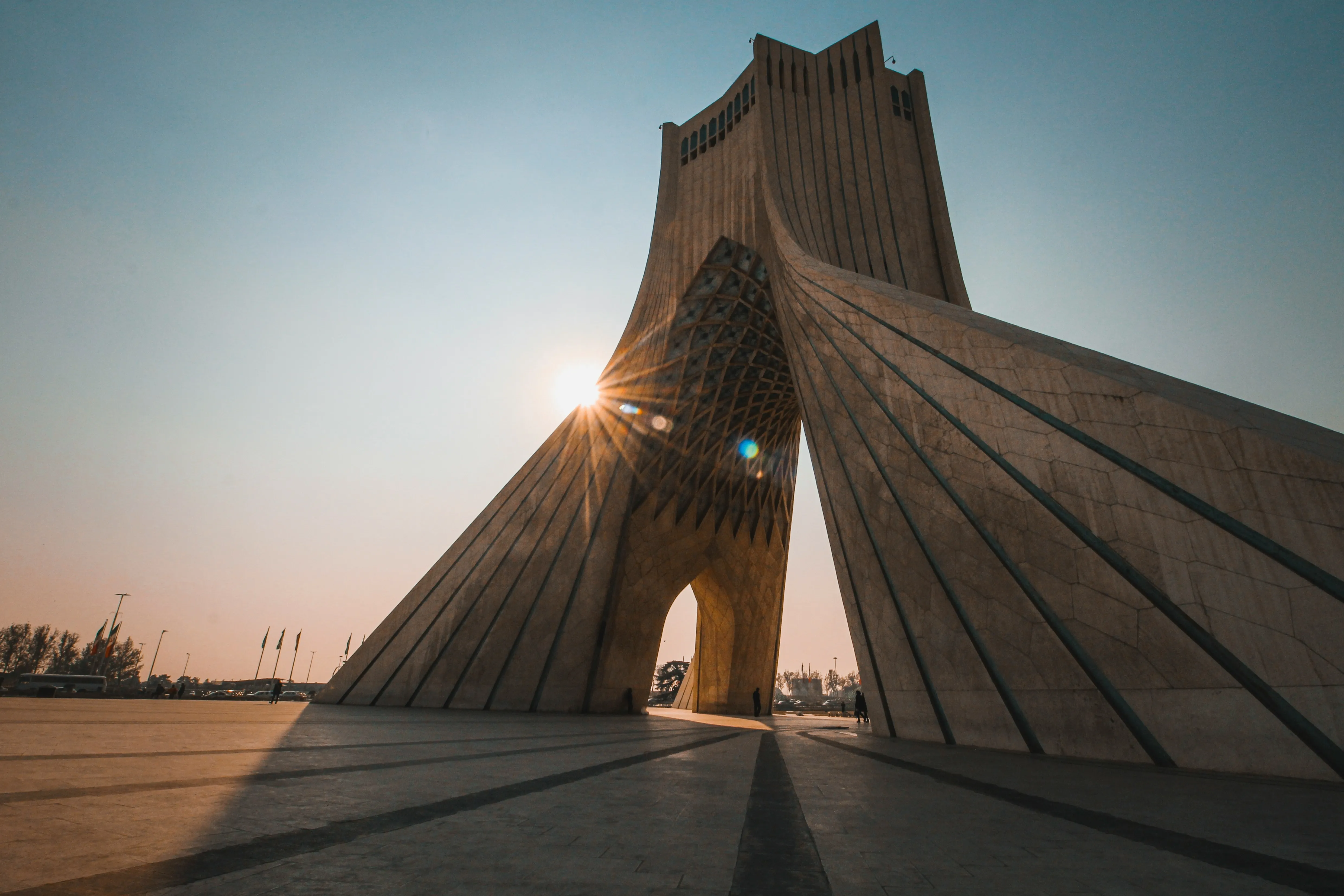
Iran
Discover the cradle of Persian civilization, where blue-tiled mosques, historic bazaars, and legendary hospitality await the traveler amidst desert landscapes.
Quick Facts
- Capital
- Tehran
- Language
- Persian (Farsi)
- Azeri, Kurdish, Luri, Arabic
- Currency
- Iranian Rial (IRR) / Toman
- Best time to visit
- Spring (March-May) and autumn (September-November)
- Budget per day
- $25 - $75 per day
- Climate
- Predominantly arid or semi-arid, with very hot summers and cold winters, especially in the northern and western mountainous areas.
- Connectivity
- medium
- Easy to obtain at airports and specialized shops
- Electricity
- Type C / F (230V)
- Local transport
- good
- Card usage
- cash is used more
- Tipping
- optional
🌎 Introduction
Halfway between the snowy peaks of the Alborz mountain range and the serenity of its vast deserts, Iranian territory unfolds as a mosaic of landscapes and contrasts. The rhythm of daily life is often marked by the leisurely ritual of tea and the spontaneous hospitality of its people, which manifests both in the bustling city squares and in the quietest corners of rural areas. It is a place where the legacy of millennial civilizations naturally coexists with modern dynamism, offering a complex identity that goes far beyond conventional images.
The seasons visibly transform the environment, from the rebirth that Nowruz brings with the arrival of spring to the fresh air that envelops Persian gardens when autumn arrives. Strolling through the bazaars, amidst the aroma of freshly baked bread and spices, or watching the sunset in front of stone reliefs and turquoise domes, allows one to appreciate a cultural heritage that deeply values poetry, art, and coexistence. In this region, the simplicity of daily gestures is intertwined with a vast history, forming a destination that reveals itself to those who observe it with an unexpected calm.
🛡️ General safety
Iran is a destination that usually pleasantly surprises travelers with its hospitality and for being, in general terms, a country with low rates of violent crime against tourists. The general safety rating for the traveler is medium-high, provided that local regulations are strictly respected and an informed attitude is maintained regarding the current geopolitical situation.
The context for the traveler in Iran is that of a country with a deeply rooted culture of welcome (the concept of taarof), where the visitor is usually treated with great respect and protection by the local population. However, it is a destination that requires careful planning and prior knowledge of its legal and social framework.
Crime and common risks
Although Iran is a safe country compared to other international destinations, there are common risks that tourists should be aware of to prevent incidents:
- Pickpocketing and minor theft: As in any large city, theft of wallets or phones can occur in crowded places such as bazaars, bus stations, or the metro.
- Snatching from motorcycles: This is one of the most reported crimes. Motorcyclists may try to snatch bags or cameras while riding near the sidewalk. It is recommended to carry belongings on the side opposite the roadway.
- Currency exchange scams: Due to the duality between the rial (official currency) and the toman (the unit commonly used), it is easy to get confused with the zeros. Always perform exchanges at official exchange houses (Sarrafi) and not on the street.
- Fake police: Occasionally, people dressed in civilian clothes or with unclear uniforms may ask for identification or search wallets. Authentic police rarely ask to search a tourist’s cash on the street; when in doubt, request to go to the nearest police station.
Safety in cities and tourist areas
Urban centers and classic routes (Tehran, Isfahan, Shiraz, Yazd) are very safe areas where tourists can walk peacefully, even after dark.
- Urban atmosphere: Iranian cities have a lot of nightlife (especially in parks and squares), which provides a constant sense of security due to the presence of families and groups of friends.
- Regional differences: Border areas with Iraq, Afghanistan, and Pakistan (especially the Sistan and Baluchestan province) are considered higher risk due to the activity of insurgent groups or illicit trafficking. It is recommended to avoid these peripheral areas and stick to the main tourist routes.
- Public transport: The Tehran metro is modern, safe, and efficient, although it is often very congested during peak hours. There are exclusive carriages for women, although they can travel in any carriage if they wish.
Transport safety
Transport is one of the points where the traveler should pay more attention, not because of crime, but because of road safety.
- Driving: In Iran, you drive on the right. Traffic in large cities can be chaotic, and drivers do not always respect pedestrian crossings or traffic signals. Crossing the street requires maximum caution.
- Taxis and private services: The use of official taxis (yellow or green) or ride-sharing apps like Snapp (the local equivalent of Uber) is recommended, as they allow you to know the price and route in advance.
- Intercity buses: They are a very safe, comfortable, and economical means of transport for moving between cities, with professional drivers and modern vehicles.
Natural and climatic risks
Iran has a diverse geography that entails certain natural risks depending on the area and the time of year:
- Seismic activity: The country is located in an area of high tectonic activity, so earthquakes are a real possibility. It is advisable to familiarize yourself with basic protection measures in case of an earthquake.
- Extreme heat: During the summer months (June to August), temperatures in desert areas and in the south of the country can exceed 45°C, posing a risk of dehydration and heatstroke.
- Sandstorms: In arid regions, sandstorms can occur that drastically reduce visibility and affect the respiratory tract.
- Flash floods: In spring, some areas may suffer rapid flooding after heavy rains, especially in valleys and dry riverbeds.
Legislation and local norms
This is the most important section to guarantee an incident-free stay, as failure to comply with local laws, based on Islamic regulations, can have serious consequences.
- Dress code: It is mandatory for women to cover their hair with a headscarf (hijab) and wear loose-fitting clothing that covers arms and legs (down to the ankles). Men should avoid shorts and sleeveless shirts.
- Alcohol and drugs: The consumption, possession, or trafficking of alcohol and drugs is strictly prohibited and carries severe penalties, including prison.
- Photography: It is prohibited to photograph government buildings, military installations, border areas, or critical infrastructure (bridges, airports). If in doubt, do not take the photo.
- Social behavior: Public displays of affection between people of the opposite sex (even married couples) should be discreet. During the month of Ramadan, eating, drinking, or smoking in public during daylight hours is prohibited.
Safety for specific groups
- Solo female travelers: Iran is a respectful country towards women, but compliance with the dress code is inescapable. It is common for local women to approach female tourists to chat or help. Traveling alone is possible and generally safe, following the usual precautions for any destination.
- LGTBIQ+ travelers: Same-sex relationships are illegal in Iran and can be punished with maximum penalties. Absolute maximum discretion is recommended, avoiding any public display of affection or identity that could attract the attention of the authorities.
- Children and the elderly: Iranian society is very family-oriented and respectful of the elderly. Children usually receive a lot of attention and are welcome almost everywhere. However, infrastructure (sidewalks, access) is not always adapted for strollers or wheelchairs.
Emergencies and assistance
In case of needing urgent help, these are the basic numbers and procedures:
- Police: 110
- Ambulances: 115
- Firefighters: 125
The police are usually friendly to tourists, although the language can be a barrier (the use of translation apps is very useful). It is essential to always carry a copy of your passport and visa, leaving the original documents in the hotel safe to avoid loss. In case of any legal incident, it is a priority to contact the consular representation of your country of origin.
”> Tip: Download a reliable VPN service before arriving in the country, as many social networks and international websites are blocked, and you will need a connection to keep your family informed or access maps.”
📝 Entry requirements
To plan a trip to Iran, the first fundamental step is to have a passport that has sufficient residual validity, usually set at at least six months from the time of arrival in the national territory. It is recommended that the document be in good condition and have free pages for the corresponding stamps. Authorities usually pay special attention to the validity of the document to avoid inconveniences during immigration control.
In most cases, foreign travelers require a prior authorization or visa to cross the borders for tourism reasons. This permit usually allows a maximum stay of thirty days, although under certain circumstances it is possible to request extensions once at the destination. It is common for this process to begin electronically before starting the journey, thus facilitating management upon arrival at major international airports or border posts.
During the entry process, immigration officials may request additional documentation supporting the reason for the trip. It is common to be asked to show a return ticket or departure ticket to a third destination, as well as an accommodation reservation for the first nights of the stay. Likewise, having travel insurance with specific coverage in the country is a common and highly valued requirement to guarantee assistance in case of need.
Regarding customs regulations, there are clear restrictions that every visitor should know. The entry of alcoholic beverages is generally prohibited, as are pork products or material that could be considered contrary to local cultural norms. If transporting specific medications, it is advisable to carry the translated medical prescription to avoid misunderstandings. At security checkpoints, luggage is usually checked to ensure compliance with these regulations on personal objects and goods.
From a health point of view, there are usually no mandatory vaccinations for all travelers, unless coming from areas where certain diseases are endemic. However, it is usually suggested to be up to date with the usual vaccination schedule. It is recommended to consume bottled water and pay attention to food hygiene to enjoy a peaceful stay without minor health complications.
Below are some practical aspects and information of interest for organizing the trip:
- Local currency: The use of international credit or debit cards is very limited, so it is common for tourists to carry enough cash to cover all their expenses.
- Dress and etiquette: It is essential to observe local dress codes, which usually require the use of discreet clothing for both men and women in public spaces.
- Climate: Due to its size, the country presents great climatic diversity, so it is preferable to opt for the spring and autumn seasons to avoid extreme temperatures.
- Gastronomy: Traditional cuisine is rich in spices, rice, and grilled meats, with tea being the social drink par excellence, frequently offered as a gesture of hospitality.
- Transport: There is a very efficient and economical long-distance bus network, in addition to rail connections between main cities and frequent internal flights.
- Telecommunications: Buying a local SIM card is a common practice among travelers to maintain connectivity, although access to certain digital services may require network management tools.
- Heritage: The country is home to numerous sites declared World Heritage Sites, highlighting its archaeological complexes, historic gardens, and religious architecture of great artistic value.
🏥 Basic health considerations
Traveling to Iran is a fascinating experience and, generally, you will feel in a safe environment regarding your health as well. You will find that the level of medical assistance in large cities like Tehran, Isfahan, or Shiraz is notably high. Professionals are usually very well trained and it is common for doctors to speak fluent English, which will greatly facilitate communication if you need to explain what is wrong. Although there is a public system, it is most recommended for you to use private healthcare, as the facilities are more modern and waiting times are much shorter. Regarding prices, you will see that medical care is relatively inexpensive compared to other destinations, but any serious unforeseen event can increase in price if you are not well protected.
Regarding travel medical insurance, you must be very clear that it is a mandatory requirement to enter the country. When processing your visa, whether online or on arrival, they will ask for proof of a policy that specifically covers Iranian territory. It is essential that your insurance includes extensive coverage for hospitalization and repatriation. An important detail you should check is that your insurer explicitly mentions Iran in its conditions, as some international companies have restrictions for operating there due to external administrative issues.
In the vaccinations section, you will be happy to know that there are no mandatory vaccinations to enter the country, unless you come from an area with a risk of yellow fever. Usually, it is enough to have your vaccination schedule up to date. As a general recommendation to move with total peace of mind, you could consider vaccinations against Hepatitis A and typhoid fever, especially if you plan to go off the most touristy routes or if you are someone who enjoys trying food in local markets.
If we talk about medication and first aid kits, you have to be a bit careful. Iran has strict laws regarding certain drugs, especially those containing codeine or psychotropic substances. If you need to take any medication of this type regularly, it is essential that you carry it in its original packaging and accompanied by an official medical prescription or certificate translated into English. For minor ailments, you can find well-stocked pharmacies on almost any street, but it is always a good idea to carry a small personal first aid kit with pain relievers, disinfectant, and some stomach protector.
The most common health risks are closely linked to the climate and geography. During the summer months, the intense heat can cause dehydration if you do not drink enough fluids, while in mountain areas you should be alert to altitude sickness if you climb too fast. In large cities like Tehran, air pollution can be somewhat annoying if you suffer from asthma or respiratory problems. Otherwise, there are no serious tropical diseases to worry about, as the risk of contracting malaria is practically non-existent in the areas you will visit.
Regarding water and hygiene, the general quality is quite acceptable. You will find that tap water is potable in most large cities, although the most recommended way to avoid minor stomach upsets is to always drink bottled water or use the filtered water fountains found in many squares and mosques. Hygiene in restaurants is usually good, so you can try the delicious local food with confidence, always using common sense when choosing busy street food stalls.
In the event you suffer a health emergency, the number you should remember is 115, which is the ambulance service. In urban areas the service is fast, although in cities with a lot of traffic it is sometimes more practical to take a taxi to reach the emergency room of a private hospital as soon as possible. Urgent care is guaranteed for everyone, but always remember to contact your insurance as soon as possible so they can manage the payments.
As final practical recommendations, I advise you to protect yourself well from the sun with cream and glasses, as the radiation can be very strong. It is also a good idea to always carry a pack of tissues or wet wipes with you, as you will not always find paper in public roadside toilets. If you follow these simple guidelines, you will see that your trip through this country will be most pleasant and worry-free.
🚌 Transport within the country
Iran has a diverse transport infrastructure that allows for efficient travel across its extensive regions. Long-distance buses represent the most common means of moving between cities, complemented by a rail network that links the main urban centers. To cover large distances in a short time, domestic flights are a frequent alternative, while the use of ferries is common for accessing the islands located in the south of the territory.
In metropolitan areas, the metro stands out as a fast and organized option, facilitating movement in dense traffic environments. However, in rural areas, the supply of public transport is scarcer, so travelers usually depend on private vehicles or local transport services to reach less connected points of interest.
Signage in stations and airports usually includes legible indications for international visitors, which simplifies orientation. Although the purchase of tickets can sometimes require the assistance of local staff due to the language, the process is generally simple. Transport services stand out for their punctuality and for offering a correct level of comfort for the standards of a long-duration trip.
The use of the taxi is fundamental in the daily life of cities. In addition to conventional taxis, there are mobile transport applications that function similarly to those in other countries, allowing vehicles to be requested quickly. It is also common to use shared taxis that follow pre-established routes, an option naturally integrated into local mobility.
“Tip”: It is advisable to confirm the location of the departure terminal in advance, as large cities usually have several different stations depending on the direction of travel.
🤵 Culture and etiquette
Hospitality is a fundamental pillar in Iranian society, manifesting through a complex and refined system of courtesy known as Taarof. This code governs much of social interaction, where deference and mutual respect are prioritized, often through the offering of services, invitations, or goods. Interpersonal treatment is usually calm and deliberate, valuing discretion and the use of a moderate voice volume in public spaces to maintain an atmosphere of harmony and avoid drawing unnecessary attention.
Regarding physical contact, the standard greeting between people of the same sex includes a firm handshake or, in contexts of greater trust, several kisses on the cheeks. However, in interactions between people of the opposite sex, the most frequent and respectful way is to perform a slight nod or place the right hand over the heart as a gesture of recognition and greeting, avoiding direct physical contact unless the other person takes the initiative. Punctuality is positively valued in formal and professional environments, although in social gatherings there is greater flexibility and times are usually more relaxed.
When invited to a private home, it is a fundamental rule of courtesy to remove your shoes before entering, leaving footwear at the entrance as a sign of respect for the personal space. At the table, hosts usually show great generosity, insistently offering food; it is considered polite to accept a second helping if offered. Regarding tipping, although not strictly mandatory, it has become common in the tourism sector and in restaurants in large cities, where a small economic gesture is appreciated as recognition of good service.
Respect for religious sites and local traditions is essential for harmonious coexistence. When visiting mosques or shrines, an attitude of reverence and silence is expected, always observing the indications on appropriate dress and behavior. Likewise, showing deference towards the elderly is a deeply rooted practice, giving way or a seat, which reflects the importance of generational hierarchy and family bonds in the social structure of the country.
“Tip”: Taarof can generate confusing situations for the visitor, such as a shopkeeper or taxi driver initially refusing payment for a service; in these cases, it is essential to insist on payment at least three times until the interlocutor accepts it, as it is a ritual courtesy formula and not a real gift.
🍛 Typical gastronomy
The cuisine of Iran is the result of centuries of history and its strategic location on the Silk Road, which has shaped a balanced, aromatic, and very varied gastronomy. Unlike other countries in the region, its dishes are not usually spicy, but base their complexity on the use of fresh herbs, fruits, and mild spices such as saffron, cinnamon, or dried lime. Long-grain rice is the undisputed protagonist of the table, prepared with techniques that seek a light and fluffy texture, often topped with a locally prized crunchy layer.
Eating habits in the country revolve around hospitality. The main meal is usually lunch, while dinners tend to be lighter. It is common to find traditional restaurants where diners sit on carpet-covered platforms called takhts, although in cities the use of tables and chairs is the standard. A fundamental aspect is the absence of alcoholic beverages, which are prohibited; instead, meals are accompanied by doogh (a savory yogurt drink with mint) or a wide variety of natural fruit juices.
Tea is the social drink par excellence and is consumed at any time of day. It is served hot in small glass cups and, traditionally, the sugar cube is not dissolved in the cup, but placed between the teeth to filter the flavor of the tea as it is drunk. Regarding etiquette, it is common for dishes to be shared in the center of the table, and it is important to remember that Iranian hospitality can lead hosts to offer food repeatedly, a social custom that is part of their culture of courtesy.
Slow-cooked stews, known as khoresht, represent the essence of the Iranian home. These dishes usually combine legumes, tender meats, and acidic elements like pomegranate or lemon, achieving deep flavors that complement the neutral flavor of the rice. The use of nuts, especially pistachios and walnuts, adds texture to both main dishes and pastries, which stand out for their aromas of rose water and cardamom.
| Dish | Description | Main ingredients | Where to try it | Tip |
|---|---|---|---|---|
| Chelow Kabab | Considered the national dish, it consists of grilled meat skewers served over rice. | Lamb or beef, basmati rice, saffron, and butter. | Specialized restaurants (kabab-saras) throughout the country. | Accompany it with a raw egg yolk over the hot rice and a bit of sumac. |
| Ghormeh Sabzi | A green herb stew with a deep and slightly acidic flavor. | Mixture of herbs (parsley, cilantro, spinach), kidney beans, lamb, and dried limes. | Traditional eating houses in Tehran or Isfahan. | It is the locals’ favorite dish; try it to understand the authentic flavor of the Iranian home. |
| Fesenjan | A thick, rich, and complex stew that combines sweet and bitter flavors. | Ground walnuts, pomegranate paste, and chicken or duck meat. | Regional cuisine restaurants, especially in the north of the country. | Its dark color may surprise you, but its flavor is one of the most sophisticated in the region. |
| Dizi (Abgoosht) | A traditional stew served in a clay pot and consumed in two steps. | Lamb, chickpeas, beans, potatoes, tomatoes, and lamb tail fat. | Traditional teahouses and specialized Dizi venues. | The solid ingredients are mashed to form a paste while the broth is drunk separately. |
| Tahchin | An inverted rice cake with a golden, crunchy outer layer. | Rice, yogurt, egg, saffron, and shredded chicken. | Classic Persian food restaurants and celebrations. | The most coveted part is the crunchy outer crust called tahdig. |
📷 Areas and places to visit
Iran is a territory of exceptional geographic and historical diversity, where the traces of ancient civilizations are intertwined with the daily life of its modern cities. The country offers a range of experiences ranging from the exploration of world-unique archaeological sites to hiking through snowy mountain ranges or contemplating desert landscapes that seem taken from another planet. The architecture, marked by the masterful use of brick, tile, and water, is the common thread that unites the different regions of the country.
The capital, Tehran, is usually the starting point for most travelers. It is a vibrant metropolis located at the foot of the Alborz mountain range, where the bustle of its wide avenues coexists with the serenity of its cultural spaces. In this city, it is essential to visit the Golestan Palace, an outstanding example of Qajar-era architecture, and walk through the corridors of the Grand Bazaar, which functions as the urban commercial lung. For those seeking a deep historical perspective, the National Museum of Iran houses pieces that narrate millennia of human evolution in the region.
To the south is Isfahan, considered by many the artistic and architectural center of the country. The core of the city is Naqsh-e Jahan Square, one of the largest in the world, surrounded by monumental buildings such as the Imam Mosque and the Lotfollah Mosque, whose blue ceramic domes are iconic. In addition to the monuments, walking across its historic bridges over the Zayandeh Rud River, such as Si-o-se-pol, allows one to observe how local inhabitants gather to talk and enjoy the sunset.
The city of Shiraz is known as the home of poetry and gardens. It is a place with a relaxed atmosphere where you can visit the mausoleums of classic poets and the Nasir al-Mulk Mosque, famous for the light effect generated by its colored stained-glass windows during the early hours of the day. Near Shiraz is Persepolis, the former capital of the Achaemenid Empire. This archaeological complex allows one to admire the grandeur of the monumental structures and stone reliefs that have survived the passing of centuries, being a key testimony of ancient history.
In the more arid zones, Yazd stands out, a city built almost entirely of adobe and ingeniously adapted to the extreme desert climate. Its characteristic wind towers or badgirs are natural ventilation systems that dominate the skyline. Yazd is also the center of Zoroastrian culture, with sites of interest such as the Fire Temple and the Towers of Silence located on the outskirts. Nearby, the small city of Kashan offers the opportunity to explore 19th-century traditional houses, which stand out for their interior courtyards and exquisite architectural decoration.
For nature lovers, Iran offers surprising contrasts. The Lut Desert, a World Heritage Site, features geological formations known as kaluts that create an almost sculptural landscape. Conversely, the Caspian Sea coast in the north is a green and forested region, with a humid climate ideal for growing tea and rice. In the far south, the islands of the Persian Gulf such as Qeshm and Hormuz attract those looking for unique coastal landscapes, with natural erosion valleys and a local culture with diverse influences.
Life in rural areas also allows for getting to know artisanal traditions, such as the making of Persian rugs or the harvesting of local products. In cities like Tabriz, located in the northwest, its historic bazaar is a meeting place where the importance of the trade routes that crossed the region is felt. Activities usually focus on observing architecture, visiting cultural centers, and participating in the social life that takes place in teahouses, which are fundamental to understanding the welcoming character of its inhabitants.
“Tip”: You cannot miss visiting Persepolis, the most emblematic site in the country.
✈️ Best time to travel
Iran is a country of great geographical contrasts, which generates a notable climatic variety across its territory. Generally, the most balanced periods to visit the country are spring and autumn. During these weeks, temperatures are usually mild in most regions, allowing for travel to both historical cities in the center and archaeological zones without the demands of extreme weather. It is a time when urban gardens look their best and visibility is usually excellent for landscape photography.
The choice of the ideal time also depends on the regions planned for the visit. While the colder months are suitable for exploring the islands and coasts of the south, where the environment remains temperate, the hottest months allow for more comfortable access to the mountainous areas of the northwest. It is convenient to keep in mind the local festivities calendar, as some traditional celebrations can transform the city dynamics and access to certain services.
| Season | Months | Typical climate | What to expect | Tourist influx |
|---|---|---|---|---|
| Spring | Mar – May | Mild temperatures, clear days, and occasional rains. | Green landscapes, flowering in Persian gardens, and New Year celebrations. | High (⭐⭐⭐) |
| Summer | Jun – Ago | Intense and dry heat in the central plateau; humidity on the coasts. | Long days, clear skies, and hiking routes in high mountain areas. | Low (⭐) |
| Autumn | Sep – Nov | Fresh and pleasant environment with a gradual decrease in heat. | Local harvests, ochre colors in the valleys, and optimal conditions for the desert. | High (⭐⭐⭐) |
| Winter | Dec – Feb | Intense cold with snow in the north and center; temperate climate in the south. | Snow sports in the Alborz mountain range and comfortable visits to the Persian Gulf islands. | Medium-Low (⭐⭐) |
🗣️ Basic vocabulary
Although in the main tourist points of Iran it is possible to communicate in English, knowing some basic expressions in Persian (Farsi) will help you move with greater ease. Using the local language in everyday situations, such as when entering a shop or asking for directions, facilitates more fluid and closer communication with the inhabitants of the country.
These words and phrases are easy to remember and will be very practical for solving common needs in markets, restaurants, or transport during your stay.
- Salaam: Hello.
- Khoda hafez: Goodbye.
- Mamnun or Merci: Thank you.
- Bale: Yes.
- Na: No.
- Bebakhshid: Sorry or excuse me.
- Lotfan: Please.
- Che ghadre?: How much does it cost?