


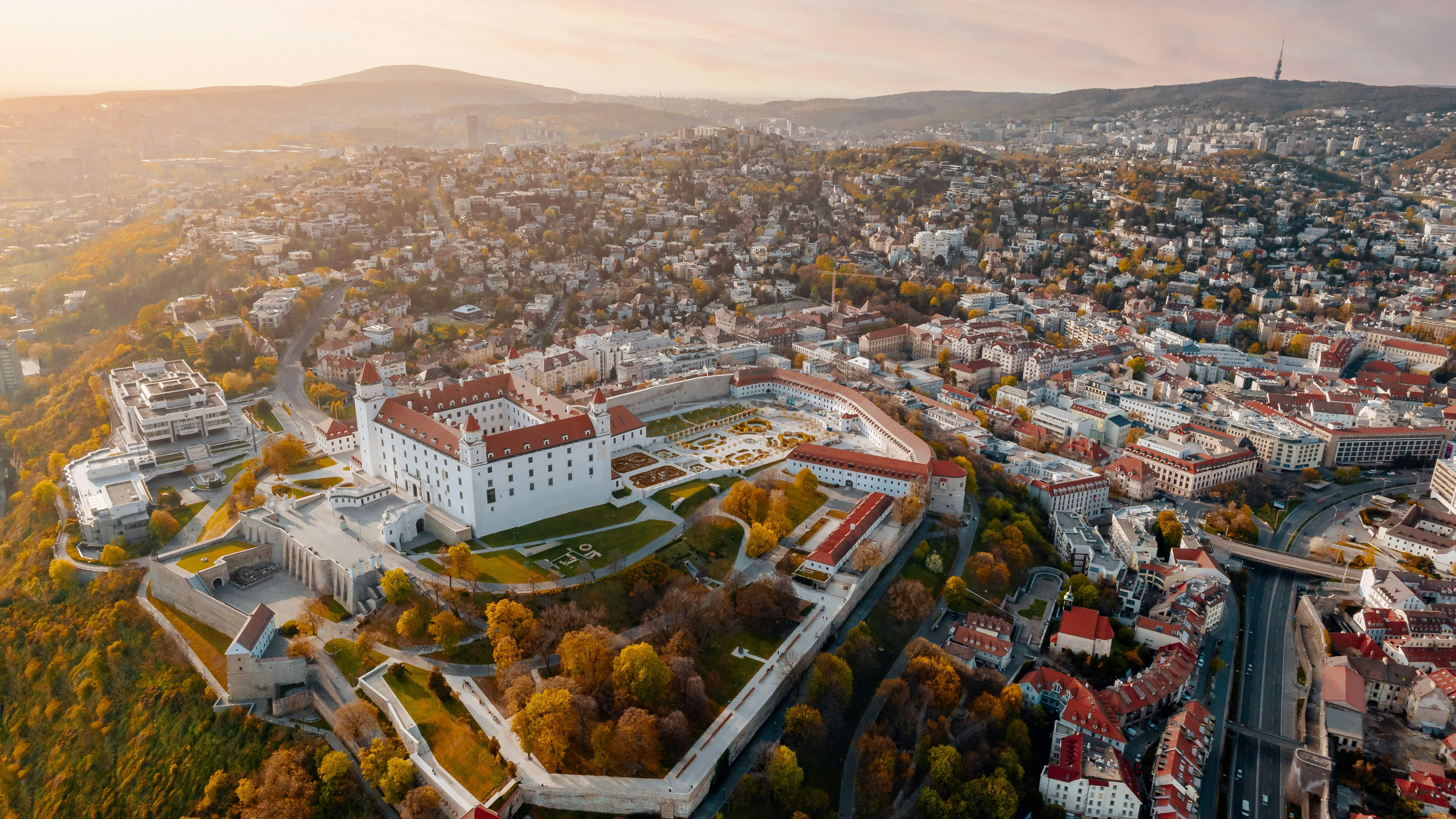
Slovakia
Discover the heart of Europe among medieval castles, the impressive Tatra Mountains, and charming historical cities, merging untouched nature and traditional Central European culture.
Quick Facts
- Capital
- Bratislava
- Language
- Slovak
- Hungarian, Czech
- Currency
- Euro (EUR)
- Best time to visit
- From May to September for hiking and from December to March for skiing.
- Budget per day
- $50 - $130 per day
- Climate
- Temperate continental climate with moderately warm summers and cold, cloudy winters with frequent snowfall in mountainous areas.
- Connectivity
- good
- Very easy to obtain at airports, kiosks, and phone stores; eSIM widely available.
- Electricity
- Type C / E (230V)
- Local transport
- good
- Card usage
- widespread
- Tipping
- optional
🌎 Introduction
In the heart of Europe, where the Tatra peaks meet the plains bathed by the Danube, a territory unfolds that seems to have preserved a rhythm of its own. It is a corner of gentle contrasts, where small wooden villages coexist with the elegance of quiet cities full of history. The passing of the seasons naturally transforms the landscape, from white winters that invite reflection to summers that fill the deep valleys and forests with light as they stretch unhurriedly toward the horizon.
The identity of these lands is perceived in everyday details and in a deep respect for its roots. Life flows between markets where the aroma of sheep’s cheese and traditional hearty dishes mark the pulse of the day, and vineyard slopes that celebrate the harvest with simplicity. Between castles that watch the passage of time and traditions that stay alive in music and craftsmanship, one breathes a balanced atmosphere, typical of a place that invites observation and discovery without unnecessary noise.
🛡️ General Safety
Slovakia is positioned as one of the most safe and stable destinations in Central Europe. For the international traveler, the country offers a peaceful environment, with crime rates notably low compared to other European capitals. The general level of safety is considered high, allowing visitors to enjoy its landscapes and cities with considerable relaxation, while always maintaining the logical precautions one would take in any other international destination.
General safety level
- The country enjoys consolidated political and social stability, which translates into a welcoming environment for tourism.
- The general safety rating is high, ranking at the level of its Central European neighbors such as the Czech Republic or Austria.
- The context for the traveler is one of tranquility, both in urban environments and in rural and mountain areas, where local hospitality is a prominent feature.
Crime and common risks
- The most frequent risk, though not alarming, is petty theft or pickpocketing. These usually occur in crowded places such as train stations, Christmas markets, or the busiest streets of Bratislava’s old town.
- It is recommended to pay attention to belongings on public transport and avoid leaving valuables in sight inside parked vehicles.
- Scams in nightlife venues are uncommon, but it is always advisable to check the price list before consuming to avoid overcharging, especially in highly touristy areas.
- On rare occasions, incidents of credit card fraud have been reported; it is advised to use ATMs located inside bank branches.
Safety in cities and tourist areas
- The urban centers of cities like Bratislava, Košice, or Banská Bystrica are very safe for walking, even at night.
- Public transport is efficient and safe at all hours, although luggage should be watched more closely at the central train stations of large cities.
- There are no “no-go zones” or high-danger slums that affect the conventional tourist circuit, but as in any city, it is recommended to use common sense when moving away from well-lit areas at night.
Transport safety
- The public transport system (trams, buses, and trains) is reliable and has adequate surveillance.
- Regarding taxis, it is highly recommended to use recognized mobile applications (such as Bolt or Uber) instead of hailing taxis directly on the street, to ensure a fair fare and a record of the journey.
- In Slovakia, you drive on the right. Main roads are in good condition, although secondary roads in mountain areas can be narrow and winding.
- The use of dipped headlights is mandatory all day long, regardless of the season.
Natural and climatic risks
- The most relevant natural risk is related to the mountains, especially in the High Tatras. Weather changes can be sudden and extreme.
- During winter, there is a risk of avalanches in skiing and hiking areas. It is imperative to respect the signs of the mountain rescue services (Horská záchranná služba).
- In summer, strong thunderstorms can occur in high-altitude areas. It is always recommended to check the weather forecast before engaging in outdoor activities.
- Flooding is an occasional and seasonal risk, mainly during the spring thaw or after very heavy rains, but it rarely affects tourist safety.
Legislation and local norms
- Slovakia has a zero tolerance (0.0 g/l) policy for drinking and driving. Sanctions are very severe and can include prison sentences.
- It is mandatory to always carry an official identity document (original passport or national identity card).
- The consumption of illegal drugs is heavily penalized, with quite strict possession and consumption laws.
- On public transport, it is mandatory to validate your ticket immediately upon boarding; inspectors are frequent and fines are collected on the spot.
Safety for specific groups
- Female travelers: Slovakia is a very safe country for women traveling alone. Street harassment is infrequent, and one can walk peacefully through the cities at any time.
- LGTBIQ+ travelers: While large cities like Bratislava are open and tolerant, in rural areas or small towns, society tends to be more conservative. Discretion is recommended in less touristy areas to avoid uncomfortable looks or comments, although violent incidents are extremely rare.
- Traveling with children and the elderly: The country is very suitable for families. Infrastructure is modern and health services are efficient. In the mountains, ensure that hiking routes match the traveler’s physical capacity.
Emergencies and assistance
- The universal emergency number is 112, which handles calls for police, ambulance, and fire services.
- Emergency services usually have staff who speak English, especially in coordination centers.
- The police are generally professional and correct. In case of theft, it is necessary to go to a police station to file a report (“oznámenie o trestnom čine”) for insurance or document replacement purposes.
Tip: Always use official apps to order taxis in cities; this avoids language confusion and guarantees that the price is the official one, avoiding unnecessary surcharges for tourists.
📝 Entry requirements
To organize a trip to Slovakia, it is essential to keep in mind that access to the territory usually requires the presentation of a valid passport. This document should have a recommended residual validity of at least three to six months from the planned end date of the trip. It is advisable that the travel document is in optimal physical condition to facilitate reading by authorities at land border points or airports.
Most foreign visitors coming for leisure or tourism do not usually need a prior visa for short stays. Typically, the limit of stay for these visits is set at ninety days, allowing for travel around the country without complex immigration procedures. However, for stays exceeding this period or involving paid activities, it is suggested to consult the specific procedures for obtaining temporary residence or work permits.
At entry controls, officers may request supplementary documentation to verify the nature of the trip. It is common to be asked to show an onward or return ticket from the country, as well as proof of sufficient financial means to cover maintenance and accommodation during the stay. Having a booking confirmation from a hotel or an invitation letter can significantly speed up these routine inspection procedures.
Regarding customs regulations, there are established limits for the introduction of certain personal consumption products. Moderation is recommended when transporting items such as tobacco or alcoholic beverages, as excessive quantities could be considered commercial importation. In the case of personal medications, it is very useful to carry a medical report or the original prescription, especially if the treatment includes sensitive substances or requires the use of needles.
In the health field, there are usually no mandatory vaccination requirements to enter the country. However, it is strongly recommended to have travel insurance that includes international medical coverage, medical transfers, and assistance in case of unforeseen events. Keeping the basic vaccination schedule up to date is always an advisable practice for any international traveler wishing to explore the various corners of Slovak geography with peace of mind.
Below are some additional considerations for preparing entry into the country:
- Verification of passport expiration before the departure date.
- Having a digital and physical copy of the accommodation reservation and itinerary.
- Checking that the contracted medical insurance has effective coverage in Slovak territory.
- Consulting limitations on transporting cash if it exceeds standard allowed amounts without declaration.
- Avoiding the entry of fresh food products that do not comply with general phytosanitary regulations.
- Maintaining a collaborative attitude during security checks at international airports.
🏥 Basic health considerations
When preparing your trip to Slovakia, it is important to know how its health system works so that you can move with total peace of mind through its cities and impressive natural landscapes.
Health system and medical assistance In this destination, you will find a healthcare system that meets European standards, especially in urban centers like Bratislava or Košice. You can access both public health centers and private clinics, the latter being a very popular option for tourists seeking more agile care. Younger medical staff usually speak English, although in rural areas or with older staff, you might find more difficulty communicating if you do not speak the local language. Regarding costs, while not exorbitant, a private consultation or an emergency without coverage can have a considerable price for your travel budget.
Travel medical insurance Having private medical insurance is completely recommended for anyone visiting the country. It is essential that your policy includes coverage for hospitalization, medical transfer, and repatriation. If you plan to enjoy nature and hike in the High Tatras, make sure your insurance also covers mountain rescue, as these services are usually billed separately and have very high costs.
Vaccines There are no mandatory vaccines to enter Slovakia. To travel with peace of mind, you only need to ensure your standard vaccination schedule is up to date. If your travel plan involves spending a lot of time in direct contact with nature, such as camping or intense hiking in forested areas, you might consider the vaccine against tick-borne encephalitis, but this is optional and depends entirely on your travel style.
Medication and first aid kit If you need to take specific medication regularly, it is best to bring it with you from the start in its original packaging. Do not forget to pack a copy of your medical prescription or a report from your doctor, preferably in English, to avoid any misunderstanding at customs or if you need to buy more doses at local pharmacies, called lekáreň. For minor ailments, you will easily find pain relievers and basic healing products at any pharmacy.
Common health risks The risks you might face are mainly seasonal and environmental. In winter, the extreme cold in mountain areas requires proper technical clothing to avoid frostbite or hypothermia. During the warmer months, the greatest risk is posed by ticks in grassland and forest areas, so it is convenient to use repellent and check your skin after a hike. There are no significant risks of waterborne or foodborne diseases.
Water, food, and hygiene You can drink tap water with full confidence throughout the country, as it is potable and of good quality. Regarding food, hygiene standards in restaurants are high, and you can try local gastronomy without special concerns. General hygiene in public spaces, shops, and accommodations is equivalent to that of any other European capital.
Medical emergencies If you find yourself in a medical emergency situation, the phone number to dial is 112. This is the unified emergency number, and from there they will coordinate the dispatch of an ambulance or indicate which hospital center you should go to. The emergency service operates 24 hours a day and is prepared to handle critical situations efficiently.
Final practical recommendations Always keep the contact number of your travel insurance and your policy number written down. If you are going to perform mountain activities, download a local rescue app or always keep your phone sufficiently charged. Finally, if you wear glasses or contact lenses, it doesn’t hurt to bring a spare pair or your prescription written down in case of any mishap.
🚌 Transport within the country
Moving around Slovakia is a simple task thanks to a transport infrastructure that efficiently connects the country’s main regions. The train is the most widely used means of transport for long-distance travel, linking cities comfortably and allowing passengers to enjoy the scenery. On the other hand, the bus network is very comprehensive and reaches practically every corner, making it the ideal complement for accessing smaller municipalities or mountain areas where the railway does not reach. There is no metro network in the country, so in urban areas, movement is mainly by tram, trolleybus, and bus.
For tourists, using public transport is intuitive. Major stations have clear signage and information panels that facilitate orientation. Ticket purchasing is usually managed through automatic machines, ticket offices at stations, or via mobile applications, which simplifies the process for those who do not master the local language. In general, services stand out for their punctuality and reliability, offering an organized and predictable travel experience.
There is a natural distinction between mobility in large cities and more remote areas. While frequencies are high in urban centers, in rural areas, schedules may be more spaced out. For this reason, car rental is a frequent option for those seeking total autonomy to explore natural parks or castles far from main routes. In cities, taxis and on-demand transport services are common and represent a fast alternative for specific journeys or night travel.
The overall feeling for the traveler is that of a comfortable and safe system. Vehicles are usually well-maintained, and staff, especially at major tourist hubs, are usually accustomed to interacting with international visitors. The combination of different means of transport allows for the organization of varied itineraries without major logistical complications, integrating both the modernity of the cities and the charm of natural environments.
Tip: When using urban transport in cities, remember to validate your ticket immediately after boarding the vehicle so that the journey is valid.
🤵 Culture and etiquette
Social interaction in Slovakia is characterized by formal courtesy and a notable respect for privacy and personal space. When greeting someone for the first time, a firm handshake while maintaining eye contact is standard, preferably using courtesy titles and the surname until invited to use a more familiar tone. In public spaces, such as transport or shops, a moderate voice volume prevails, as excessive noise or very loud behavior is usually considered inappropriate for civic coexistence.
In the domestic sphere, there is an essential rule of coexistence: it is customary to remove your shoes when entering a private home. Hosts usually offer house slippers to their guests to ensure their comfort and maintain the cleanliness of the home. Regarding punctuality, it is valued positively in both professional and social contexts, so arriving at the agreed time is interpreted as a sign of consideration toward others.
During meals, behavior is usually slow-paced, and guests are expected to wait for the host to indicate the start with the expression “Dobrú chuť” (bon appétit). If you receive an invitation to visit a house, it is a gesture of courtesy to bring a small gift, such as flowers or chocolates. In the case of flowers, tradition suggests giving an odd number, avoiding the number thirteen or bouquets usually associated with mourning contexts. In restaurants, gratitude for service is generally expressed by rounding up the bill or leaving a tip close to 10% if the service was satisfactory.
Respect for religious heritage and local traditions is fundamental for harmonious integration. When visiting churches or places of worship, it is recommended to dress discreetly and maintain a respectful silence. Likewise, Slovak society values order and compliance with basic courtesy norms, such as giving up a seat to the elderly or those with reduced mobility, gestures that facilitate fluid and natural interaction in the country’s daily life.
“Tip”: When entering a private home, always remember to take off your shoes at the entrance without waiting to be asked, as it is the most widespread courtesy norm in Slovak homes.
🍛 Typical gastronomy
The gastronomy of Slovakia is defined by its traditional, simple, and comforting character. Its roots are deeply linked to rural life and a climate of cold winters, which has resulted in a cuisine based on local ingredients that provide plenty of energy. Among its fundamental pillars are potatoes, fermented cabbage (sauerkraut), and dairy products, especially those derived from sheep’s milk, which give a unique flavor to its most emblematic dishes.
Eating habits usually follow a Central European schedule. Lunch is the main meal of the day and usually begins with a hot soup, a very deep-seated custom regardless of the time of year. Dinner is usually somewhat lighter, although in social contexts it can be more elaborate. In restaurants, it is common for service to be functional, and it is customary to wish a bon appétit with the expression “Dobrú chuť” before starting to eat.
Flavors are usually intense but balanced, with frequent use of spices such as cumin, paprika, and garlic. Regarding drinks, beer enjoys great popularity and quality throughout the territory, sharing the spotlight with local wines produced in the southern regions. It is also common to find fruit distillates and herbal liqueurs, which are part of the country’s hospitality culture.
To enjoy an authentic experience, it is recommended to visit kolibas or salaš, which are rustic establishments traditionally decorated where the most classic recipes are served. Table etiquette does not differ from other European countries, although punctuality and respect for local traditions related to toasting and after-dinner conversation are valued.
| Dish | Description | Main Ingredients | Where to try it | Tip |
|---|---|---|---|---|
| Bryndzové halušky | Small potato gnocchi covered in a creamy cheese sauce | Potato, flour, sheep cheese (bryndza), and fried bacon bits | In traditional mountain taverns or kolibas | Mix it well so the cheese melts uniformly with the heat. |
| Kapustnica | Dense and aromatic soup, very common during festivities and celebrations | Fermented cabbage, mushrooms, smoked sausages, and prunes | In any local cuisine restaurant or markets | Ideally accompanied by a slice of dense rye bread. |
| Zemiakové placky | Crispy grated potato pancakes, fried until golden | Potato, garlic, egg, flour, and marjoram | Street food stalls and as a side dish in restaurants | Order them freshly made to fully enjoy their crispy texture. |
| Vyprážaný syr | Breaded and fried cheese, a very popular dish in daily life | Edam or Hermelín type cheese, breadcrumbs, and egg | Popular diners and daily menu restaurants | It is essential to try it with tartar sauce and fries. |
| Skalický trdelník | Hollow cylinder-shaped sweet roasted over fire | Flour, sugar, chopped nuts, and cinnamon | Stalls in historical centers and local fairs | Consume it while still hot to better appreciate the aroma of the nuts. |
📷 Areas and places to visit
Slovakia presents itself as a destination of great geographical and cultural contrasts, where the Danube plains gradually give way to some of the most imposing mountain ranges in Central Europe. The journey through the country usually begins in Bratislava, the capital, a city that has managed to transform its urban physiognomy while maintaining a charming pedestrian historical center. Strolling through its streets, one discovers squares flanked by Baroque buildings and the St. Martin’s Cathedral, a historic site for coronations. The city’s most recognizable landmark is Bratislava Castle, situated on a hill offering panoramic views over the Danube River and nearby borders, serving as an excellent example of the defensive architecture that characterizes the region.
To the north, the landscape becomes more rugged upon meeting the High Tatras, the highest part of the Carpathian mountain range. This area is a benchmark for active tourism year-round, offering everything from hiking routes bordering glacial lakes like Štrbské Pleso to infrastructure dedicated to winter sports. In these mountains, visitors can experience traditional alpine life and observe protected flora and fauna in their natural environment. The contrast between granite peaks and green valleys defines the visual identity of this region, which has a network of well-marked trails for different difficulty levels.
Historical heritage is another pillar of the country, standing out especially for the density of its fortresses. Spiš Castle, one of the most extensive monumental complexes on the continent, dominates the horizon from its location atop a limestone hill and is part of the protected heritage due to the relevance of its ruins and medieval history. Not far away is the city of Levoča, known for its walled enclosure and for housing masterpieces of wood carving in the St. James Church. On the other hand, Bojnice Castle offers a very different aesthetic, with a romantic style that seems taken from a fairy tale, surrounded by parks and gardens that often host historical festivals.
In the eastern part, the city of Košice serves as the main cultural and economic hub. Its historical center revolves around a long main street where the St. Elisabeth Cathedral, the largest Gothic church in the country, is located. This area stands out for its dynamic atmosphere, with numerous art museums and exhibitions reflecting the mix of Hungarian, Slovak, and Saxon influences. Near this city, travelers can explore the wooden churches of the Carpathian region, religious buildings of unique design that integrate perfectly into the rural and forested landscape.
Slovak nature also manifests spectacularly underground and in its river canyons. Slovak Paradise National Park is famous for its exploration routes that include catwalks, wooden ladders, and suspension bridges over gorges and waterfalls. Likewise, the country’s cave system is of great importance, with prominent examples such as the Dobšiná Ice Cave or the karst formations of the Slovak Karst, which show the geological diversity of the territory. These rural areas also preserve picturesque villages like Vlkolínec, where traditional wooden architecture remains intact, offering a glimpse of daily life in past centuries.
“Tip”: You cannot miss visiting Spiš Castle, the most emblematic place in the country.
✈️ Best time to travel
Slovakia is a destination that offers very different experiences depending on the season, thanks to its marked continental climate. The choice of the ideal time for a visit depends largely on the activities you wish to perform: while the summer months are ideal for walking the trails of the national parks, winter transforms the terrain into a setting conducive to snow sports.
During spring and autumn, the country shows a more leisurely side, with moderate temperatures that facilitate walks through the historical centers of cities like Bratislava or Košice. In these transitional periods, nature experiences notable chromatic changes, from the green awakening of the valleys to the ochre tones of the dense Carpathian forests, allowing for the discovery of the country’s rich heritage and landscape in a quieter atmosphere.
| Season | Months | Typical Climate | What to Expect | Tourist Influx |
|---|---|---|---|---|
| Spring | Mar – May | Cool temperatures gradually rising and moderate rainfall. | Thawing on peaks, blooming valleys, and the opening of most caves and castles. | ⭐⭐ Medium |
| Summer | Jun – Aug | Warm and long days, with the possibility of occasional thunderstorms. | Optimal season for high mountain hiking, folk festivals, and activities on the lakes. | ⭐⭐⭐⭐ High |
| Autumn | Sep – Nov | Cool atmosphere and clear skies at first, turning cloudier toward November. | Forested landscapes with autumn colors, harvest festivities, and cultural visits without crowds. | ⭐⭐ Low - Medium |
| Winter | Dec – Feb | Intense cold with frequent frosts and precipitation in the form of snow. | Opening of ski resorts, traditional markets in main squares, and snowy landscapes. | ⭐⭐⭐ Medium - High |
🗣️ Basic vocabulary
Although it is common to communicate in English in tourist areas of Slovakia and among the younger population, learning a few words in Slovak is very useful. Local residents usually appreciate the gesture of trying to speak their language, which facilitates smoother and closer interaction in shops, restaurants, or public transport.
It is not necessary to delve deep into grammar to get by comfortably during the trip; memorizing a few courtesy expressions and functional terms is enough. These terms will help you greet, ask for basic information, or show gratitude in everyday situations.
- Dobrý deň: Hello (polite form, used during the day).
- Ďakujem: Thank you.
- Prosím: Please (also used for “you’re welcome”).
- Dovidenia: Goodbye.
- Áno / Nie: Yes / No.
- Prepáčte: Sorry / Excuse me.
- Nehovorím po slovensky: I don’t speak Slovak.
- Účet, prosím: The bill, please.