


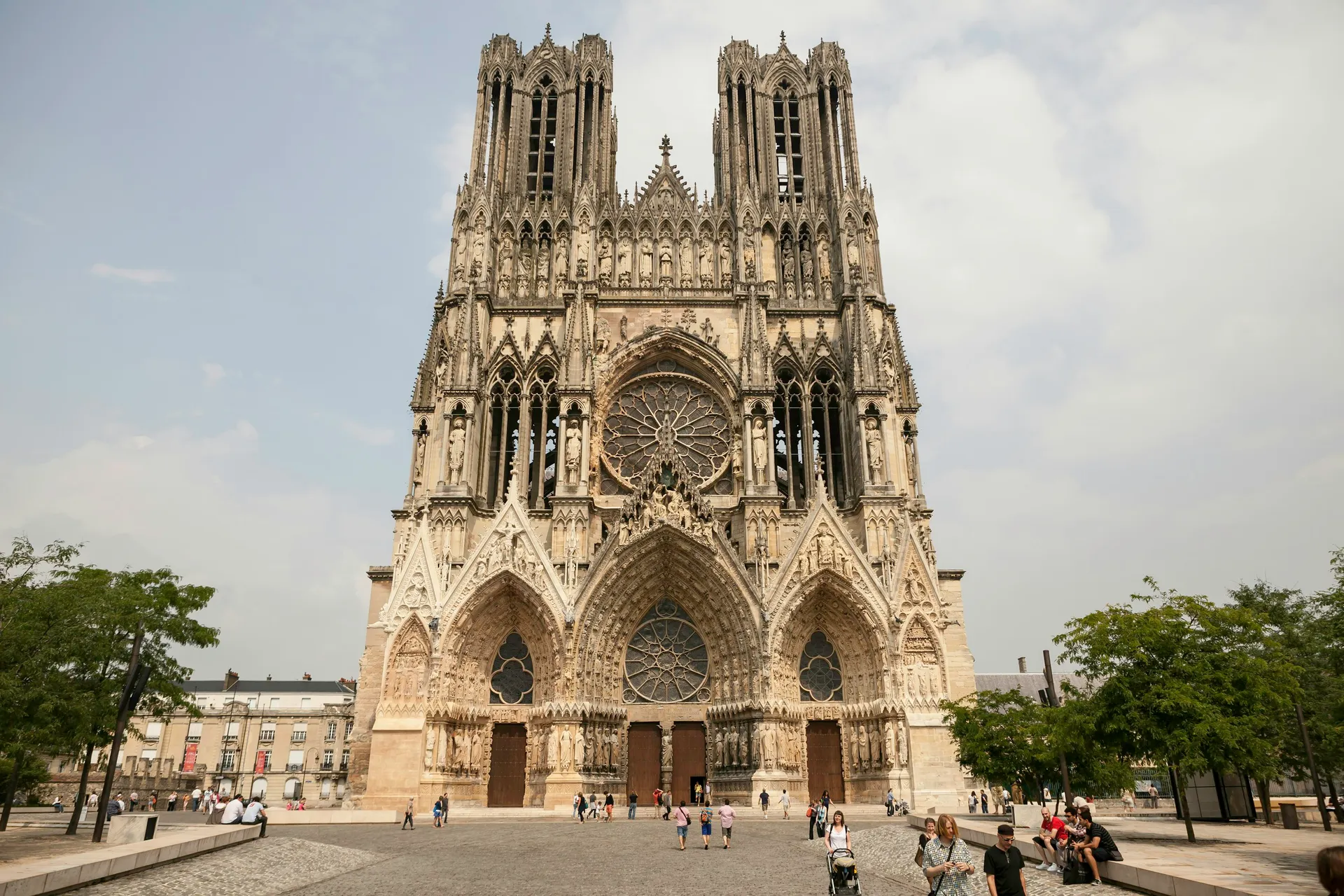
Reims
Reims travel guide: the coronation cathedral, champagne cellars like Veuve Clicquot and Taittinger, the Palais du Tau and art deco cafés.
Quick Facts
- Best time to visit
- April to October, and December for the Christmas market
- Budget per day
- $70 - $170 per day
🌎 Introduction
Reims is two cities in one: the solemn Gothic capital where 33 French kings were crowned, and the cheerful capital of champagne, where the chalk cellars beneath the streets hold millions of bottles at a constant temperature. Forty-five minutes from Paris by train, it is the easiest big-city escape in the country — a cathedral that belongs in the first division, UNESCO-listed monuments and tasting rooms, all walkable in a compact centre.
In December, a Christmas market sets up against the cathedral’s west front. To plan your cellar visits and tours, you can compare tours and activities in Reims before you travel.
🎟️ Tours and Activities
The cellar tour is Reims’s signature experience — the great houses open their crayères (Roman chalk quarries) to visitors. You can browse tours and tastings in Reims: guided visits to Veuve Clicquot, Taittinger, Pommery or the smaller growers, cycling routes through the Montagne de Reims vineyards, and combined cathedral-plus-cellar tours from Paris. Book the famous houses several days ahead; the small grower tastings are the connoisseur’s move.
Tip: Two cellar tours in one day is the comfortable maximum — the tastings add up. Book one grand maison in the morning and a small grower in the afternoon, and leave the evening for the centre’s restaurants.
📷 What to See
Notre-Dame Cathedral
The cathedral where kings from Louis VIII to Charles X were crowned is a Gothic giant famous for its west front: three portals carved with some 2,300 figures, and the Smiling Angel, the city’s beloved symbol. Inside, the 13th-century stained glass includes the famous winegrower’s rose window; the Chagall-designed windows in the axial chapel mix medieval and modern. Give it a slow hour, then see it lit at night.
The crayères: champagne cellars
Beneath the city lie kilometres of Roman chalk quarries, reused by the champagne houses to age their bottles at a natural 10-12 °C. The cathedral sits literally above parts of the network. Each grande maison gives its own tour — Veuve Clicquot’s modern descents, Taittinger’s galleries under its historic house, Pommery’s art installations in the cellars — all ending, usefully, in a tasting.
Palais du Tau
The former archbishop’s palace next to the cathedral, where kings dressed and feasted after coronations, is now a museum of the cathedral treasury — tapestries, coronation relics and the talisman of Charlemagne. With the cathedral and the basilica, it forms the UNESCO World Heritage trio.
Saint-Remi Basilica and museum
A mile south, the Romanesque-Gothic basilica holds the tomb of Saint Remi, the bishop who baptized Clovis and made Reims a royal city. The adjoining former abbey houses the city’s history museum, in one of its quietest, most beautiful corners.
Place d’Erlon and the art deco centre
Reims was rebuilt after the First World War, and its centre is a lesson in art deco and reconstruction architecture. Place d’Erlon is the social heart: cafés, the Subé fountain, and the half-timbered restaurants of the rue de Vesle. Walk the streets off the square to spot the 1920s façades.
The vineyard villages
The Montagne de Reims begins at the city limits: villages like Sillery, Verzy and Verzenay grow the pinot noir that powers the big blends, and the Phare de Verzenay (a lighthouse among vines) has a small museum and spectacular views. It works as a half-day by car, bike or organized tour.
Les Halles du Boulingrin
The 1927 covered market, a masterpiece of thin concrete vaults, is the gastronomic stop: champagne producers, cheese and the pink biscuits of Reims sold at the source. It works as the picnic supplier for a vineyard afternoon.
🏘️ Neighborhoods and Where to Stay
- Centre (cathedral to Place d’Erlon): walkable to everything, most of the hotels and restaurants; the practical choice for a first visit.
- Around the station: modern hotels a 10-15 minute walk from the cathedral; best for train commuters and early starts.
- Vieux Port / Laon side: quieter residential streets east of the centre; budget-friendly and well served by trams.
- Vineyard stays: chambres d’hôtes in the Montagne villages, 15-20 minutes out; the choice for a slow champagne weekend with a car.
🍛 Typical Gastronomy
Champagne is the cuisine’s frame; the rest is Champagne-region comfort food and the city’s own institutions.
| Dish | Description | Where to try it | Tip |
|---|---|---|---|
| Champagne | The local beverage at every price, from grower bottles to the grandes maisons. | Cellars, bars, Halles | Taste at the source in the morning, buy at the Halles after. |
| Biscuit rose de Reims | The pink twice-baked biscuit, traditionally dipped in champagne or in desserts. | Maison Fossier, shops | The local gift, invented here centuries ago. |
| Jambon de Reims | Parsleyed ham set in aspic, the charcuterie classic of the region. | Charcuteries, markets | Served in thin slices with cornichons. |
| Potée champenoise | Pork and cabbage stew, the countryside’s winter dish. | Traditional restaurants | The right lunch after a cold cellar tour. |
| Chaource and local cheeses | The soft washed cheeses of the Champagne borders. | Cheese shops | Ask what pairs with a blanc de blancs. |
| Tarte au sucre / galette des rois | Sugar tart and the region’s king cake tradition. | Bakeries | January is galette season. |
Many restaurants offer champagne-by-the-glass lists longer than their wine lists — the local way to compare houses without buying bottles.
🚌 Getting Around
From Paris. High-speed trains from Gare de l’Est cover the distance in about 45 minutes; it makes Reims an easy day trip or overnight. The Champagne TGV station is north of the centre (tram or taxi in); some trains also stop at Reims-centre station.
In the city. Two tram lines cross the centre; most of the sights are within a 15-minute walk of the cathedral anyway. Bikes and the compact street plan make a car unnecessary in town.
To the vineyards. The Montagne de Reims villages need a car, a bike (the quiet roads between vines are lovely in good weather) or an organized tour — sensible when tastings are involved.
Further afield. Épernay, the avenue of the great houses, is 30 minutes away by train or car; Paris and Strasbourg bookend the region by TGV.
🛡️ Safety and Common Scams
Reims is a calm mid-size city; traveller-facing risks are few.
- Pickpockets at the station and market: the usual care on the TGV and at Halles on busy mornings.
- Tasting-and-driving: the real local risk — plan a driver, a tour or the tram back if you have tasted more than a glass; the legal limit in France is lower than many visitors assume.
- Restaurant touts: rare; the centre’s good tables speak for themselves and often need booking.
- Bike routes: vineyard roads are quiet but narrow; lights and visible clothing matter at dusk.
The emergency number is 112.
✈️ Best Time to Visit
| Season | What to expect | Notes |
|---|---|---|
| Spring (April-June) | Vines budding, terraces out | Cellar tours at their most pleasant |
| Summer (July-August) | Warm, vines in full leaf | Book the big houses well ahead; harvest begins late August |
| Autumn (September-October) | Harvest season, golden vines | The most atmospheric window; growers are busiest — book tastings |
| Winter (November-December) | Cold, quiet, Christmas market | The market usually runs late November into December — see our best Christmas markets in France guide |
Cellar visits run year-round; book the grandes maisons and vineyard tours ahead whatever the season.
Pair Reims with Paris for the museums, Strasbourg and Colmar for the Christmas markets, or make it the champagne stop of a France tour — the full map is in the France travel guide.