


Colmar
Colmar travel guide: Petite Venise canals, the Unterlinden Museum, five Christmas markets, Alsatian food and wine, and the wine villages nearby.
Quick Facts
- Best time to visit
- May to October, and December for the Christmas markets
- Budget per day
- $65 - $160 per day
🌎 Introduction
Colmar is the Alsace of storybooks condensed into a walkable old town: canals where boats drift past half-timbered houses, streets of impossible colours, and wine bars pouring riesling and pinot gris a few steps from each other. It is smaller and quieter than Strasbourg, an hour north by train, and it works both as a destination and as the best base for the wine villages of the route des vins.
In December, five Christmas markets take over the centre — the town runs one of the longest seasons in France. Before you travel, you can compare tours and activities in Colmar and book the wine-route day trips that sell out first.
🎟️ Tours and Activities
Colmar’s essentials are its old town on foot and the wine country around it. You can browse tours and activities in Colmar: guided walks of the historic centre, the tourist train loop, canal boat rides in Petite Venise, and — the most popular — half-day tours of the wine villages with tastings. In December, add the Christmas market evenings; the combination of markets and cellars is the reason many travellers pick Colmar over its bigger neighbour.
Tip: The village tours (Eguisheim, Riquewihr, Kaysersberg) are the first activities to sell out in December; book them when you book the hotel, and keep the old-town walk for your arrival evening.
📷 What to See
Petite Venise
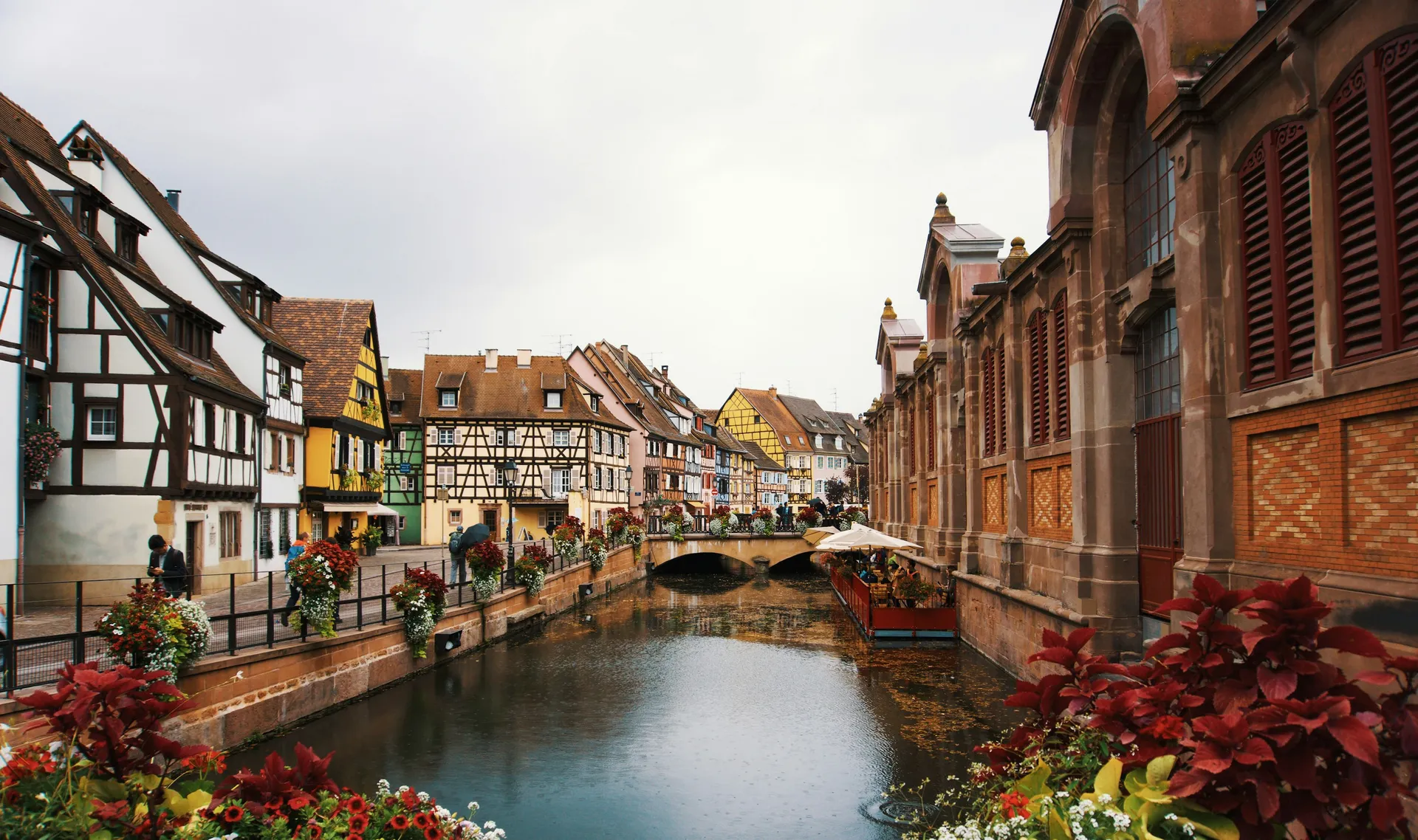
The quarter of tanners and fishermen along the Lauch river is the image of Colmar: flowered bridges, pastel façades and flat-bottomed boats. Walk it early, then see it again from the water on a short boat ride — the perspective that made it famous.
Unterlinden Museum
A Dominican convent turned museum holds the Isenheim Altarpiece, Grünewald’s monumental Renaissance masterpiece, plus a strong collection from medieval sculpture to Picasso. It is one of France’s finest provincial museums and deserves two unhurried hours.
The old town houses
Colmar’s burgher houses read like a timeline: the stone Merchant’s House (Koïfhus), the timbered Maison Pfister with its murals, the crooked Maison des Têtes crowned with 106 sculpted faces. They line a compact circuit you can follow between squares.
Place de la Cathédrale and the covered market
The collegiate church of Saint-Martin anchors the old town; around it, the streets narrow into the gourmet circuit. The covered market (Marché Couvert) is the edible Colmar: fish, cheese, bread and wine taps in a 1905 iron hall — ideal for assembling a picnic by the canal.
The five Christmas markets
In season (typically late November to late December), the markets spread from the cathedral square to Petite Venise, each with a theme: crafts, gastronomy, children, and the indoor market hall’s producers. Colmar’s season is among the longest in France, running past Christmas into the last days of December.
Bartholdi’s Colmar
The sculptor of the Statue of Liberty was born here; his family house is now a museum, and a replica of his Lady Liberty watches the roundabout on the way into town — a five-minute detour that surprises most visitors.
The vineyards’ edge
The town fades into vine-covered hills at its northern edge: the beginning of the wine route. A one-hour walk climbs to a viewpoint over the roofs; on clear evenings the Vosges glow pink behind the steeples.
🏘️ Neighborhoods and Where to Stay
- Old centre (inside the old walls): canals, markets and restaurants at the door; small hotels and apartments, and December prices to match. Book 2-3 months ahead for the market season.
- Petite Venise: the most romantic strip, quiet at night once the day-trippers leave.
- Around the station: 10-12 minutes on foot from the centre, better value, practical for train travellers.
- Quartier Européen / west Colmar: modern hotels with parking, the right call if you are touring the wine route by car.
🍛 Typical Gastronomy
Colmar eats like the rest of Alsace, with the wine route’s cellar doors an hour’s walk from the centre.
| Dish | Description | Where to try it | Tip |
|---|---|---|---|
| Tarte flambée | Thin tart of fromage blanc, onion and bacon, wood-fired. | Winstubs and market stalls | The Savour d’Alsace-style stands make it in front of you. |
| Baeckeoffe | Slow-baked meats and potatoes in white wine. | Traditional restaurants | Order-ahead classic; a whole afternoon in a dish. |
| Fleischnacka | A spiral of pasta dough around minced meat, pan-fried. | Family winstubs | A local speciality visitors rarely discover. |
| River fish | Trout and pike from the region’s rivers, usually in Riesling sauce. | Old-town restaurants | The dish that pairs with Colmar’s own whites. |
| Bredele and kougelhopf | Christmas biscuits and the crown-shaped brioche. | Bakeries and Christmas stalls | December’s edible souvenir. |
| Alsatian whites | Riesling, pinot gris, gewurztraminer from the surrounding slopes. | Wine bars and the covered market | Ask for a flight of three; the taps at the market pour by the glass. |
Book dinner in December — the good old-town tables fill with market visitors by 7 p.m.
🚌 Getting Around
From the airport. Colmar-Houssen handles little traffic; most travellers arrive via Basel-Mulhouse airport (about 45 minutes by road) or Strasbourg airport, with train connections via Mulhouse or Strasbourg.
Trains. Direct regional trains link Colmar with Strasbourg (30-40 minutes) and Mulhouse (20 minutes); the station is a 10-minute walk from the old centre.
On foot. The old town is entirely pedestrian and compact; you will not need transport inside it.
By car. Useful for the wine villages, which sit off the rail line; parking rings the old town. Winter note: roads to the villages are usually clear, but carry chains if snow is forecast and you are heading into the Vosges.
🛡️ Safety and Common Scams
Colmar is a small, safe town; the main hazards are seasonal crowds and tourist pricing.
- Market crowds: keep bags closed on December evenings in the narrow lanes around Petite Venise.
- Menu traps: restaurants with photos and multilingual touts by the door rarely match the winstubs one street over.
- Parking ‘helpers’: at busy lots, strangers waving you into spots may expect payment; ignore and use official parking meters.
- Ice on the canals’ paths: December mornings glaze the stones by the water; flat shoes with grip.
The emergency number is 112.
✈️ Best Time to Visit
| Season | What to expect | Notes |
|---|---|---|
| Spring (April-June) | Mild, vines budding, few crowds | Best value of the warm season |
| Summer (July-August) | Warm and lively, boat rides in season | Peak for the wine route; book villages’ parking early |
| Autumn (September-October) | Harvest colours, new wine | Wine-festival weekends; our favourite window |
| Winter (late Nov-Dec) | Cold, festive, five Christmas markets | The town’s high season — see the Alsace Christmas markets route for the full plan |
For the December weeks, book the wine-route tours and the popular tables well ahead.
Pair Colmar with Strasbourg to the north and the champagne cellars of Reims to the west, or head home via Paris. The full picture is in the France travel guide.