


Paris
Paris travel guide: the Eiffel Tower, the Louvre, Montmartre, the Marais, the Seine, day trips to Versailles and Champagne, food, transport and safety tips.
Quick Facts
- Best time to visit
- April to June and September to October
- Budget per day
- $90 - $250 per day
🌎 Introduction
Paris is the city every traveller has already visited in films, books and photos, and it still manages to feel bigger than its reputation. The Eiffel Tower really does appear at the end of unexpected streets, the Louvre really does take days, and the café terraces, the baguettes under arms and the zinc rooftops are not a set but daily life. It is also compact: most of what you came for sits inside a walkable ring along the Seine.
This guide covers what to see, where to stay, what to eat and how to move around without wasting your days in queues. If you want to organize your bookings before you fly, you can compare tickets, tours and day trips in Paris in one place.
🎟️ Tours and Activities
Paris rewards planning more than any other European capital: the big sights use timed entry, the good guides sell out and the skip-the-line difference can be hours — our skip-the-line tickets guide details which monument needs which booking. You can browse tours and activities in Paris — from Louvre and Eiffel Tower entries to Seine cruises, walking food tours in Le Marais and guided visits to Versailles. Read the meeting point and the cancellation terms before you book; in high season, reserve the tower and the Louvre as soon as your dates are fixed.
Tip: Cluster your bookings geographically: Louvre and Sainte-Chapelle on one morning, Orsay and the Tuileries on another. Paris distances look short on the map and are not.
📷 What to See
Eiffel Tower
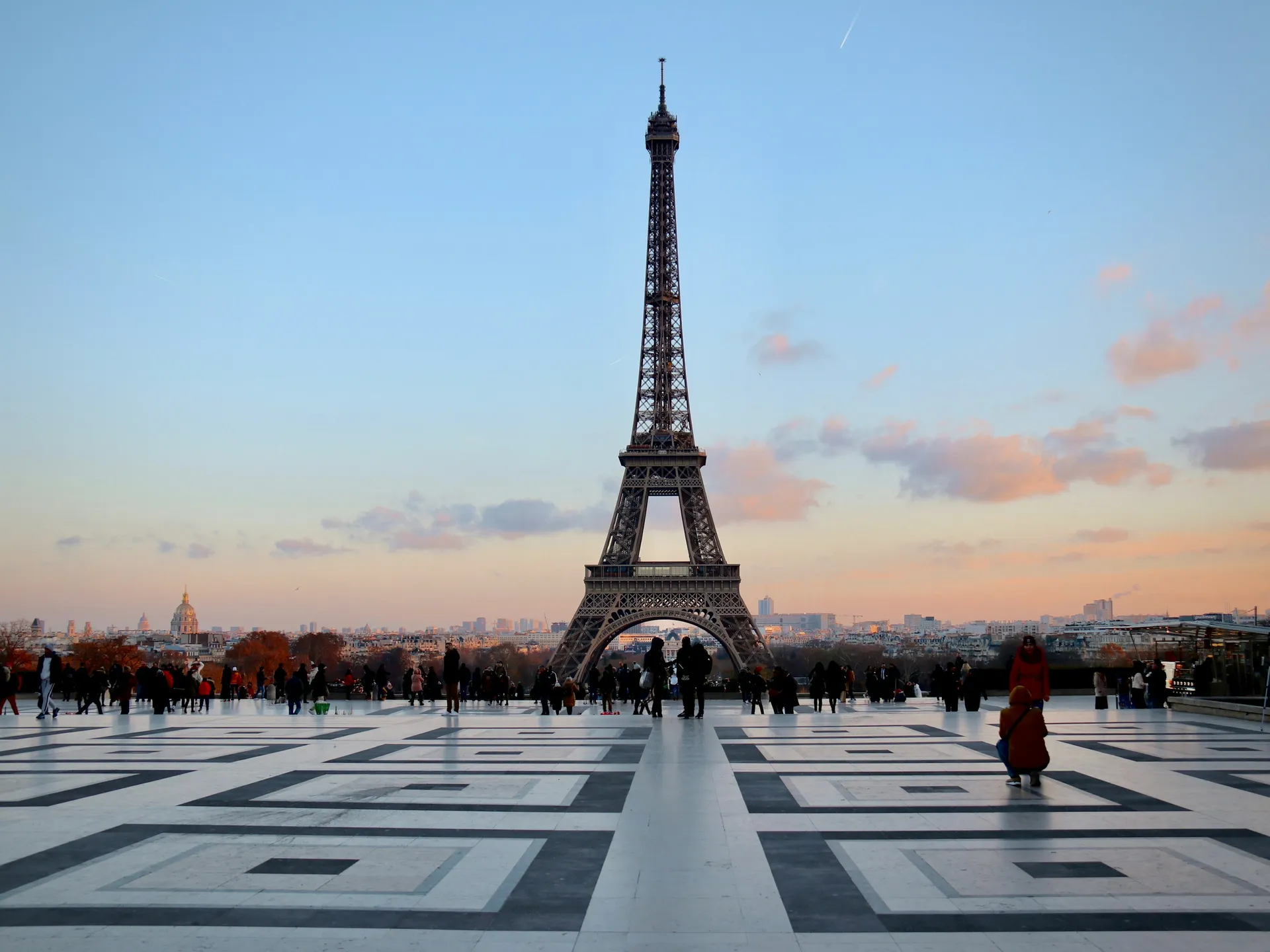
The 330-metre iron tower needs no introduction, but it does need a strategy. Book online in advance for the lift to the second floor or the summit, or take the stairs to the second floor for a shorter queue and a workout. For photographs, the Trocadéro across the river at dawn and the Champ de Mars at dusk are the classic angles; the tower sparkles for five minutes at the start of every hour after dark.
The Louvre
The world’s most visited museum holds the Mona Lisa, the Venus de Milo and 35,000 more works in a former royal palace. One visit cannot cover it: pick two wings, book a timed ticket and accept that you will miss most of it. It is closed on Tuesdays; the glass pyramid is worth seeing by night too.
Notre-Dame and the Île de la Cité
After the 2019 fire and its meticulous restoration, Notre-Dame’s Gothic interior is open again. Around it, the two islands of the Seine hold Sainte-Chapelle’s stained-glass jewel box, the Conciergerie and the quiet Place Dauphine — the Paris of before Paris.
Montmartre and Sacré-Cœur
The hill of painters, windmills and steps still delivers village atmosphere if you walk one street away from Place du Tertre. The white basilica offers the free view of the city; the funicular saves the climb. Come early: by mid-morning the crowds own the hill.
The Marais
Aristocratic mansions, the Jewish quarter around Rue des Rosiers, the Place des Vosges (the city’s oldest square) and a dense mix of boutiques and museums, including the Musée Picasso. It is the best neighbourhood for aimless walking, and it is open on Sundays when much of the city is not.
Musée d’Orsay
The former railway station on the Left Bank holds the world’s best Impressionist collection — Monet, Van Gogh, Renoir, Degas — under a giant glass arch. Two to three hours do it justice; closed on Mondays.
The Seine and its bridges
The river is Paris’s main street. Walk it from the Orsay to Notre-Dame, cross Pont Alexandre III, the most decorated of the bridges, and finish on the car-free banks. A one-hour cruise at dusk is the tourist cliché that earns its price.
Day trips
Versailles with its palace and gardens is 40 minutes away by RER train; the Champagne cellars of Reims are 45 minutes by high-speed train; Giverny’s gardens open from spring to autumn; Disneyland Paris sits 40 minutes to the east. In December, pair the city with the lights of Strasbourg and the Alsatian markets.
🏘️ Neighborhoods and Where to Stay
- The Marais (3rd-4th arr.): central, lively, open on Sundays; ideal for a first visit on foot. Small hotels and apartments; can be noisy on weekends.
- Saint-Germain (6th arr.): elegant, literary, steps from the Louvre and Orsay across the river; among the priciest beds in the city.
- Latin Quarter (5th arr.): student atmosphere, bookshops, affordable menus and good metro links; some streets are very touristy near the boulevards.
- Montmartre (18th arr.): the most romantic and the most stepped; best for a second visit. Stay west of Sacré-Cœur rather than around Barbès.
- Bastille-Oberkampf (11th arr.): where Paris eats and drinks now; 20-30 minutes on foot or metro to the big sights, better prices.
If you are unsure between hotel and apartment, our hostels, hotels and apartments comparison can help you decide.
🍛 Typical Gastronomy
Paris cooking is France’s cooking condensed: bistro classics from every region, plus the city’s own street icons.
| Dish | Description | Where to try it | Tip |
|---|---|---|---|
| Croissant / pain au chocolat | The daily butter test of every bakery. | Any boulangerie with a queue of locals | Eat it the morning it is baked; never refrigerate. |
| Steak frites | Bistro steak with fries and sometimes a pepper or shallot sauce. | Classic bistros of the 11th and 5th | A benchmark dish: good bistros, good fries. |
| Escargots | Snails baked with garlic-parsley butter. | Traditional bistros | Order six, not twelve, the first time. |
| Falafel | The Marais’s own institution, a leftover of its Jewish history. | Rue des Rosiers | Join the street queue; eat standing. |
| Crêpes | Buckwheat galettes (savoury) and sweet crêpes. | Crêperies of Montparnasse | A galette-and-cider lunch is the Breton way. |
| Fromage and charcuterie | The before-or-after course: cheeses and cured meats. | Fromageries and wine bars | Ask the cheesemonger for a “plateau for two”. |
Book dinner for popular tables, and keep lunch light — the best Paris meals are sometimes a baguette, a cheese and a bench by the Seine.
🚌 Getting Around
From the airports. Charles de Gaulle connects to the centre with the RER B train (about 35 minutes to Châtelet) and buses; Orly is served by metro line 14, plus trains and trams. Taxis have fixed fares to the banks of the Seine — confirm before boarding. For tickets and transfers you can also compare airport transfer options in Paris.
Metro and buses. The metro’s 16 lines cover everything; a carnet of tickets or the contactless Navigo Easy card makes it automatic. The same ticket works on buses, which are slower but show you the city. Keep your ticket until you exit.
On foot and by bike. Central Paris is 4-5 km across: the Louvre, the Marais and Saint-Germain are mutually walkable. Vélib’ bikes sit every few hundred metres. Avoid driving: traffic is dense and parking is expensive.
Trains. Six major stations radiate to the country and abroad: Versailles (RER), London (Eurostar from Gare du Nord), Reims and Lyon by high-speed train. Buy TGV tickets in advance for the best fares.
🛡️ Safety and Common Scams
Paris is safe for its size; the risks that touch travellers are petty and concentrated in tourist zones — the Eiffel Tower approaches, Montmartre’s funicular, the big museums and crowded metros.
- The friendship bracelet: a string tied to your wrist before you can refuse, then payment demanded. Keep hands in pockets and keep walking.
- The petition scam: clipboard signers surround you while an accomplice goes for pockets, especially near Sacré-Cœur.
- The gold ring: someone “finds” a ring and offers it to you, then asks for money. Say no and move on.
- Three-card monte on pedestrian bridges and around Montmartre: the game is theatre; the crowd are accomplices.
- Fake tickets: buy Louvre and Eiffel Tower entries only from official sites or reputable resellers.
The emergency number is 112. Keep bags closed in packed metro cars, and split your cash and cards.
✈️ Best Time to Visit
| Season | What to expect | Notes |
|---|---|---|
| Spring (April-June) | Mild, parks in bloom, long days | The classic best window; book museums ahead |
| Summer (July-August) | Warm to hot, lively, many locals away | Peak crowds; August is paradoxically calmer for sights |
| Autumn (September-October) | Golden light, cultural season open | Excellent compromise: good weather, thinner queues |
| Winter (November-March) | Cold and damp, short days | Fewest tourists; Christmas lights and museums; check our Paris at Christmas guide |
Whatever the month, prebook the Eiffel Tower and the Louvre and keep one afternoon unplanned for the Seine.
Keep exploring France with Strasbourg and the Christmas markets, Lyon for food, or Reims for champagne — and see the full France travel guide for the rest of the country.