


Lyon
Lyon travel guide: Vieux Lyon and traboules, Fourvière, Presqu'île, bouchon restaurants and Lyonnais cuisine, the Festival of Lights and the river banks.
Quick Facts
- Best time to visit
- April to June and September to October; early December for the Festival of Lights
- Budget per day
- $70 - $180 per day
🌎 Introduction
Lyon is France’s gastronomic capital wearing a history of silk and cinema: a Roman city on two hills at the meeting of the Rhône and the Saône, with a Renaissance old town threaded by secret passageways, and a food culture that runs from the historic bouchons of the working-class quarters to the density of great chefs found almost nowhere else. It is also the natural gateway to the Alps and the Beaujolais vineyards, an hour in each direction.
In early December, the whole city becomes a stage for the Fête des Lumières. To organize your visit, you can compare tours and activities in Lyon before you travel.
🎟️ Tours and Activities
The experiences that define Lyon are walking the old town with its hidden traboules, eating in a proper bouchon, and seeing the city from the river. You can browse tours in Lyon: guided traboule walks, food tours through the Halles Paul Bocuse and the old town, cruise loops at the confluence, Segway circuits along the banks, and half-day trips into Beaujolais. For the Festival of Lights in December, the official map matters more than any tour — but book everything early; festival nights are the busiest of the year.
Tip: Reserve your bouchon dinner for the day you book the hotel. The traditional ones are small, close early and do not fit walk-ins on festival weekends.
📷 What to See
Vieux Lyon and the traboules
One of Europe’s largest Renaissance quarters spreads at the foot of Fourvière, in ochre and pastel streets. Its secret is the traboules: covered passageways that cut through buildings and courtyards, built so silk workers could move goods without rain. Around forty are open to respectful walkers — start at 54 rue Saint-Jean.
Fourvière Basilica and the hill
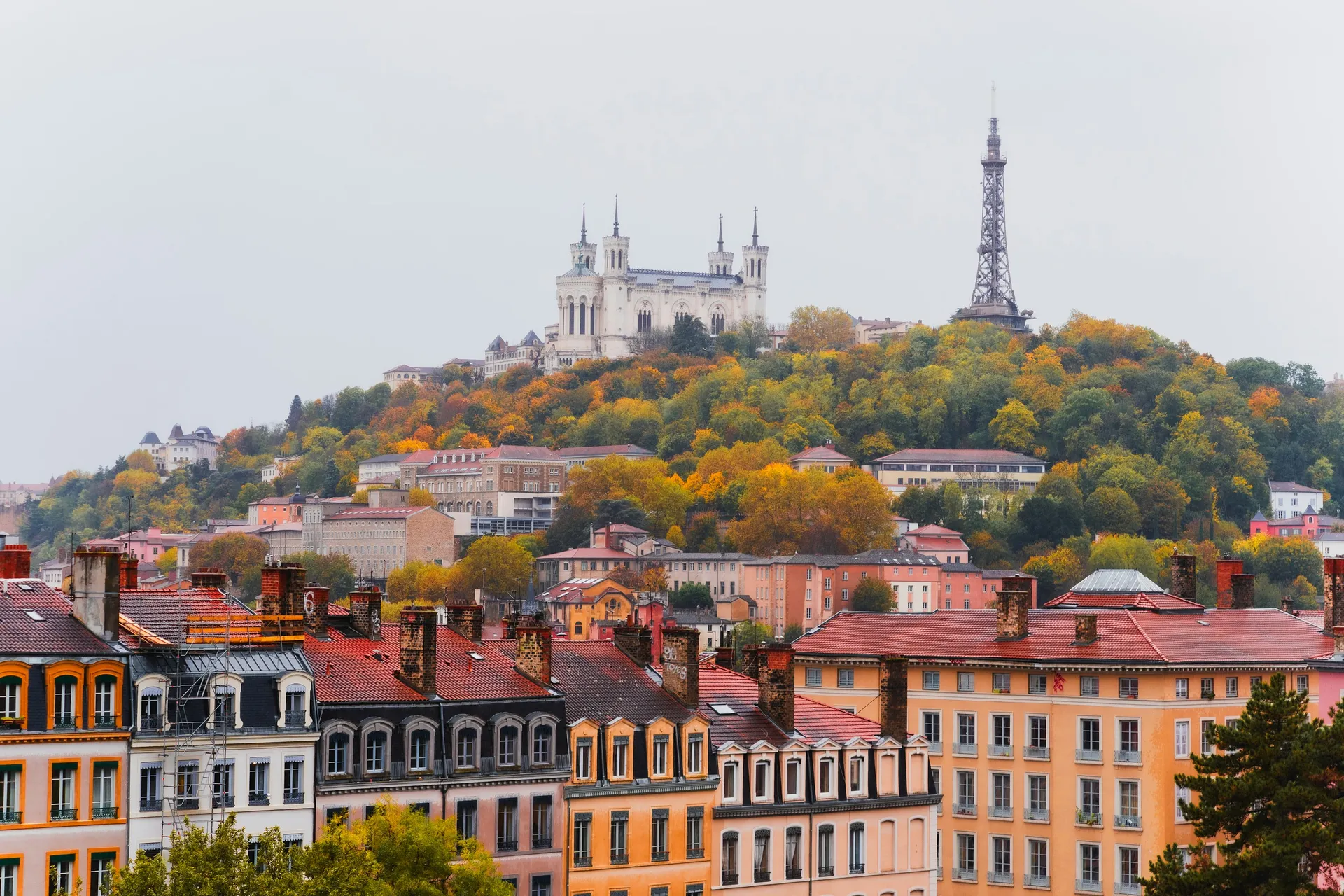
The white basilica watching over the city since the late 19th century rewards the climb (or funicular) with the best panorama: red roofs, two rivers, and the Alps on clear days. Beside it, the Roman theatres — where Lyon began as Lugdunum — still host summer concerts.
Presqu’île
The peninsula between the rivers is the elegant core: Place Bellecour, one of Europe’s largest pedestrian squares, the Hôtel de Ville and the Opera on Place des Terreaux with the Bartholdi fountain, and the shopping spine of rue de la République. This is where Lyon’s street life happens.
Croix-Rousse
The silk workers’ hill is today the alternative quarter: slopes of ateliers, street-art-covered walls, a daily market on the boulevard, and the canuts’ apartment-museums telling the story of the 1831 silk revolt. It pairs well with a morning coffee and great views over Presqu’île.
Confluence and the rivers
At the southern tip of Presqu’île, where the rivers finally meet, the old industrial docks have become an architecture showcase — the orange cube, the Musée des Confluences — reached by a riverside walk or boat. Both river banks have become car-free promenades; the Rhône’s left bank is where Lyonnais jog, picnic and dance on summer evenings.
Musée des Confluences and the fine arts museum
Two museums for two weathers: the science-and-societies museum at the Confluence, in a building of glass and steel like a crystal, and the Musée des Beaux-Arts in a former abbey on the Presqu’île — France’s largest collection outside Paris.
Halles Paul Bocuse
Not a sight but a pilgrimage: the covered food market where Lyonnais gastronomy is displayed in full — cheeses, charcuterie, quenelles, praline tarts — and several counters serve proper lunches. It sits a metro ride north of the centre; go hungry.
🏘️ Neighborhoods and Where to Stay
- Presqu’île: central on both rivers, walkable to everything, the full range of hotels. The practical first choice.
- Vieux Lyon: atmospheric Renaissance streets; quieter at night; funicular and metro at the door.
- Croix-Rousse: village air, food markets, stairs by design; best for a second stay or longer trips.
- Part-Dieu: the business district by the main station — bland but well connected and often cheaper; the airport tram leaves from here.
- Confluence: modern riverside architecture, calm; a pleasant walk or tram from the centre.
🍛 Typical Gastronomy
Lyon takes food as seriously as any city in France — which is to say, more seriously than almost anywhere.
| Dish | Description | Where to try it | Tip |
|---|---|---|---|
| Quenelle | Light pike dumpling in a crayfish sauce (Nantua). | Bouchons | The signature dish; order it as a main. |
| Salade lyonnaise | Green salad with bacon, croutons and a poached egg. | Any bouchon | The safe, brilliant starter. |
| Andouillette | Sausage of pork intestines — beloved locally, challenging elsewhere. | Bouchons | An acquired taste; ask for it grilled. |
| Cervelle de canut | Fresh cheese whipped with herbs and shallots. | Bouchons, cheese shops | Spread on bread; order with a Beaujolais. |
| Praluline / tarte aux pralines | Brioche and pink-praline tart, Lyon’s sweet icon. | Pralus and bakeries | The pink tart is photogenic and enormous; share. |
| Charcuterie lyonnaise | Rosette, saucisson, pistachiated pâtés. | Halles Paul Bocuse | Buy a picnic’s worth for the river banks. |
The bouchon is the institution: a small, traditional restaurant with checked tablecloths and Lyonnais mothers’ recipes. Look for the “Les bouchons lyonnais” label — a certification protecting the tradition — and be ready for generous plates.
🚌 Getting Around
From the airport. Lyon-Saint Exupéry connects to Part-Dieu station by the Rhônexpress tram in under 30 minutes, every 15-30 minutes.
Metro, trams, funiculars. Four metro lines, tram lines and two funiculars up to Fourvière cover the city; a day pass pays for itself quickly. TCL is the network to search for tickets and plans.
On foot and by bike. The centre is walkable, but Lyon is a city of two hills: plan the climbs (or cheat with the funicular). Vélo’v bikes are everywhere; the river banks are made for them.
Trains. High-speed links to Paris (2 hours), Marseille (1.5 hours), Geneva and the Alps. In ski season, many trains run to the northern Alps resorts — see our France winter content for choosing a resort.
🛡️ Safety and Common Scams
Lyon is a safe major city with the usual big-city caveats.
- Pickpockets: Terreaux, Bellecour and the metro lines at rush hour; also festival nights in December, when crowds are at their densest.
- Petition and bracelet scams: around Bellecour and Part-Dieu station; the standard refusal-and-distance works.
- Late-night areas: parts of the Guillotière quarter and the Perrache station surroundings feel less comfortable at night; nothing dramatic, just basic care.
- River banks: lovely but quiet very late; the lit promenades are the sensible walk home.
The emergency number is 112.
✈️ Best Time to Visit
| Season | What to expect | Notes |
|---|---|---|
| Spring (April-June) | Mild, terraces back out | Ideal for walking the two hills |
| Summer (July-August) | Hot, festival season, some locals away | Roman theatre concerts; river-bank evenings |
| Autumn (September-October) | Golden light, Beaujolais harvest | Food-and-wine season at its best |
| Winter (December-February) | Cold; Festival of Lights around 8 December | Up to two million visitors — book months ahead; see our Festival of Lights guide |
Whenever you come, book the popular food tours and the bouchon tables early — Lyon’s calendar fills fast.
From Lyon, continue to the Alps — Chamonix for the high mountains and Annecy for the lake — south to Marseille and the Mediterranean, or north to Paris — and see the France travel guide for the whole map.