


Troyes
Troyes travel guide: the champagne-cork-shaped medieval old town, half-timbered lanes and stained-glass, the Côte des Bar cellars and the factory outlet malls.
Quick Facts
- Best time to visit
- April to June and September to December
- Budget per day
- $65 - $150 per day
🌎 Introduction
Troyes is the medieval city that champagne forgot: the historic capital of Champagne (the county, not just the drink), preserved so completely — its old town is famously shaped like a champagne cork — that its half-timbered lanes and stained-glass churches feel uncrowded only because the world goes to Reims instead. The drink is still nearby: the Côte des Bar, the southern half of the champagne region, grows its pinot around Troyes’ back door. And there is a modern footnote: the factory-outlet malls that draw half of Paris on Saturdays.
This guide covers the city and its surrounding cellars. It pairs with Reims for the northern champagne houses and Paris 1 h 30 by train.
🎟️ Tours and Activities
The essentials: the old town on foot (the lanes are the sight), the stained-glass circuit, and the champagne cellars of the Côte des Bar — grower country, warmer and more personal than the grandes maisons. You can browse tours and activities in Troyes: guided old-town walks, cellar visits and tastings in Bar-sur-Seine and Les Riceys’ villages, and the outlet villages’ shopping shuttles. Book grower cellars for the morning circuit.
Tip: the tourist office’s pass bundles the museums (contents on the official site); the old town’s free walking map marks the cork shape’s outline — take the aerial view in from the Saint-Pierre tower first to believe it.
📷 What to See
The cork-shaped old town
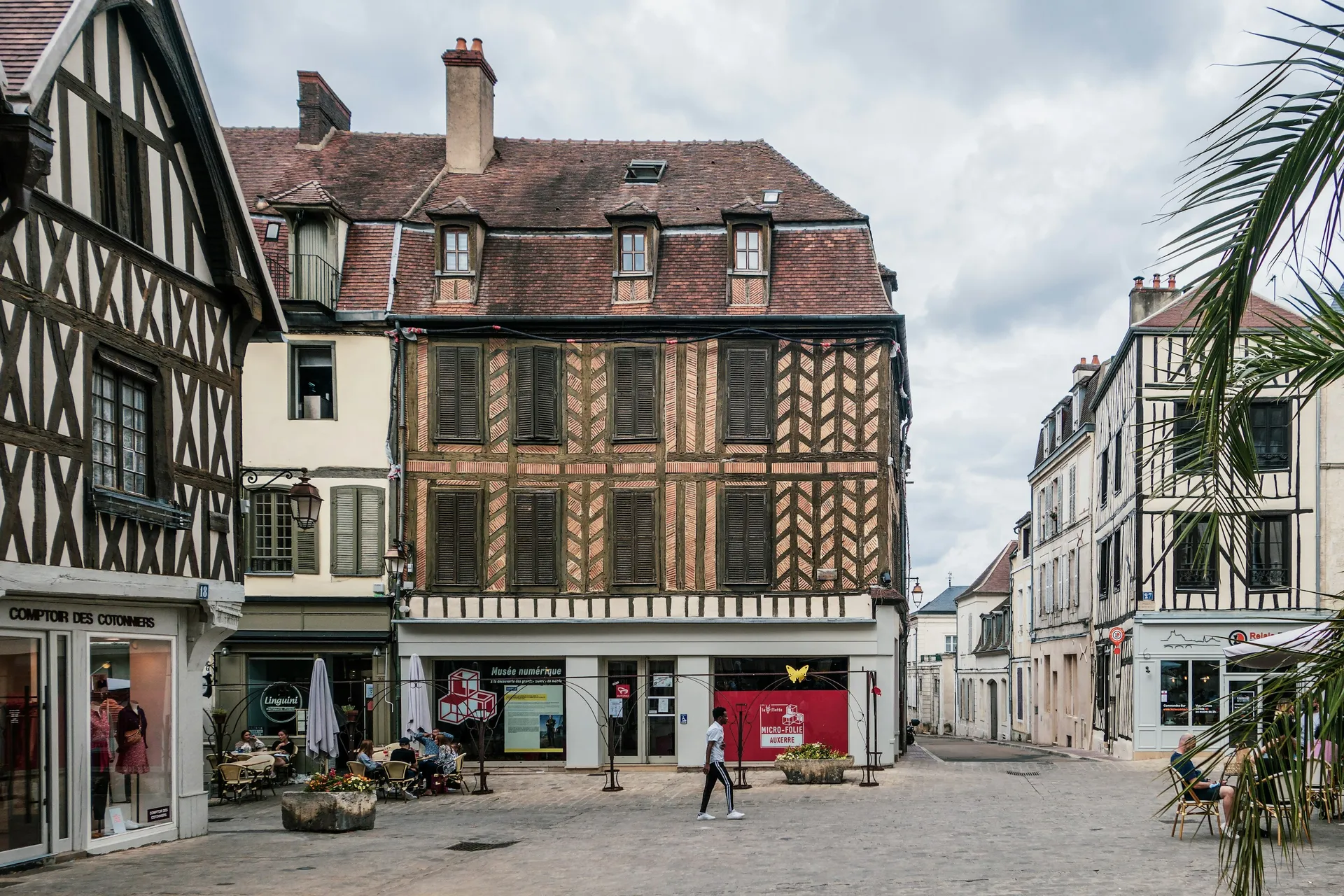
From above (the Saint-Pierre-et-Saint-Paul tower’s platform), the old town draws the shape that made it famous: a champagne cork. On the ground, it is a web of streets of 16th-century timber houses, courtyards and passageways — one of the largest preserved ensembles in France.
Cathédrale Saint-Pierre-et-Saint-Paul
The Flamboyant Gothic cathedral with an exceptional stained-glass ensemble — the 16th-century glass of Troyes’ workshops is among France’s finest, and the cathedral leads a circuit of nine churches (Sainte-Madeleine’s rood screen first among them) that the tourist office maps.
Ruelle des Chats and the lanes
The lane where the houses lean until the cats could cross roof to roof — the postcard of Troyes’ streetscape. Around it, the quarter’s courtyards, the Hôtel de Mauroy’s patterned facade, and the half-timbered hotels of the merchants who ran the Champagne fairs of the Middle Ages.
The Champagne fairs’ heritage
Troyes was one of medieval Europe’s trade-fair capitals, and the wealth shows: the bankers’ houses, the hospital’s wooden halls (Hôtel-Dieu-le-Comte), and the hosiery fortunes of later centuries — the city knitted France’s stockings, and the Musée de la Bonneterie tells it with working machines.
The Côte des Bar cellars
South and east of the city, the champagne region’s southern half: family growers’ cellars around Bar-sur-Seine, Les Riceys (three appellations in one village), and Buchères’ circuits — pinot noir country, sold at the cellar door at prices the avenue of Épernay forgot. Tastings by appointment; the champagne day trip guide covers the northern contrast.
The outlet villages
The modern Troyes ritual: two factory-outlet villages (McArthurGlen’s and Marques Avenue’s clusters) at the city’s edge, discounted French and international brands. The tourist office runs the shuttle logic; Saturdays bring Paris in buses.
The Hôtel de Mauroy and the tool museum
One lesser stop completes the city: the Hôtel de Mauroy, a 16th-century merchant’s house with a chessboard-pattern courtyard of brick and stone, now home to the tool museum (Maison de l’Outil), a large collection where the trades of pre-industrial Champagne are grouped by craft. The tool museum surprises children and carpenters alike; book the guided visit for the explanations the cases don’t give.
How two days fit
Day 1
- Morning: the Saint-Pierre tower’s platform first (to read the cork shape from above), then the cathedral’s glass.
- Midday: lunch in a timbered restaurant — andouillette for the convinced, chaource for everyone else.
- Afternoon: the nine-church circuit’s highlights and the ruelle des Chats’ lanes; the merchants’ courtyards between.
- Evening: the illuminated timber lanes after dinner — quietest after nine.
Day 2
- Morning: two Côte des Bar grower cellars by appointment (the tastings add up; eat between).
- Midday: Les Riceys’s three-appellation village; a village lunch.
- Afternoon: back in town — the hosiery museum’s machines, or the outlets’ afternoon discounts.
- Book ahead: the cellar appointments; the tower’s tickets in season.
🏘️ Neighborhoods and Where to Stay
- Old centre (inside the cork): timber at the window; small hotels and B&Bs; the choice.
- Saint-Jean quarter and around: quieter lanes, residential charm.
- Around the station: practical for Paris trains; a 10-minute walk to the cathedral.
- The outlet belt: budget hotels by the malls; for shoppers and drivers.
🍛 Typical Gastronomy
Champagne-region cooking with the city’s own stamps.
| Dish | Description | Where to try it | Tip |
|---|---|---|---|
| Andouillette de Troyes | The city’s famous (and challenging) tripe sausage. | Traditional tables | For the convinced; order it grilled with the local mustard. |
| Chaource | The creamy cow’s cheese of the region’s south. | Cheese shops, markets | At cellar temperature, with champagne — yes, it works. |
| Prunelle de Troyes | The city’s amber liqueur. | Cellars, bars | The digestif of the region. |
| Champagne | The drink, at grower prices. | Côte des Bar cellars | Buy where you taste; the growers ship. |
| Potée champenoise | Pork and cabbage, the rural classic. | Bistros | The lunch between two cellars. |
| Escargots de Champagne | Snails, the region’s festive classic. | Classic tables | In garlic butter, in season. |
🚌 Getting Around
From the airport. Paris’s airports via the Gare de l’Est line: Troyes is 1 h 30-2 h from Paris by regional and intercity trains. Compare transfers for late arrivals.
In town. The old town walks end to end; buses and the outlet shuttles cover the malls; bikes handle the canal paths.
Outward. Reims is 1 h 30 north by road (train via Paris or Châlons); the Côte des Bar villages need a car or a booked cellar tour.
The station sits west of the cork, a flat ten-minute walk to the cathedral; the outlet villages’ shuttles and their timetables live at the tourism office’s desk, worth confirming the day before a shopping run. For the Côte des Bar, the honest logistics are a car or a booked tour — the region’s buses exist but keep countryside hours.
🛡️ Safety and Common Scams
Troyes is a small, safe city.
- Pickpockets: the market days and the December market’s lanes.
- Outlet parking: opportunistic car break-ins exist — never leave purchases visible.
- Cellar roads: the Côte des Bar’s lanes are narrow; taste and drive on separate days.
Emergency number: 112.
✈️ Best Time to Visit
| Season | What to expect | Notes |
|---|---|---|
| Spring (April-June) | Mild, vines budding | The cellar circuit’s pleasant season |
| Summer (July-August) | Warm, timber in flower boxes | The lanes photograph best |
| Autumn (September-October) | Harvest, golden vines | Growers busiest; book tastings |
| Winter (late Nov-Dec) | Cold, the Christmas market | The timber lanes under lights |
For cellar weekends, book the grower visits ahead.
Pair Troyes with Reims for the northern champagne houses, Dijon and Burgundy south, or Paris for the return — the full map is in the France guide.