


Dijon
Dijon travel guide: the Dukes of Burgundy's capital, polychrome roofs and the owl trail, mustard and pain d'épices, the Route des Grands Crus wine villages.
Quick Facts
- Best time to visit
- April to June and September to October
- Budget per day
- $70 - $160 per day
🌎 Introduction
Dijon is the capital of Burgundy and was the capital of a state that rivaled kings: the Dukes of Burgundy ruled a European power from here, and the city still carries the swagger — a palace, a forest of towers, glazed rooftops in geometric colours, and a gastronomy that takes itself as seriously as the wine region at its doorstep. The Route des Grands Crus begins at the city’s edge; the mustard is world-famous; and the old town is a compact, cheerful maze.
This guide covers the city and the wine route’s start. Lyon is 1 h 40 south by train, Troyes and champagne two hours north.
🎟️ Tours and Activities
The essentials: the old town on foot (the owl trail is the way in), the palace and its museum, and the wine route — by car, bike or tour. You can browse tours and activities in Dijon: cellar visits in Gevrey-Chambertin and Nuits-Saint-Georges, bike rentals for the route’s flat first stretch, and Beaune day trips. Book the cellar visits ahead; the good ones are small.
Tip: the tourist office’s owl trail (a marked walk of around twenty stops named for the carved owl on a church wall — rub it for luck, everyone does) is the perfect first hour; the map is free at the office.
📷 What to See
Palais des Ducs and the Tour Philippe le Bon
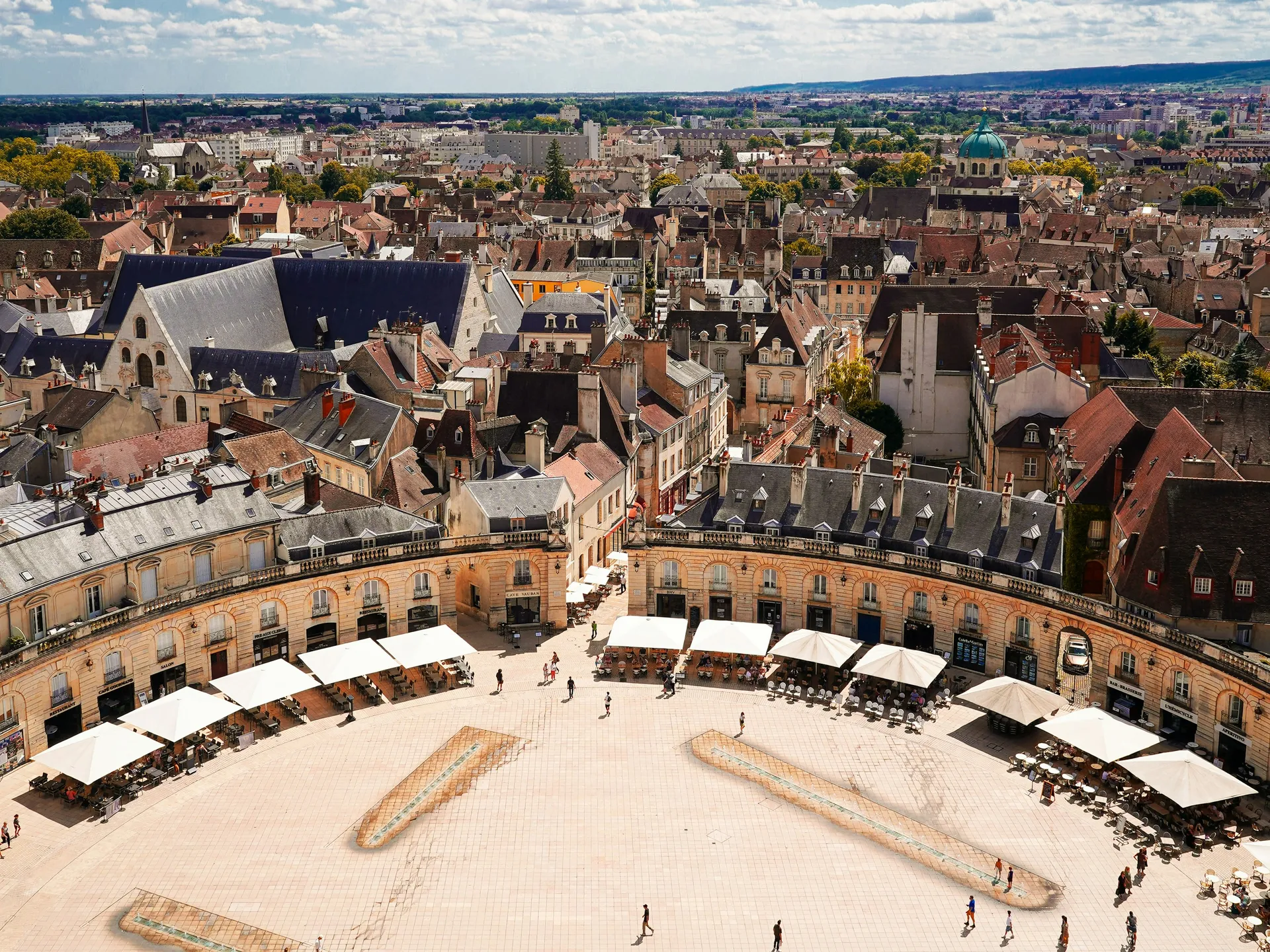
The ducal palace, now the town hall and fine-arts museum: courtyards of three centuries, the kitchens’ immense fireplaces, and the Philippe le Bon tower’s panorama (climbed by tour) over the polychrome rooftops — the glazed-tile geometry that is Burgundy’s signature, best understood from above.
The old town and the owl
The owl trail links the essentials: Saint-Michel’s facade, Notre-Dame’s triple-niche portal and its famous owl (worn smooth by centuries of wishes), the wooden-market streets, the mansions of the wine merchants. Dijon’s centre is walkable, golden and full — take the trail, then deviate.
The glazed rooftops
Burgundy’s multicoloured tile roofs — geometries of green, yellow and russet — crown the palace’s wings, the Hospices’ counterpart buildings, and rooftops across the centre. They are the region’s architectural signature (Beaune’s hospices own the famous version); Dijon shows them street-level and above.
The market and the food halls
The covered market (a 19th-century iron hall from Gustave Eiffel’s workshop) and the morning markets set up around it on fixed weekdays are Burgundy’s pantry: cheese, snails, bœuf, cassis, breads. The gastronomy continues in the Cité Internationale de la Gastronomie, the institution set in the old hospital and dedicated to French food culture.
Saint-Bénigne and the churches
The cathedral’s Gothic spire over a crypt of Romanesque stones; Saint-Philibert’s and Saint-Jean’s quieter fronts; and, out at the edge, the Chartreuse de Champmol’s Well of Moses — carved by Claus Sluter, the starting point of northern Renaissance sculpture, standing alone in a hospital courtyard.
The Route des Grands Crus
From Dijon’s southern edge, the wine route runs through the villages every label has taught you: Marsannay, Fixin, Gevrey-Chambertin, Vougeot, Nuits-Saint-Georges, to Beaune beyond. Cellars receive by appointment; bikes cover the flat stretch; the route’s tourist office maps the circuit.
The Cité de la Gastronomie and the owl’s lane
The Cité Internationale de la Gastronomie — set in the old hospital — takes French food seriously as culture: exhibits on the table’s arts, tastings, and a bookshop that doubles as a pantry. Ten minutes away, the rue de la Chouette (the owl’s own lane) keeps the old wood-turners’ workshops; the carved owl itself, worn smooth by wishes, sits in a corner of Notre-Dame’s north wall — the luck ritual is to touch it with the left hand, and the queue of hands has polished it into a small brown stone.
How two days fit
Day 1
- Morning: the owl trail’s loop (about ninety minutes at reading pace), then the palace’s courtyards and museum.
- Midday: the market halls’ lunch — œufs en meurette is the local midday classic.
- Afternoon: the Philippe le Bon tower’s tour (timed) for the rooftops; the Well of Moses at the edge before it closes.
- Evening: a bistro’s bœuf bourguignon, bottled Burgundy beside it.
Day 2
- Morning: the Grands Crus road south — Gevrey-Chambertin’s first cellar at ten, Vougeot’s château after.
- Midday: lunch in a wine village; Nuits-Saint-Georges’s second tasting after.
- Afternoon: Beaune’s hospices if the legs remain; the canal’s towpaths as the flat alternative.
- Book ahead: two cellar appointments as the day’s anchors; the tower’s timed tours.
🏘️ Neighborhoods and Where to Stay
- Centre historique: the owl trail at the door; small hotels in mansions and timber houses.
- Around the station: practical (Paris 1 h 35, Lyon 1 h 40); a 10-minute walk to the palace.
- Grésilles and other residential quarters: quieter, tram-quick in.
- Wine-route bases (Gevrey, Nuits): for slow wine weeks; the villages sleep early.
🍛 Typical Gastronomy
Burgundy’s table, the reference version.
| Dish | Description | Where to try it | Tip |
|---|---|---|---|
| Bœuf bourguignon | The beef-and-red-wine braise that needs no translation. | Traditional tables | Order it where the menu changes slowly. |
| Escargots de Bourgogne | Snails in garlic-parsley butter. | Classic tables | The festive classic; six to start. |
| Œufs en meurette | Eggs poached in red-wine sauce. | Bistros | The region’s brunch of the old world. |
| Pain d’épices | The spiced honey bread, Dijon’s centuries-old specialty. | Mulot et Petitjean’s house and bakers | Buy the loaf; it keeps for days and improves. |
| Mustard | The city’s world-famous condiment — seeded, flavoured, stone-ground. | Mustard shops | The shop tastings distinguish the styles. |
| Cassis | The blackcurrant in liqueur, sirop and crème. | Distillers, bars | The kir’s other half — try the blanc-cassis at the source. |
🚌 Getting Around
From the airport. Dijon’s small field takes little traffic; Paris and Lyon (1 h 35 / 1 h 40 by TGV) are the gateways. Compare transfers for late arrivals.
In town. The centre walks; two tram lines and buses cover the quarters; bikes extend to the canal and the first vineyards.
Outward. Trains south to Lyon and the Alps’ connections, north to Paris and Troyes; the wine route itself wants wheels — car, bike or booked tour.
The tram from the station solves the arrival in minutes, but the walk works too: the palace sits about ten flat minutes from the platforms, with the owl trail’s first markers en route. For the wine route, the rental-car cluster near the station is the usual pick-up; the bike alternative starts at the canal and joins the route’s flat first third.
🛡️ Safety and Common Scams
Dijon is a safe, well-kept city.
- Pickpockets: the market mornings and the palace square’s bustle.
- Restaurant touts: none famous; the good tables book anyway.
- Wine-route driving: the tastings add up — plan a driver or a tour.
Emergency number: 112.
✈️ Best Time to Visit
| Season | What to expect | Notes |
|---|---|---|
| Spring (April-June) | Mild, vines budding | The wine route’s pleasant season |
| Summer (July-August) | Warm, festivals | The route fills; book cellars |
| Autumn (September-October) | Harvest, golden vines | The region’s best window — and busiest |
| Winter (November-March) | Cold, the Christmas market | The chefs’ season; the hospices’ version is Beaune’s |
For cellar days and harvest weeks, book the wine tours ahead.
Pair Dijon with Lyon south, Troyes and champagne north, or Beaune and the vineyards immediately south — the full map is in the France guide.