


Rouen
Rouen travel guide: Monet's cathedral, the Gros-Horloge, half-timbered streets, Joan of Arc's square, the ceramics quarter and Normandy's capital city.
Quick Facts
- Best time to visit
- April to June and September to December for the market
- Budget per day
- $65 - $150 per day
🌎 Introduction
Rouen is Normandy’s capital and one of France’s great medieval cities: a forest of half-timbered houses around a cathedral that Monet painted in thirty canvases, a belfry clock that has struck the hours since the Renaissance, and the square where Joan of Arc’s story ended. An hour and a bit from Paris, it is the natural first stop of any Normandy trip — and a city that repays a full weekend on its own.
This guide covers the city. The region unfolds from it: Honfleur and the coast, the Mont-Saint-Michel a day west, and the Christmas market each December (see the markets guide).
🎟️ Tours and Activities
The essentials: the old town on foot (the timber lanes hide the best stories), the museums (the fine-arts museum is one of France’s best provincial collections), and the Seine loops by bike or boat. You can browse tours and activities in Rouen — walking tours with the Joan of Arc history, food tours of the market, and half-day trips into the Seine valley’s abbeys and gardens. In December, the market’s ferris wheel sells its views first.
Tip: the Rouen Pass bundles the monuments and museums; contents on the official tourism site. The cathedral’s light show — projected on the façade in summer evenings in most years — is the free evening event; check the city’s program.
📷 What to See
Rouen Cathedral
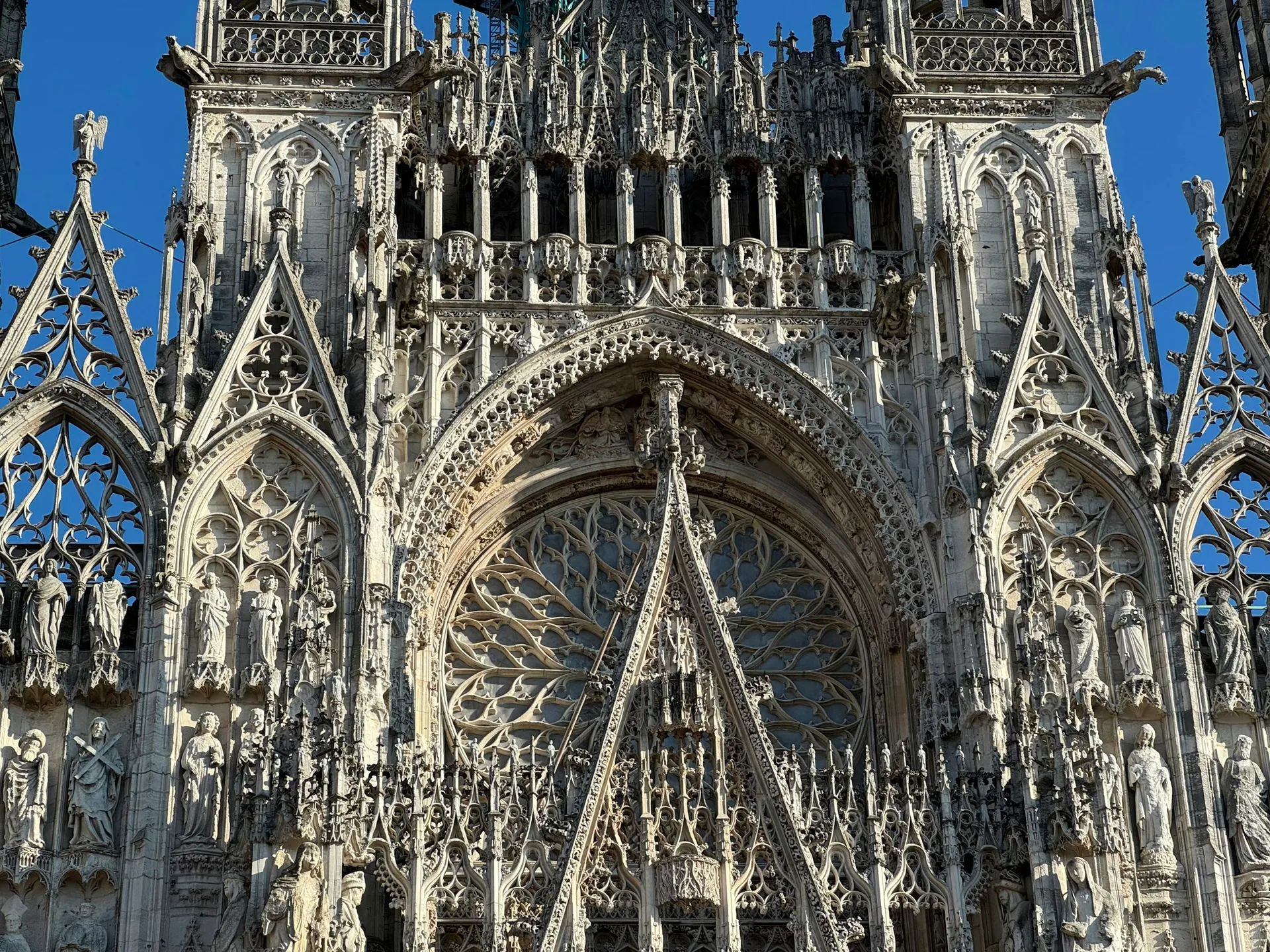
Monet’s obsession: the west front he painted at every hour, the Tour de Beurre, and the tallest cast-iron spire of France crowning the crossing. Inside, Richard the Lionheart’s heart rests in a tomb; outside, the façade plays light like an instrument.
Gros-Horloge
The Renaissance astronomical clock spanning its street on a Gothic belfry: one dial, centuries of striking. Walk under it, then up (the visit climbs the bell tower) for the old town’s rooftops.
The half-timbered old town
Rouen keeps some two thousand colombage houses: the rue du Gros-Horloge’s parade, the Saint-Maclou quarter’s painterly decline, the Place du Vieux-Marché’s restored rows. Get lost between them; the town is the sight.
Place du Vieux-Marché
The market square where Joan of Arc was burned in 1431: a modern church shaped like an upturned longboat beside the spot, the cross marking it, and the market’s covered food halls holding the gourmand life of the square.
Aître Saint-Maclou
The strangest cloister in France: a medieval charnel house whose wooden galleries are carved with danse-macabre figures — memento mori in oak, five minutes from the cathedral.
The museums
The Musée des Beaux-Arts (Caravaggio, Velázquez, Monet, Sisley — the Impressionists’ Seine valley), the Musée Le Secq des Tournelles’ ironwork oddity, and the National Ceramics Museum in the faience quarter (see below). Rainy Rouen is provided for.
Saint-Maclou church and the ceramics quarter
The flamboyant Saint-Maclou church anchors its quarter; in the streets nearby the ceramic tradition lives on — Rouen’s blue-and-red faience, its museum, and the shops still painting it.
The left bank and the panorama
Cross the river for the view that completes the visit: from the Saint-Sever side, the spire and the rooftops stack into the postcard the painters also chased. The Pierre-Corneille bridge’s walk, the modern library and the old hangars’ cultural quarter give the crossing its own hour, and the evening return over the Boieldieu bridge, lit below, closes the loop.
How two days fit
Day 1
- Morning: the cathedral’s façade in first light; the Gros-Horloge’s walk and tower before the street fills.
- Midday: the Vieux-Marché’s square, Joan’s story, lunch by the modern church.
- Afternoon: the fine-arts museum (closed Tuesdays) or the Aître’s carved galleries; both fit if the pace holds.
- Evening: dinner on a timbered lane — canard à la rouennaise for the ceremonial table.
Day 2
- Morning: Giverny’s gardens in season (train and bus; go at opening), or the ceramic quarter’s shops.
- Afternoon: the Seine loop’s abbeys by car, or the left bank’s museums if the weather argues.
- Book ahead: the tower’s timed tickets; December market weekends early.
🏘️ Neighborhoods and Where to Stay
- Old centre (cathedral to Vieux-Marché): the postcard at the door; small hotels in timber houses.
- Saint-Marcouf / Saint-Maclou quarter: quieter lanes, antiques and workshops.
- Around the station (Rive Droite): practical for Paris trains; a 10-minute walk to the cathedral.
- Left bank (Saint-Sever): modern and business-facing; cross-river views.
🍛 Typical Gastronomy
Norman cooking: butter, cream, apples and the sea’s nearness.
| Dish | Description | Where to try it | Tip |
|---|---|---|---|
| Canard à la rouennaise | Pressed duck in its own blood sauce — Rouen’s grande classique. | The city’s classic tables | Theatrical service; order for the table. |
| Sole meunière | Sole in Normandy butter, the Seine valley’s classic. | Traditional bistros | Simple and unbeatable. |
| Poulet vallée d’Auge | Chicken in cream and cider sauce. | Bistros | Normandy in a pan. |
| Teurgoule | Slow-baked cinnamon rice pudding. | Delis, markets | A peasant dessert gone cult. |
| Pommeau and Calvados | The apple apéritif and the apple brandy. | Cellars, bars | The Trou Normand’s two instruments. |
| Neufchâtel | Normandy’s heart-shaped cheese. | Cheese shops | The oldest Norman cheese; buy the heart. |
🚌 Getting Around
From the airport. Paris’s airports connect via the main line; Rouen’s own tiny field is irrelevant. Trains from Paris Saint-Lazare run frequently, reaching Rouen in about 1 h 10-1 h 30. Compare transfers if arriving from the coast.
In town. The centre walks end to end; the métro (a two-line light system) and buses cover the slopes and the left bank; bikes share the Seine paths.
Outward. Trains and buses fan out to the coast (Honfleur by bus, Le Havre by train), Giverny’s gardens (in season), and the abbeys of the Seine loop.
Arrival from Paris is the main event: the Saint-Lazare trains run roughly half-hourly through the day, and the station’s exit puts you about a ten-to-fifteen-minute walk from the cathedral. Drivers should park at the underground lots on the old town’s edge and stay pedestrian: the lanes were drawn for carts, not cars.
🛡️ Safety and Common Scams
Rouen is a safe mid-size city.
- Pickpockets: the rue du Gros-Horloge’s crowds and market days.
- Petition teams: the cathedral square; the standard refusal.
- Late-night river edges: quiet; the lit centre is the walk home.
Emergency number: 112.
✈️ Best Time to Visit
| Season | What to expect | Notes |
|---|---|---|
| Spring (April-June) | Mild, gardens opening (Giverny) | The classic window |
| Summer (July-August) | Warm, cathedral light shows | Check the summer program for projections |
| Autumn (September-November) | Golden timber, cider season | The markets fill with the harvest |
| Winter (late Nov-Dec) | Cold, festive, the Christmas market | One of Normandy’s biggest — see the markets guide |
For December weekends, book the ferris wheel and the classic tables early.
Pair Rouen with Honfleur and the coast, the Mont-Saint-Michel on the western day, or Giverny on the way — the full map is in the France guide.