


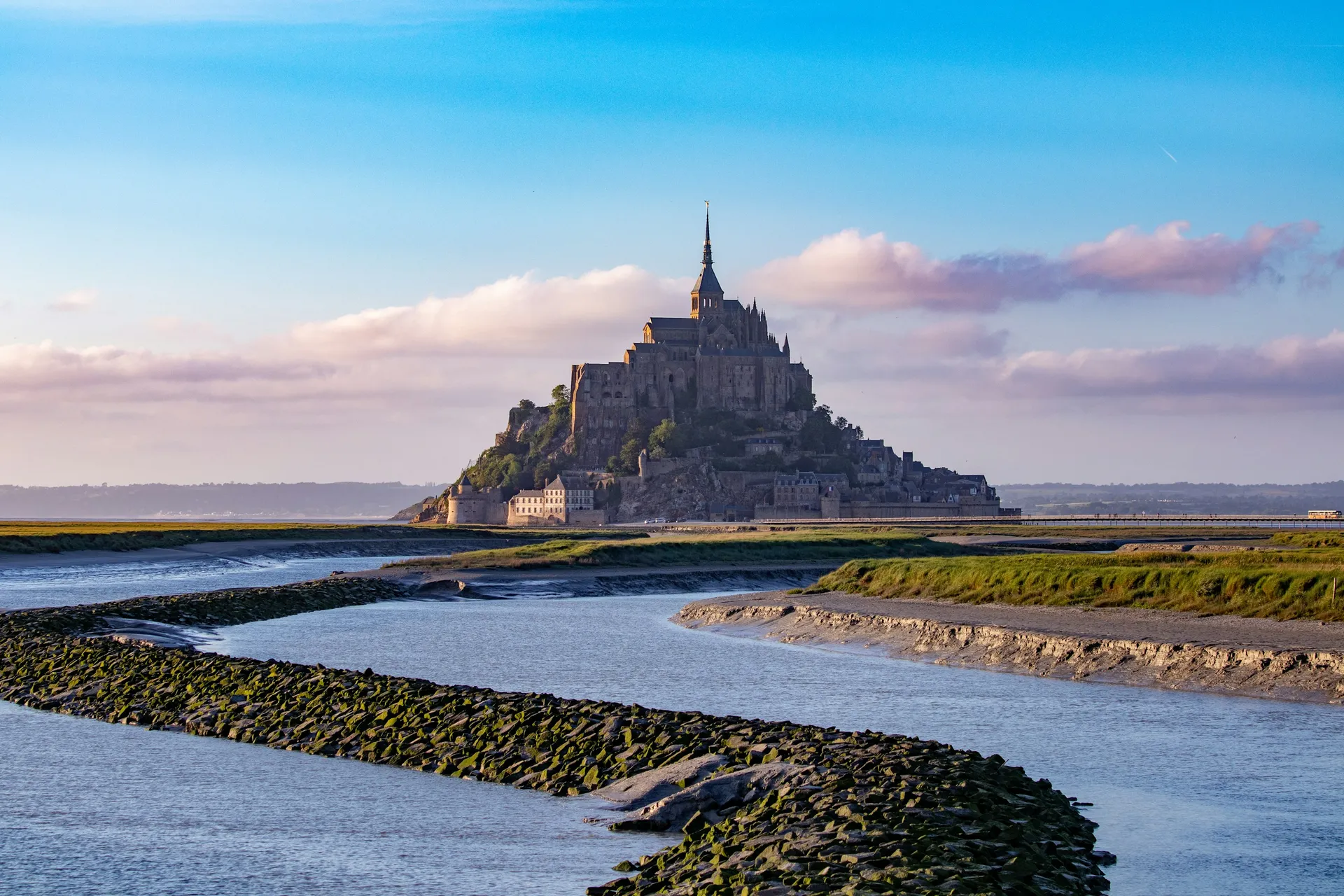
Mont-Saint-Michel
Mont-Saint-Michel travel guide: the abbey on its tidal island, the bay's great tides, the medieval street and how to plan it without the crowds.
Quick Facts
- Best time to visit
- April to June and September to October; any month for the tides
- Budget per day
- $70 - $170 per day
🌎 Introduction
The Mont-Saint-Michel needs no introduction and defeats most of them: a granite island a few hundred metres off the Normandy coast, crowned by an abbey a thousand years in the building, ringed by the highest tides in continental Europe, and visited by more people than almost any monument in France. The trick is not whether to come — it is how to see it as the marvel it is instead of the queue it can become.
This guide covers the mount, the bay and the planning. It anchors any Normandy trip: Rouen is about three hours east by road, Honfleur about two hours, and Saint-Malo’s walled corsair city sits just across the Breton border.
🎟️ Tours and Activities
The essentials: the abbey itself (the monument), and the bay crossings with a certified guide — walking the sands barefoot around the mount is the experience the tide makes unique. You can browse tours and activities around the Mont-Saint-Michel: guided abbey visits, bay walks at low tide, and day tours from Paris. Book the abbey’s timed entry online; the bay walks depend on the tide calendar, so dates are fixed by the sea. If you are building the trip around a Paris base, our day trips from Paris guide covers the honest logistics of the long day.
Tip: the tide tables are the trip’s real timetable — the official tourism site (mont-saint-michel-tourisme) and the abbey’s official pages publish them. The mount is fully an island only at the highest spring tides, a few days each month; plan around them if the enclosed mount is your dream, and never walk the bay without a guide.
📷 What to See
The abbey
The Gothic Benedictine abbey at the summit: the church’s platform, the cloister’s suspended garden, the refectory’s light, the giant’s wheel that hauled supplies. The architecture is the story of a thousand years of faith, engineering and stubbornness — take the guided visit or the audioguide; the walls explain themselves poorly.
The Grand Rue
The single medieval street spirals up from the gate: shops, crêperies, the crowds of midday. Walk it, then leave it immediately for the ramparts — the chemin de ronde gives the same climb with the bay’s panorama and a fraction of the people.
The ramparts and the lower paths
The fortified walls’ circuit is the quiet spine of the visit; below, the flats and the new bridge’s pedestrian causeway give the classic perspectives of the mount rising whole. The west terrace, by the abbey’s entrance, is the photograph at sunset.
The bay and its tides
The sea arrives, famously, “at the speed of a galloping horse” — a legend, but the tide’s range here (among the largest in the world) is real: the shoreline moves kilometres between low and high water. Watch it once from the shore: the sands empty, the channels fill, and the mount’s reflection begins.
The night mount
After the last coaches leave (and in summer, after the sound-and-light show on the abbey’s walls — schedules on the official site), the mount returns to being a village of thirty residents and a few hotels. Staying the night is the modern luxury here: the empty streets and the lit abbey are what the day-trippers never see.
Around the bay
The honest surroundings: the bay’s guided walks, the birdlife of the salt meadows, the mussels of the Vivier-sur-Mer beds, and Avranches’ Scriptorial with its medieval manuscripts looking down on the mount from its hill.
How two days fit (and why one is not enough)
Day 1
- Late afternoon: arrive as the coaches leave; walk the causeway in (35-40 minutes), take the abbey’s last timed entry.
- Evening: dinner in the lanes; the illuminated abbey from the west terrace after dark.
Day 2
- Early morning: the ramparts’ circuit and the bay’s first light — the mount at its emptiest.
- Mid-morning: the shore paths or the guided bay walk (the tide table fixes the hour), leaving as the queues form.
- Book ahead: abbey timed entries; the bay walks with certified guides; rooms — especially for the spring-tide dates — far out.
🏘️ Neighborhoods and Where to Stay
- On the mount (inside the walls): a handful of small historic hotels — the night-and-dawn experience; book far ahead.
- La Caserne (the shuttle causeway base): the practical modern cluster: hotels, parking, the free shuttle (and the 35-40 minute walk along the causeway).
- Beauvoir and the mainland villages: B&Bs and farms a few minutes out; the morning drive-in beats the shuttle.
- Saint-Malo side: sleep in Brittany’s corsair city and day-trip west-to-east against the flow.
🍛 Typical Gastronomy
Norman and Breton at the border — the bay’s own specialities first.
| Dish | Description | Where to try it | Tip |
|---|---|---|---|
| Omelette de la Mère Poulard | The famous whipped omelette, the mount’s century-old institution. | La Mère Poulard | A tourist rite with a real pedigree; go for the building’s history. |
| Agneau de pré-salé | Lamb grazed on the bay’s salt meadows, in season. | The area’s tables | Rare, seasonal, expensive — and genuinely local. |
| Moules de bouchot | Rope-grown mussels from the bay’s beds. | Vivier-sur-Mer and around | AOC-protected; order the marinière. |
| Crêpes and galettes | The Breton answer, just across the border. | The Grand Rue’s crêperies | A galette-saucisse from a market stall is the local’s version. |
| Cider and Calvados | Norman apples again. | Anywhere | The Trou Normand between courses. |
| Caramels d’Isigny | The region’s butter caramels. | Sweet shops | The edible souvenir that survives the trip. |
🚌 Getting Around
Getting there. No airport of its own: Paris is 3 h 30-4 h by car, or by train to Rennes or Pontorson and then a bus; from Rennes it is about 1 h 15 by bus. Day tours from Paris exist and suit tight schedules; a Normandy road trip suits everything else.
On site. Park at La Caserne (paid, large), then the free shuttle (with a stop at the dam viewpoint) or the causeway walk. The mount itself is pedestrian, cobbled and stepped — wear real shoes.
Outward. Saint-Malo is 45-50 minutes; Rouen about three hours; the D-Day beaches 1 h 30-2 h to the east.
🛡️ Safety and Common Scams
The mount is small and heavily visited; the risks are mostly logistical.
- Crowds: the Grand Rue at midday is pickpocket territory; the ramparts are calm.
- The bay is not a beach: quicksands and the tide’s speed are real — cross only with certified guides.
- Tide timing: the old car park at the foot of the mount, which the tide used to flood, is gone, but check the tide table before the walk along the footbridge: at the highest tides its last stretch can be covered for a while.
Emergency number: 112.
✈️ Best Time to Visit
| Season | What to expect | Notes |
|---|---|---|
| Spring (April-June) | Mild, lighter crowds | Long light for the bay |
| Summer (July-August) | Full, busy, luminous | Come early, stay late, or sleep on the mount |
| Autumn (September-October) | Golden, quieter | The bay’s light at its best |
| Winter (November-March) | Empty mornings, dramatic tides | The mount at its most itself; check the spring-tide dates |
For the abbey and bay walks, book the timed entries and guides ahead; the tide fixes the calendar.
Pair the Mont-Saint-Michel with Rouen and Honfleur on the Normandy loop, or Saint-Malo and Brittany west — the full map is in the France guide.