


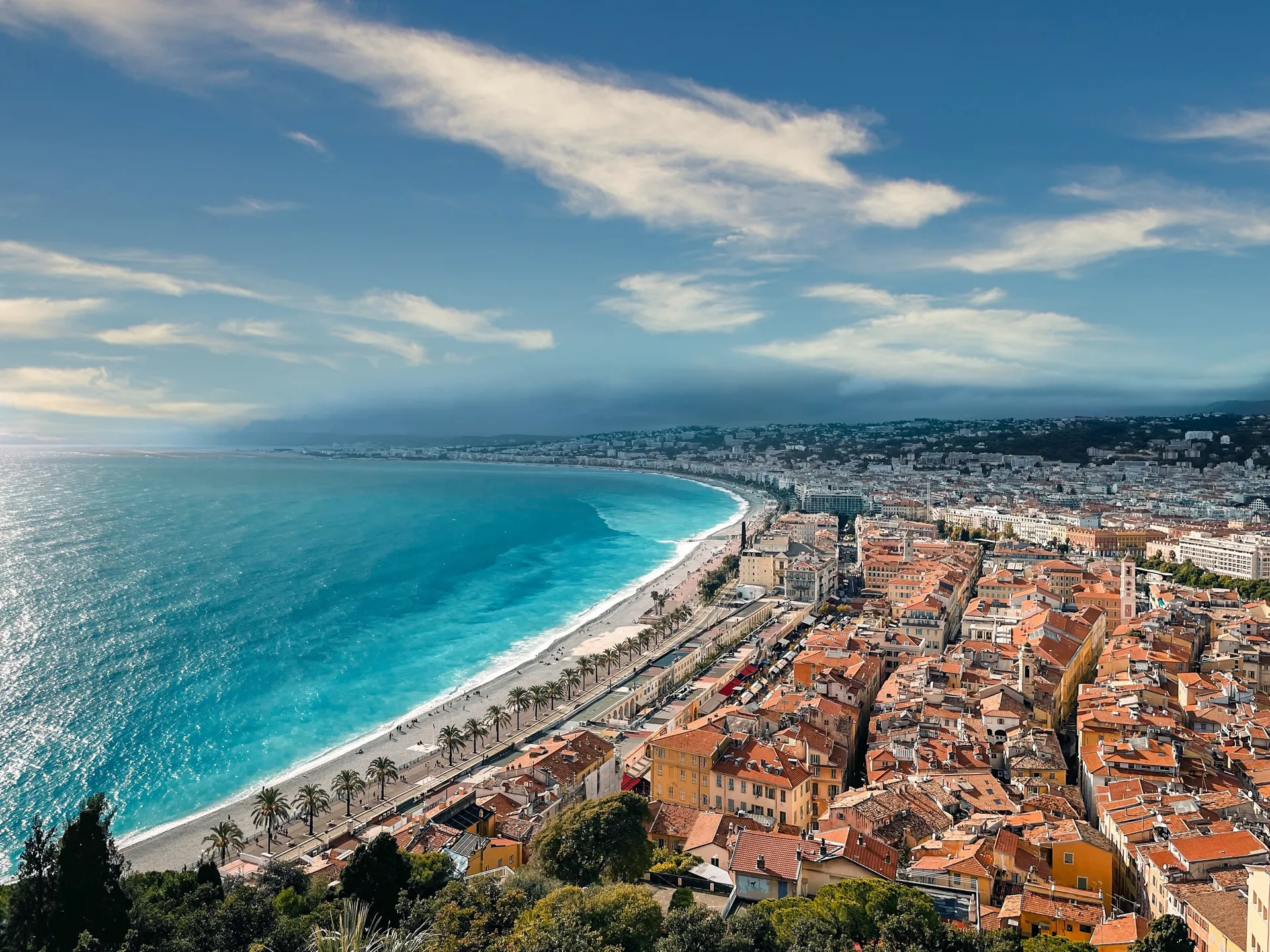
Nice
Nice travel guide: the Promenade des Anglais, Vieux Nice and Cours Saleya, Castle Hill, Matisse and Chagall, the Carnival and Riviera winter sun.
Quick Facts
- Best time to visit
- September to October for calm; February for the Carnival
- Budget per day
- $75 - $190 per day
🌎 Introduction
Nice is the capital of the French Riviera and its most complete city: a great crescent beach backed by a belle-époque promenade, an old town of lanes and markets, a chain of art museums, and flights that cost less than the train from Paris. Its winter secret deserves naming: while the Alps freeze an hour inland, Nice sits at spring temperatures, and February brings the Carnival — floats, flower battles and a party that has run since the 19th century.
It is also the region’s transport hub, which makes it the base for the hill villages and microstates east and the Cannes country west. To organize ahead, you can compare tours and activities in Nice before you travel.
🎟️ Tours and Activities
The essentials: the old town and food walks around Cours Saleya, the hop-on essentials along the bay, boat trips along the coast, perfume-workshop visits in Grasse country, and the trains and tours to Èze, Monaco and Menton. In February, book Carnival seats (the themed stands on Place Masséna) well ahead — the parade evenings sell out. In summer, the beaches’ paid sections take reservations; the free public ones do not.
Tip: the tourist train and the local buses climb Castle Hill and the viewpoints — the lazy and the smart arrive at the panorama without the stairs.
📷 What to See
Promenade des Anglais and the Baie des Anges
The seven-kilometre seafront is the city’s stage: blue chairs, palm rows, cyclists, joggers and the pebble beach that tourists learn to love by day two. Walk it at sunset from the airport end toward the castle for the full crescent.
Vieux Nice and Cours Saleya
The old town is a grid of ochre lanes with baroque churches, ice-cream institutions and socca griddles. Cours Saleya hosts the flower-and-food market on mornings (Mondays turn antiques) and restaurant terraces after dark — the city’s living room since the 18th century.
Castle Hill (Colline du Château)
The park on the hill between old town and port keeps the ruins of the citadel, a waterfall, playgrounds and the two definitive panoramas: the Baie des Anges west and the port east. Lift or stairs from the old town; the trains mentioned above cheat politely.
Place Masséna and the modern city
The red-ochre square with its checkerboard pavement and resident sculptures joins the old town to the modern centre and the tram lines. Around it: the pedestrian zone of rue Masséna, the big brands, and the Museum of Modern and Contemporary Art (MAMAC) a few blocks north.
Matisse and Chagall museums
On the Cimiez hill, the Matisse museum (in a 17th-century villa, with the artist’s late cut-outs) and the Chagall museum (the largest public collection of his biblical paintings) form the Riviera’s best art pairing; the nearby Franciscan monastery gardens look over the town.
The port and the eastern corniches
The Lympia port with its pastel facades starts the coastal road to Villefranche-sur-Mer and the three corniches — the high one the most scenic and Hitchcock’s — climbing to the perched village of Èze, whose stone lanes justify the trip alone.
🏘️ Neighborhoods and Where to Stay
- Vieux Nice: lanes, market, nightlife; small hotels, some street noise in summer.
- Around the Promenade (Carabacel / Musiciens): belle-époque apartment hotels between station and sea; the practical choice.
- Port Lympia: restaurants and calm, quick buses to Monaco; slightly off the beach circuit.
- Cimiez: museums, gardens, residential quiet; buses to the centre.
- Across the Paillon (Libération): local, cheaper, on the tram line — a budget answer with fast links.
🍛 Typical Gastronomy
Niçois cooking is Mediterranean with an Italian accent — olive oil, vegetables, anchovies.
| Dish | Description | Where to try it | Tip |
|---|---|---|---|
| Socca | Chickpea pancake baked in a wood oven, peppery, eaten hot at the counter. | Chez Pipo and the Cours Saleya griddles | A snack, not a course; order by the slice. |
| Salade niçoise | The real one: tomatoes, eggs, tuna or anchovies, olives, no cooked vegetables in the purist version. | Old-town bistros | Expect arguments about the recipe; that is the point. |
| Pissaladière | Caramelized onion, anchovy and olive tart on brioche-ish dough. | Bakeries and markets | The local breakfast of champions. |
| Pan bagnat | The salade niçoise as a sandwich, pressed and beach-ready. | Bakeries, takeaway counters | The picnic standard since the 19th century. |
| Tourte de blettes | Swiss-chard, pine-nut, raisin and apple pie — sweet and green and better than it sounds. | Old-town bakers | The dessert locals actually eat. |
| Glaces artisanales | Ice cream in improbable local flavours (olive, lavender, tomato). | Vieux Nice institutions | Queue where the queue is local. |
🚌 Getting Around
From the airport. Nice-Côte d’Azur connects to the centre by two tram lines (lines 2 and 3) in about 20-30 minutes; buses and taxis complete the offer. Compare airport transfers if you land late with family and luggage.
Trams and buses. The modern tram network stitches airport, station, old town and port; the coastal buses (such as the 100 to Monaco and Menton) are the budget Riviera’s secret weapon — exact fare or contactless, schedules on the official Lignes d’Azur site.
Trains. The coastal line runs west to Antibes, Cannes and Saint-Raphaël, east to Villefranche, Monaco and Menton-Italy; the station is a fair walk from the old town (or a couple of tram stops).
On foot. The centre between promenade and station fits on foot; the hills want buses or motivation.
🛡️ Safety and Common Scams
Nice is a safe city with Riviera-style petty crime in season.
- Pickpockets: Vieux Nice lanes, the market crush, the beach at midday and tram line 1 at peak — zipped bags, phone off the table.
- The three-shells and bracelet games: the promenade and Masséna corners, exactly as elsewhere; the crowd are accomplices.
- Restaurant touts with photo menus: one street back from Cours Saleya usually beats them.
- Beach theft: don’t leave bags while swimming; the free beaches have no lockers.
Emergency number: 112.
✈️ Best Time to Visit
| Season | What to expect | Notes |
|---|---|---|
| Spring (April-June) | Warm sea air, festivals begin | The locals’ favourite; book Carnival-adjacent dates early if bridging |
| Summer (July-August) | Hot, crowded, full beach season | Prices peak; day trips beat the midday city |
| Autumn (September-October) | Warm sea, golden light, calmer | Our favourite window overall |
| Winter (November-February) | Mild days (often 12-17 °C), quiet streets | The Nice Carnival runs about two to three weeks in February — dates on nicecarnaval.com; the city fills on parade nights |
Whenever you come, book the popular tours and the Carnival seats ahead.
Pair Nice with Marseille west along the coast, the Alps two hours inland — Chamonix for the high mountains — or Paris for the museums; the full map is in the France guide.