

Lille
Lille travel guide: the Grand Place and Vieux Lille, the Palais des Beaux-Arts, Wazemmes market, the Vauban Citadelle and its Flemish beer halls.
Quick Facts
- Best time to visit
- April to June and September to December for the market
- Budget per day
- $65 - $150 per day
🌎 Introduction
Lille is France with a Flemish accent: brick façades, beer served like a local religion, a grand square that feels Dutch, and a friendliness the south claims to own. An hour from Paris by train and less than two from London, it is the country’s most underrated city break — big enough for a first-rank museum and a real restaurant scene, small enough to walk in a weekend, and at its most atmospheric in December, when the Christmas market takes over the centre.
This guide covers what to see, where to stay, what to eat and how to move around. If you are planning the wider season, our Christmas markets in France guide covers Lille’s market in context; and you can compare tours and activities in Lille before you travel.
🎟️ Tours and Activities
Lille rewards a guide more than most French cities — its history is layered (Flemish, Spanish, French) and easy to miss. You can browse tours and activities in Lille: old-town walks, the regional-art highlights of the Palais des Beaux-Arts, bike rides along the Deûle, and day trips into Belgian Flanders. In season, the market area tours and the big wheel on the Grand Place sell first.
Tip: the Lille City Pass includes transport and museums; the current contents are on the official Lille tourism site. It pays for itself from the second museum onward.
📷 What to See
Grand Place and the Vieille Bourse
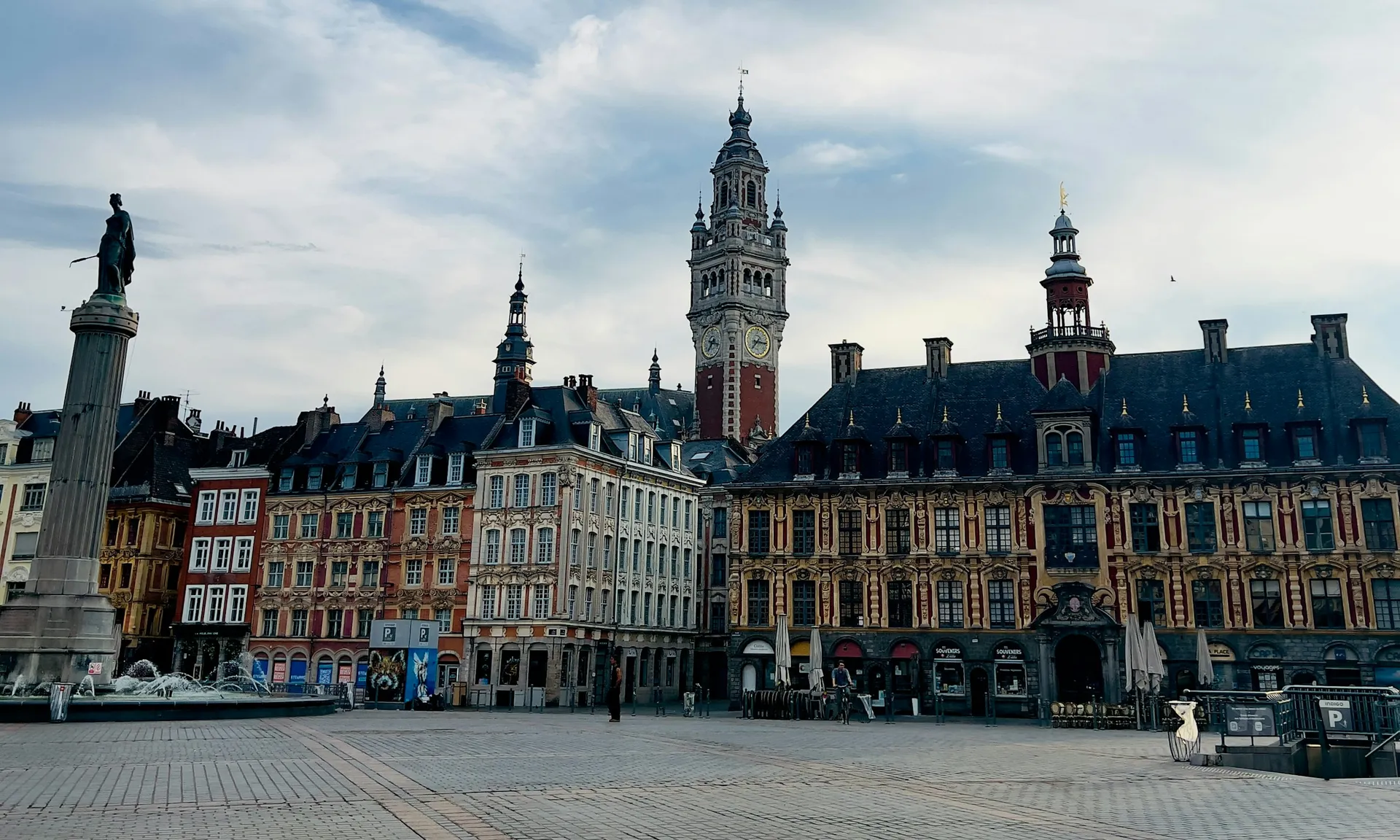
The official name is Place du Général de Gaulle (Lille’s most famous son), but everyone says Grand Place: the city’s living room, ringed by gabled houses and the old stock exchange. The Vieille Bourse’s inner courtyard, with its booksellers and chess players under painted ceilings, is the quiet heart of the visit.
Vieux Lille
North of the square, the old quarter is a maze of cobbled lanes, designer boutiques in 17th-century houses, and the city’s best estaminets. Rue de la Basse and the area around the cathedral are the atmosphere core; get deliberately lost once.
Palais des Beaux-Arts
One of France’s largest fine-arts museums, in a Belle Époque palace: Flemish and Dutch masters (Rubens, van Dyck), French painting from David to Delacroix, and a remarkable collection of relief maps of fortified towns. Two hours minimum; check the closing days on the official site.
Vieux Lille’s cathedral and the Hospice Comtesse
The neo-Gothic Notre-Dame de la Treille houses a modern bronze facade worth seeing; the Hospice Comtesse, the city’s 13th-century hospital turned museum, shows Flemish Lille at home — kitchens, ward halls, tiles.
Wazemmes
The working-class market quarter, east of the centre, hosts one of France’s biggest markets (Tuesday, Thursday and Sunday mornings): a full theatre of cheese, chips, lace and bargains. Sunday morning here is the city at its most itself.
The Citadelle and its park
Vauban’s star fortress (17th century), still military ground, sits in a ring of parkland designed for running and picnics. You cannot freely enter the fortress itself; you walk and admire the geometry — Vauban’s masterpiece pattern, exported across France.
LaM and the modern side
A metro ride out at Villeneuve-d’Ascq, the Lille Métropole museum holds one of Europe’s best modern-art collections (Modigliani, Picasso, Klee) plus an associated sculpture park. It repositions Lille for anyone who thinks it is only bricks.
How two days fit
Day 1
- Morning: Grand Place, the Vieille Bourse’s courtyard and the cathedral quarter — all close together on foot.
- Afternoon: Palais des Beaux-Arts (choose two wings), then tea in Vieux Lille.
- Evening: dinner in an estaminet — carbonade flamande, small glasses of the house beer.
Day 2
- Morning: Wazemmes market on Tuesday, Thursday or Sunday; any other day, the quarter’s streets still work.
- Midday: the Citadelle’s park loop, half an hour flat.
- Afternoon: LaM’s modern collection by metro, or the 35-minute train to Brussels.
- Book ahead: the museum’s temporary exhibitions; Sunday dinners — the good tables fill with families.
🏘️ Neighborhoods and Where to Stay
- Vieux Lille: the postcard at the door; boutiques and estaminets; the priciest beds and the quietest nights.
- Around the Grand Place: maximum walkability, business hotels, everything central.
- Wazemmes: authentic, market mornings included, a short metro hop from the centre; best value.
- Around the two stations (Lille-Flandres / Lille-Europe): practical for early trains and Eurostar; ordinary in the evening.
🍛 Typical Gastronomy
Nordic comfort food, cooked in beer and butter.
| Dish | Description | Where to try it | Tip |
|---|---|---|---|
| Welsh | Cheddar melted in beer with an egg on top, served with chips. | Estaminets | A whole meal; order once and share resistance is futile. |
| Carbonade flamande | Beef stewed in Flemish beer with onions. | Estaminets, brasseries | The classic — better than the welsh for first-timers. |
| Potjevleesch | Three meats set in jelly, served cold. | Traditional tables | The region’s oddball; ask for it in winter. |
| Merveilleux | Meringue and whipped cream rolled in chocolate shavings. | The city’s pastry specialists | The Lille sweet to take home. |
| Moules-frites | Mussels and chips, the market-day standard. | Any brasserie, Wazemmes first | Sunday after the market is the true service. |
| Bière du Nord | The local blonde, amber and brown ales. | Estaminets | Served in small glasses; ask for the house list. |
The estaminet — the Flemish tavern with wooden benches and chipped mugs — is the institution: dinner there is Lille in one sitting.
🚌 Getting Around
From the airport. Lille-Lesquin connects to the centre by shuttle in about 20 minutes; Paris Charles de Gaulle, with a direct TGV to Lille-Europe, and Brussels airport, with a train connection, are realistic alternatives.
Trains. Lille-Flandres (regional and Paris via TGV in about an hour) and Lille-Europe (Eurostar to London in about 1 h 20, Brussels in about 35 minutes) sit ten minutes apart on foot. This is Lille’s superpower: two countries, one weekend.
In town. Two driverless metro lines (VAL), trams and buses cover everything; the centre is walkable end to end. Bikes share the flat streets.
🛡️ Safety and Common Scams
Lille is a safe, student-heavy city; the cautions are small.
- Pickpockets: the Grand Place on market and event evenings, and the Wazemmes crush on Sundays.
- Late-night quarter: the area around the stations gets quiet after business hours; normal city care.
- Market scams: none famous — just count your change on the busy stalls.
Emergency number: 112.
✈️ Best Time to Visit
| Season | What to expect | Notes |
|---|---|---|
| Spring (April-June) | Mild, terraces out | The pleasant walking season |
| Summer (July-August) | Warm, festivals, day trips into Flanders | Bruges and Ghent add themselves |
| Autumn (September-November) | Cool, cultural season, the Braderie | Europe’s biggest flea market (first weekend of September, dates on the official site) |
| Winter (late Nov-Dec) | Cold, festive, the Christmas market | See the Christmas markets guide |
For the December weeks, book the popular tables and the big wheel a few days ahead.
Pair Lille with Reims for champagne, Metz across the east, or Brussels just over the border — and see the France guide for the whole map.