


Metz
Metz travel guide: Saint-Étienne cathedral and its Chagall glass, the Centre Pompidou-Metz, the imperial German quarter, the Moselle and the Christmas market.
Quick Facts
- Best time to visit
- April to June and September to December for the market
- Budget per day
- $65 - $150 per day
🌎 Introduction
Metz is Lorraine’s capital and a city of two golden ages: the medieval one, which built a cathedral with one of the largest expanses of stained glass in France, and the German imperial one, which annexed the city in 1871 and endowed it with a quarter of grandiose architecture unmatched in France. The third age is recent: the Centre Pompidou-Metz opened in 2010 and turned the city into a modern-art destination an 80-minute train ride from Paris.
Compact, green (the city claims one of France’s highest ratios of parkland) and seriously underrated, Metz rewards a weekend. Its Christmas market is among the oldest in France — see our Christmas markets guide for the season; Strasbourg and Alsace complete the eastern loop.
🎟️ Tours and Activities
The essentials: the cathedral and its glass, the Pompidou-Metz’s exhibitions, and the old town’s layers — medieval, French classical, German imperial. You can browse tours and activities in Metz: guided city walks, the Pompidou’s guided visits, and river circuits on the Moselle. In December, the market’s guided evenings and the craft workshops sell first.
Tip: the Pompidou-Metz’s exhibition calendar rotates constantly — check what’s on before you plan the day. The tourism office’s city pass bundles museums and transport; current contents on the official site.
📷 What to See
Cathédrale Saint-Étienne
The Gothic cathedral whose stained glass covers some 6,500 m² (one of the largest glass expanses in any French church): medieval glass, modern glass by Villon and, in the axial chapel, Chagall’s deep-blue Genesis. Climbing the tower (in season) repays the town’s rooftops in tiled patterns.
Centre Pompidou-Metz
The satellite of Paris’s modern-art temple: a swooping roof of timber weave over galleries that host rotating exhibitions of the national collections. The architecture alone justifies the trip; the programme usually doubles it.
Place de la Comédie and the old town
The theatre square by the cathedral, the Place Saint-Louis’s arcaded merchants’ square (the medieval bankers’ quarter), and the lanes between: golden Jaumont stone, café terraces, the covered market’s food halls. The old town walks in a happy hour.
The imperial German quarter
After 1870, the German empire built a showcase city: the monumental train station (one of Europe’s grandest, with its great hall and its park), the post office’s German-style architecture, the boulevards’ official architecture — a Berlin-in-Lorraine quarter that is unique in France. Walk the avenue Foch and the station’s surroundings with your eyes open.
The Moselle, the gardens and the temples
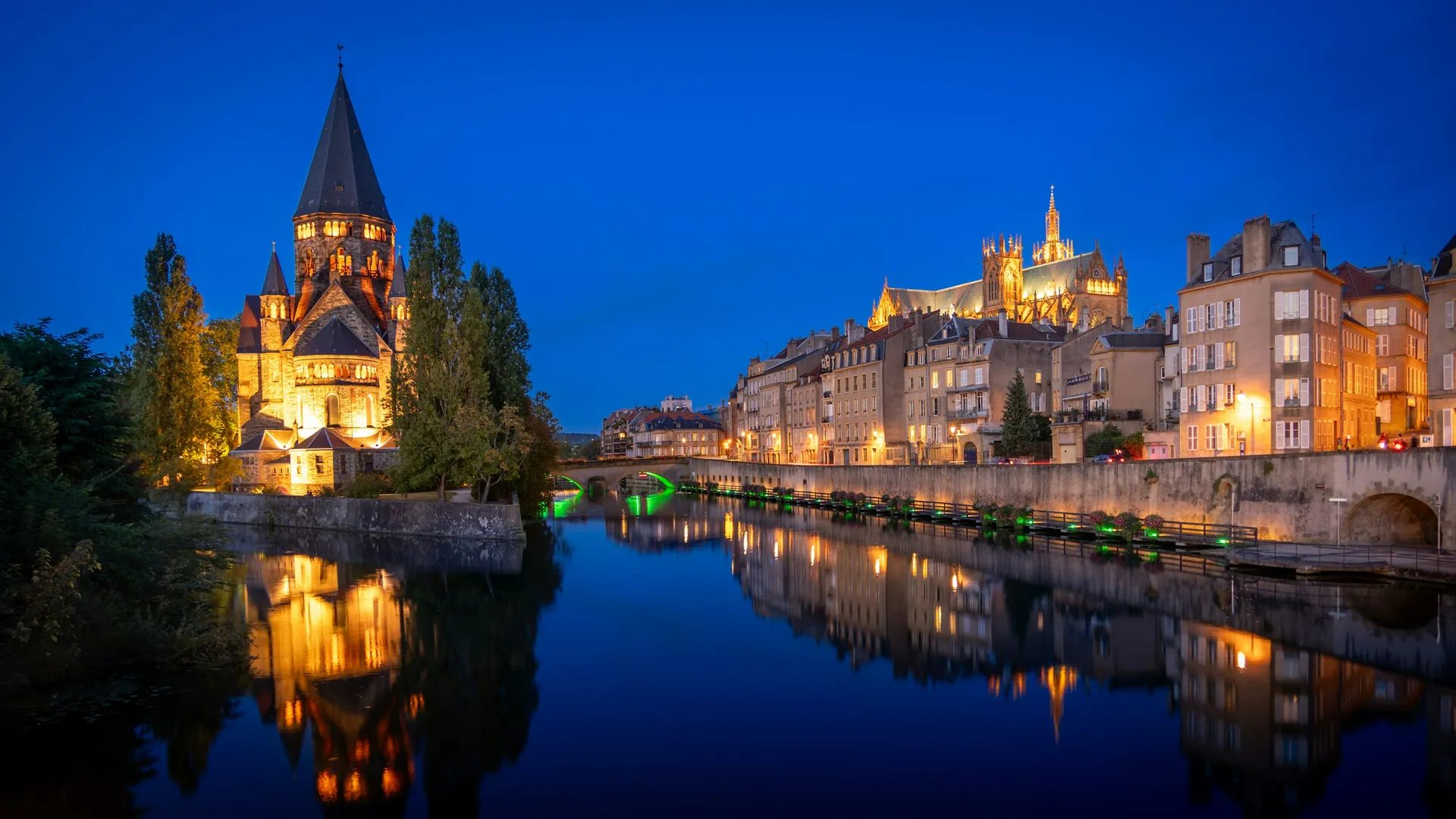
The river splits around the old town; its islands hold gardens — the Esplanade’s ramparts walk, the Plan d’Eau park’s lake, the Botanical Gardens’ oldest trees. The Protestant temple and the synagogue (one of the largest in France, visit hours on the official site) speak the city’s mixed history.
Porte des Allemands and the walls
The double-towered medieval gate where the walls’ riverside walk begins: the city’s most photographed monument after the cathedral, and the start of a green loop along the Seille.
The Arsenal and the evening city
The Arsenal — a concert hall created in 1989 inside a converted arsenal — programmes the city’s classical music, from symphony to chamber seasons, in a brick vault with more than a thousand seats. Around it, the evening Metz: the Comédie’s lights, the rue Taison’s restaurants, and the Moselle’s banks doing their nightly illumination — a small city that keeps its culture within a ten-minute radius.
How two days fit
Day 1
- Morning: the cathedral’s glass (the Chagall chapel last, with the sun high), then the Saint-Louis square’s arcades.
- Midday: the covered market’s lunch — quiche lorraine’s home turf — and the old town’s lanes.
- Afternoon: the Pompidou-Metz’s exhibitions until closing.
- Evening: the Moselle’s gardens and the Esplanade’s walls as the riverside lights come on.
Day 2
- Morning: the imperial quarter’s grandeur — the station’s hall first, then the avenue Foch’s façades.
- Midday: the Porte des Allemands and the walls’ waterside walk.
- Afternoon: the botanical gardens’ loop, or Nancy’s Stanislas square by train (forty minutes) for the rococo contrast.
- Book ahead: the Pompidou’s timed slots; December market evenings.
🏘️ Neighborhoods and Where to Stay
- Old centre (cathedral / Comédie): everything at the door; small hotels in stone houses.
- Around the station (imperial quarter): grand architecture, practical for trains; a 10-15 minute walk to the cathedral.
- Sablon: the quiet south, gardens and families; bus-quick to the centre.
- Borny / outskirts: modern budget hotels; drive-in practicality.
🍛 Typical Gastronomy
Lorraine’s table, between French and German kitchens.
| Dish | Description | Where to try it | Tip |
|---|---|---|---|
| Quiche lorraine | The region’s world export — here with bacon and cream, no cheese. | Traditional tables | The original has no cheese; trust the local version. |
| Potée lorraine | Pork and cabbage stew, the farmhouse classic. | Bistros | Sunday lunch’s honest answer. |
| Mirabelles | The Lorraine plum, in eau-de-vie, jams and tarts. | Markets, distillers | The mirabelle tart in season is the region on a plate. |
| Bouchée à la reine | The vol-au-vent of Lorraine’s kitchens. | Classic tables | Comfort food of the old school. |
| Lorraine wines | The Moselle’s small vineyards’ whites and gris. | Wine shops | Tiny production; ask what’s local this year. |
| Madeleines | The shell-shaped cakes, Commercy’s gift to the world. | Bakeries | Fresh, warm if you can find them. |
🚌 Getting Around
From the airport. Metz-Nancy-Lorraine takes regional traffic; Luxembourg and Paris (via the TGV Est, Metz to Paris in about 80-90 minutes) are the practical gateways. Compare transfers for late arrivals.
In town. The centre walks; buses cover the hills and the outskirts; the two stations (city and TGV, linked by bus and train) frame the town.
Outward. Nancy’s Stanislas square is 40 minutes by train; Luxembourg 60; Strasbourg and the Alsace route two hours east — see the Alsace Christmas markets route for the seasonal plan.
The two stations confuse newcomers: Metz-Ville is the centre’s imperial terminus, while the TGV station (Lorraine) sits out at Louvigny with shuttle connections — check which one your train uses before the day of travel, since Metz-Ville also receives TGVs. From Metz-Ville, the cathedral is a straight ten-minute walk through the Sablon’s edge; from the TGV side, the bus’s timetable is the plan.
🛡️ Safety and Common Scams
Metz is a calm, mid-size city.
- Pickpockets: the market season’s crowds and the station’s bustle; standard care.
- Late-night station zone: the usual quiet-after-business; the centre is the walk home.
- River paths: lit and pleasant; the far loops are dark — bring company.
Emergency number: 112.
✈️ Best Time to Visit
| Season | What to expect | Notes |
|---|---|---|
| Spring (April-June) | Mild, gardens out | The parks’ season |
| Summer (July-August) | Warm, riverside life | The Moselle’s terraces fill |
| Autumn (September-November) | Golden stone, exhibition season | The Pompidou’s calendar peaks |
| Winter (late Nov-Dec) | Cold, festive, the Christmas market | One of France’s oldest — see the markets guide |
For December weekends, book the market tours and museum slots early.
Pair Metz with Strasbourg and the Alsace route east, Nancy’s rococo square south, or Luxembourg north — the full map is in the France guide.