


Avignon
Avignon travel guide: the Popes' Palace and its bridge, the ramparts, the July theatre festival, Côtes du Rhône wines and the Luberon and Ventoux countryside.
Quick Facts
- Best time to visit
- April to June and September to October; July for the festival
- Budget per day
- $65 - $150 per day
🌎 Introduction
Avignon is the city where the papacy moved in the 14th century and never quite packed up: a walled city on the Rhône with one of the great Gothic palaces of Europe at its centre, a bridge famous for a children’s song about dancing on it, and a theatre festival each July that turns the whole town into a stage. Compact, sunlit and southern, it is the natural base for Provence’s western side.
This guide covers the city and its rhythms. For the region in the cold half of the year, our Provence in winter guide covers the traditions; the coast lies a little over an hour south in Marseille.
🎟️ Tours and Activities
The essentials: the palace with an audio guide (allow half a day honestly), wine tours into Châteauneuf-du-Pape and the Côtes du Rhône, and the festival’s “Off” programme in July. You can browse tours and activities in Avignon — palace and bridge combos, wine country days, kayak on the Rhône and lavender-season trips (June-July, before the cut). Book festival-month everything early: the town doubles.
Tip: the Avignon Passion pass discounts the monuments; contents on the official tourism site. And check the palace’s exhibition calendar — its summer shows are worth timing a visit around.
📷 What to See
Palais des Papes
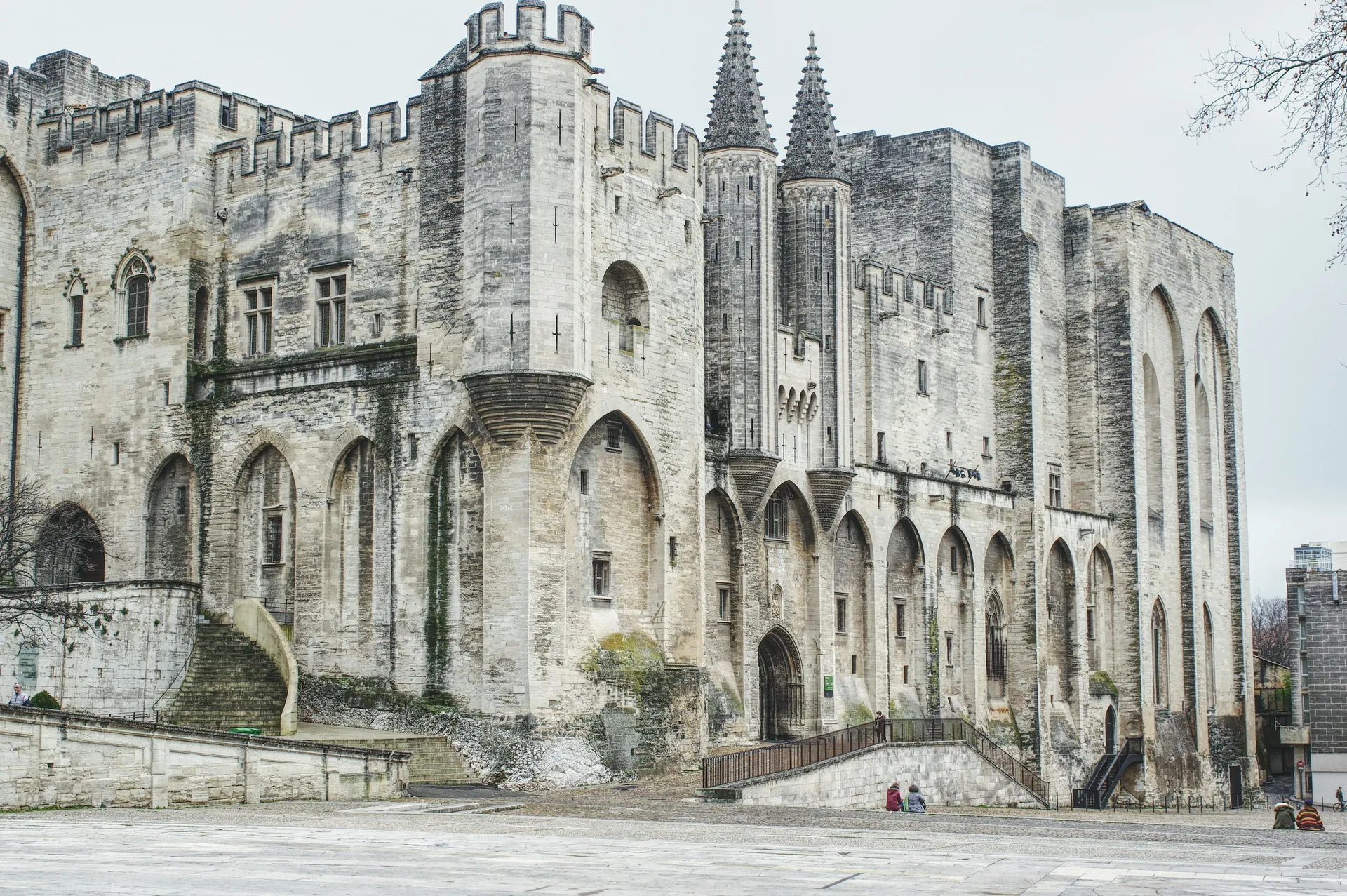
The largest Gothic palace in Europe, built in decades of papal splendour in the 14th century: cavernous halls, frescoed chapels, terraces over the Rhône. It is architecture as political theatre, and the audio tour is genuinely good. Climb to the terraces for the Ventoux on the horizon.
Pont Saint-Bénézet
The bridge of “sur le pont d’Avignon” fame — four surviving arches of a bridge that once spanned the Rhône, ending mid-river at the Bénézet chapel. The song is better known than the history; the walk out is short and the river views are the point.
The ramparts and Rocher des Doms
Avignon keeps its full circuit of 14th-century walls — nearly five kilometres, pierced by gates. Inside, the Rocher des Doms park climbs above the palace with gardens and the classic view over the bridge, the Rhône and Villeneuve’s fort towers.
Place de l’Horloge and the old town
The café square between the palace and the town hall, carousel included, anchors lanes of mansions, bookshops and the petit palais museum (its Italian primitives are the quiet masterpiece). The old town is walked, not visited.
The festival city (July)
Each July, the Festival d’Avignon transforms the town: the official programme in the palace courtyard’s Honour Court, and the “Off” everywhere — a thousand shows in every church, courtyard and garage. Dates and programmes are published on the official festival sites each season; the town books out months ahead.
Across the river: Villeneuve-lès-Avignon
The cardinals’ city across the Rhône answers with its fort (Tour Philippe-le-Bel) and charterhouse — quieter, monumental, and the best view back at Avignon’s skyline.
The bridges of the everyday city
Beyond the famous ruin, Avignon’s river crossings tell the city’s story: the Pont Édouard-Daladier’s modern span, the seasonal Barthelasse island shuttle that ferries walkers to the island’s orchards and swimming lane, and the riverbank paths on both sides that make the Rhône the town’s park. On summer evenings the south bank fills with the guinguettes — open-air bars and food stalls — that put the festival city’s other face on the water.
How two days fit
Day 1
- Morning: the Palais des Papes first (timed entry; two hours with the terraces), the bridge before the queues build.
- Afternoon: the old town’s lanes and the petit palais museum; the Rocher des Doms as the light drops.
- Evening: dinner inside the walls — daube provençale and a Côtes du Rhône.
Day 2
- Morning: the wine villages by tour or car — Châteauneuf-du-Pape’s cellars take bookings from ten.
- Afternoon: Villeneuve’s fort tower and charterhouse across the river; back for the Horloge’s café hour.
- Book ahead: palace entries in season; everything — rooms, tables, shows — for July’s festival weeks.
🏘️ Neighborhoods and Where to Stay
- Inside the walls (centre): everything at the door; the practical first choice; festival months are loud and full.
- Horloge / palace quarter: atmospheric lanes, small hotels, steps everywhere.
- Station-side (Centre-ville sud): convenient for the TGV link and cheaper; a 10-15 minute walk to the palace.
- Across the bridge (Villeneuve): calm, views, and parking peace.
🍛 Typical Gastronomy
Provençal cooking with a papal-city richness.
| Dish | Description | Where to try it | Tip |
|---|---|---|---|
| Papeton d’aubergine | Eggplant flan with tomato coulis, an Avignon classic. | Traditional tables | The local dish visitors never discover. |
| Daube provençale | Beef braised in red wine with olives and orange peel. | Bistros | Order it with Côtes du Rhône — the region in one plate-glass. |
| Soupe au pistou | Vegetable soup with basil-garlic pesto. | Family tables | Summer’s starter. |
| Fougasse | The Provençal flatbread, plain or studded. | Bakeries | Morning fuel for the ramparts walk. |
| Côtes du Rhône | The local reds (and whites), from village to Châteauneuf level. | Wine bars, cellars | Ask for a tasting flight of the villages. |
| Berlingots and fruits confits | Carpentras-style sweets at the city’s shops. | Sweet shops | The edible souvenir tradition. |
🚌 Getting Around
From the airport. Avignon’s small airport takes seasonal traffic; Marseille and Nîmes are the practical gateways, and the TGV station (outside the centre, linked by shuttle) connects to Paris in about 2 h 40. Compare transfers for late arrivals.
In town. Everything inside the walls walks; the shuttle links the TGV station; bikes extend to Villeneuve and the river paths.
Outward. Trains and buses cover the region: Arles in half an hour, Orange’s Roman theatre, the Luberon and Ventoux by tour or car — our trains in France guide covers the regional logic.
Arrival logistics deserve five minutes of planning: the high-speed station (Avignon TGV) sits outside the walls, linked by a frequent shuttle whose last runs end earlier than you expect; the centre’s station (Avignon Centre) walks to everything but takes regional lines. Drivers should note that the intra-muros parking is scarce and resident-weighted — the paid lots at the walls’ gates, or across the river in Villeneuve, are the honest plan.
🛡️ Safety and Common Scams
Avignon is a safe mid-size city with a seasonal crush.
- Pickpockets: the palace square and the main street (rue de la République) at rush and festival times.
- Festival ticket touts: buy “Off” shows at the official venues, not from street resellers.
- River paths at night: the Rhône banks are calm but dim; the lit streets are the walk home.
Emergency number: 112.
✈️ Best Time to Visit
| Season | What to expect | Notes |
|---|---|---|
| Spring (April-June) | Mild, lavender approaching, terraces out | The sweet window; book early for May |
| Summer (July-August) | Hot, festival takeover, crowds | July’s Festival d’Avignon (official sites for dates) is the reason — or the reason to wait |
| Autumn (September-October) | Warm, harvest, quiet | Wine country at its best |
| Winter (November-March) | Bright, mistral, museums | The santon season and Provence in winter |
For the festival, book the palace, bridge and wine tours weeks ahead.
Pair Avignon with Marseille and the coast south, Aix across the plain, or the Roman towns around — the full map is in the France guide.