


Aix-en-Provence
Aix-en-Provence travel guide: the Cours Mirabeau and its fountains, Cézanne's atelier and Sainte-Victoire, markets, the Mazarin quarter and calissons.
Quick Facts
- Best time to visit
- April to June and September to October
- Budget per day
- $70 - $170 per day
🌎 Introduction
Aix-en-Provence is Provence polished: a baroque city of fountains, plane-tree squares and golden stone where Cézanne was born, painted and never really left, and where the good life — markets, café terraces, a certain unhurried elegance — is the municipal religion. It is the classiest base in the region: smaller than Marseille’s energy, grander than Avignon’s medievalism.
This guide covers the city and Cézanne’s mountain. For the wider season and its traditions, our Provence in winter guide covers the ground; Marseille and the sea lie 40 minutes south.
🎟️ Tours and Activities
The essentials: Cézanne’s route (the atelier, the bibémus quarries, Sainte-Victoire viewpoints), the markets with a food guide, and wine days in the Palette and Luberon vineyards nearby. You can browse tours and activities in Aix — walking tours, e-bike rides toward the mountain, and lavender-season trips (the plateaux bloom roughly mid-June to mid-July; check before promising it). Book the atelier’s timed entry in season.
Tip: the Aix City Pass (contents on the official tourism site) covers the main museums and transport; but Aix’s real “activity” is free — the morning market and a terrace on the Cours Mirabeau.
📷 What to See
Cours Mirabeau
The 17th-century plane-lined avenue splits old town from Mazarin quarter, fountains spaced like punctuation: the hot-water fountain (34 °C, the thermal source that founded the city), the king René’s fountain with its grapes. The terraces fill by ten; the morning belongs to the light.
The old town’s markets
The city’s engine: the food market on Place Richelme runs daily (Sunday is the loudest), the flower and produce market on Place des Prêcheurs and the Palais de Justice squares on set days, and the book market rotates through. Aix at market hour is the Aix of the postcards.
Cézanne’s atelier and the bibémus quarries
The studio on the hillside des Lauves is preserved as the painter left it — the objects of his still-lifes on the shelves, the light from the north window. The red-and-gold bibémus quarries, where he painted, visit by guided tour. Together they explain the city’s most stubborn relationship.
Sainte-Victoire
The white limestone ridge east of the city, painted by Cézanne dozens of times, walked by everyone since. Trails rise from Le Tholonet and Vauvenargues (Picasso’s castle and grave, closed but present); the plateau paths and the crossing are full-day walks for the prepared — see the practical notes below.
The Mazarin quarter
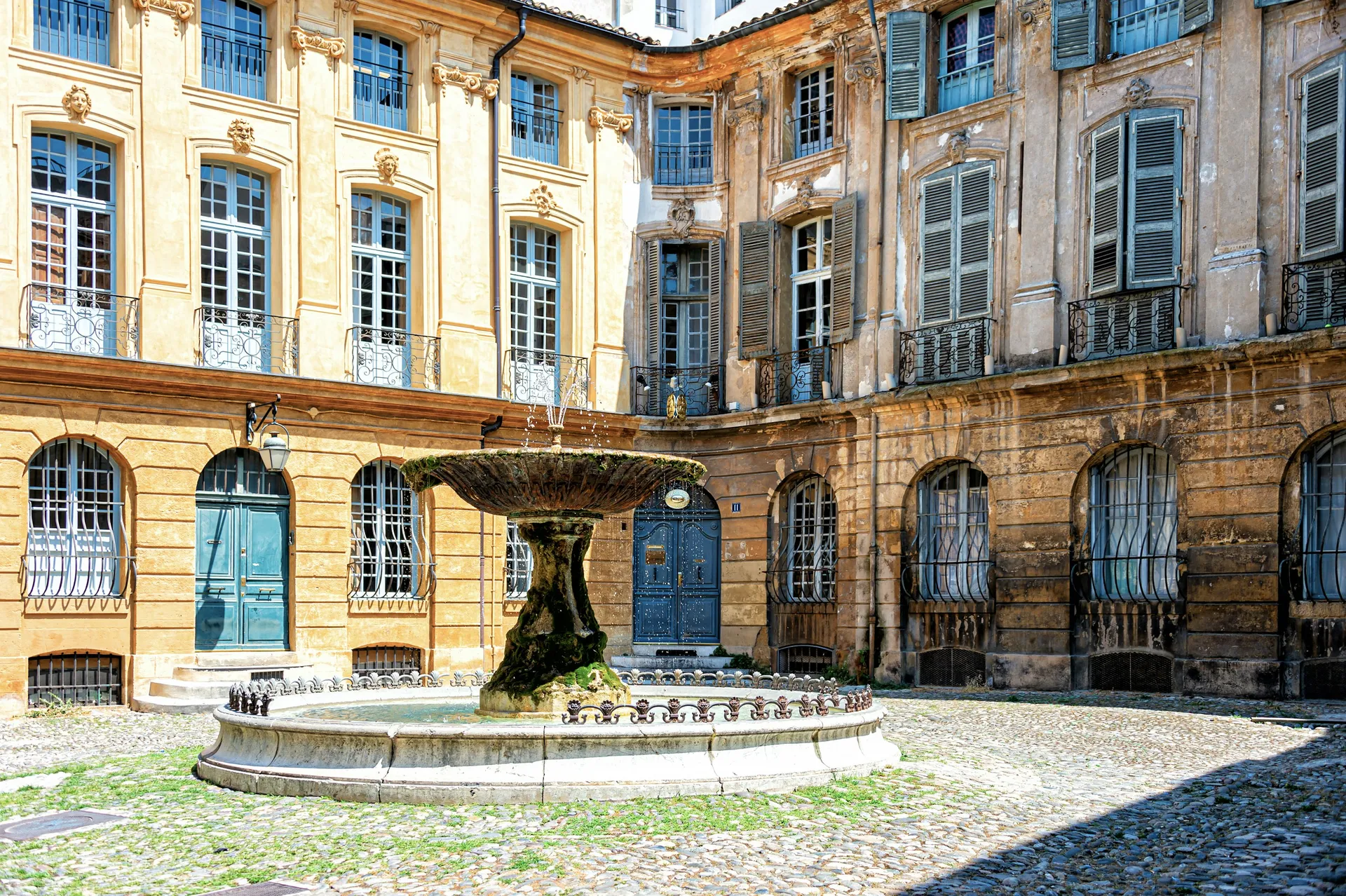
The 17th-century grid of hôtels particuliers south of the Cours: quiet streets, thePlace des Quatre-Dauphins fountain, and the Musée Granet, whose collection spans Cézanne (a room of him) to the modern donation.
The santon fair and the December city
Each late November into January, Aix hosts one of Provence’s great santon fairs — the little clay figures of the Provençal nativity (the Provence winter guide covers the tradition). The city’s Christmas lights and the market rhythms make December a second season here.
The Pavillon de Vendôme and the city’s quiet corners
Between the centre and the Cézanne side streets, the Pavillon de Vendôme — a 17th-century pleasure palace with a formal French garden — hides behind plane trees; its rooms of Provençal painting are the calm hour the busy squares refuse. Pair it with two other quiet stops: the Saint-Jean-de-Malte church’s stone interior (the quarter’s oldest), and the fountains at either end of the Cours Mirabeau, best taken at eight in the morning with the café chairs still stacked.
How two days fit
Day 1
- Morning: the Richelme market at eight-thirty, then the squares’ rotation and the Cours Mirabeau’s fountains.
- Midday: an early terrace lunch — the kitchens close between services.
- Afternoon: the old town’s lanes and the Granet’s Cézanne room (closed Mondays).
- Evening: dinner in the courtyards’ lanes; calissons from an old confectioner on the way.
Day 2
- Morning: Cézanne’s atelier at opening; the bibémus quarries if a guided slot allows (they book out).
- Afternoon: Sainte-Victoire from Le Tholonet’s road — driven, biked or walked — with the afternoon light on the ridge.
- Book ahead: the atelier’s timed entries; the quarries’ guided visits; July’s rooms far ahead.
🏘️ Neighborhoods and Where to Stay
- Old town (inside the ring): markets and lanes at the door; small hotels, palace courtyards; the choice.
- Mazarin quarter: quieter, aristocratic, walk-everywhere.
- Around the ring (Couronne / Sextius): modern hotels, the thermal baths, parking ease; a 10-minute walk in.
- The countryside bases: B&Bs toward Le Tholonet and Sainte-Victoire, for the walking-and-Cézanne version.
🍛 Typical Gastronomy
Provençal market cooking, with Aix’s own sweets.
| Dish | Description | Where to try it | Tip |
|---|---|---|---|
| Calissons | The almond-and-melon-paste sweet, Aix’s signature since centuries. | The city’s royal confectioners | Buy the box from the oldest houses; it travels well. |
| Soupe au pistou | Vegetable soup with basil pesto. | Family tables | The summer classic. |
| Daube provençale | Wine-braised beef with olives and orange. | Bistros | With a local red. |
| Aïoli garni | Salt cod with garlic mayonnaise and vegetables. | Traditional Sundays | The Friday-Provençal tradition made festive. |
| Navettes and croquants | Orange-blossom and almond biscuits. | Bakeries | The everyday sweet. |
| Local wines | Palette’s tiny appellation and the Côtes de Provence around. | Wine bars | Rosé is the region’s daily pour. |
🚌 Getting Around
From the airport. Marseille-Provence airport is 25-30 minutes by shuttle or taxi; compare transfers for late landings. The TGV station (Aix-en-Provence, outside the centre) links Paris in about 3 hours.
In town. The centre walks; buses and the shuttle link the ring, the TGV station and the airport. Bikes handle the flat; the mountain needs a bus, tour or car.
Outward. Marseille in 30-40 minutes by bus or train; the Luberon and the coast by regional lines and tours.
Two arrival notes save the first hour: the TGV station (Aix-en-Provence TGV) is a shuttle ride from the centre, not a walk — the bus connects them on a frequent timetable; and drivers should aim straight for the underground parkings on the ring road rather than the lanes, where the medieval geometry punishes cars. Arrive on a Friday evening if you can: the Saturday market at dawn is the city at its best, and sleeping close beats commuting into it.
🛡️ Safety and Common Scams
Aix is a safe, well-to-do city; the cautions are small.
- Pickpockets: the Cours Mirabeau and the markets’ crush; phones off terrace tables.
- Parking scams: ticket “helpers” at the underground car parks; the machines take cards.
- Mountain walks: Sainte-Victoire is serious in summer heat — water, early starts, and the fire-risk closures posted in the dry season.
Emergency number: 112.
✈️ Best Time to Visit
| Season | What to expect | Notes |
|---|---|---|
| Spring (April-June) | Mild, terraces, markets at full voice | The best window overall |
| Summer (July-August) | Hot, festival-adjacent, full | Lavender mid-June to mid-July (approx.); book rooms far ahead |
| Autumn (September-October) | Golden, wine harvest, quiet | Sainte-Victoire walks at their best temperature |
| Winter (late Nov-Dec) | The santon fair, the lit Cours | Provence’s Christmas traditions at their source |
For Cézanne season, book the atelier and the guided quarries a week ahead.
Pair Aix with Marseille and the sea, Avignon and the papal north, or the Luberon villages — the full map is in the France guide.