


Toulouse
Toulouse travel guide: the pink-brick Capitole, the Canal du Midi, Saint-Sernin, aerospace at the Cité de l'Espace, violet sweets and the Garonne evenings.
Quick Facts
- Best time to visit
- April to June and September to October
- Budget per day
- $65 - $160 per day
🌎 Introduction
Toulouse is la Ville Rose: a big, warm, brick-built city in the southwest where the brick glows pink at sunset, the aerospace industry has one of its main European bases, and the student population keeps the terraces full. It is France’s fourth city and one of its most likeable — southern in pace, serious in food, and full of unexpected culture, from a Romanesque pilgrimage basilica to a canal that changed the region’s geography.
This guide covers the essentials. Toulouse also works as a base for the region — Carcassonne is an hour away by road and rail; Albi’s episcopal city and the Cathar hills lie further afield.
🎟️ Tours and Activities
The essentials: the aerospace visits (the Cité de l’Espace museum, and the assembly-plant tours booked far ahead), the old town walks, and the Garonne and canal circuits by bike or boat. You can browse tours and activities in Toulouse — city walks, the Cité’s space displays, day trips to Albi and Carcassonne. Book the aerospace plant visits weeks in advance; the museum itself takes walk-ins.
Tip: the Toulouse Tourisme site lists the current city-pass contents; the Cité de l’Espace deserves half a day and children rate it above everything else in the city.
📷 What to See
The Capitole
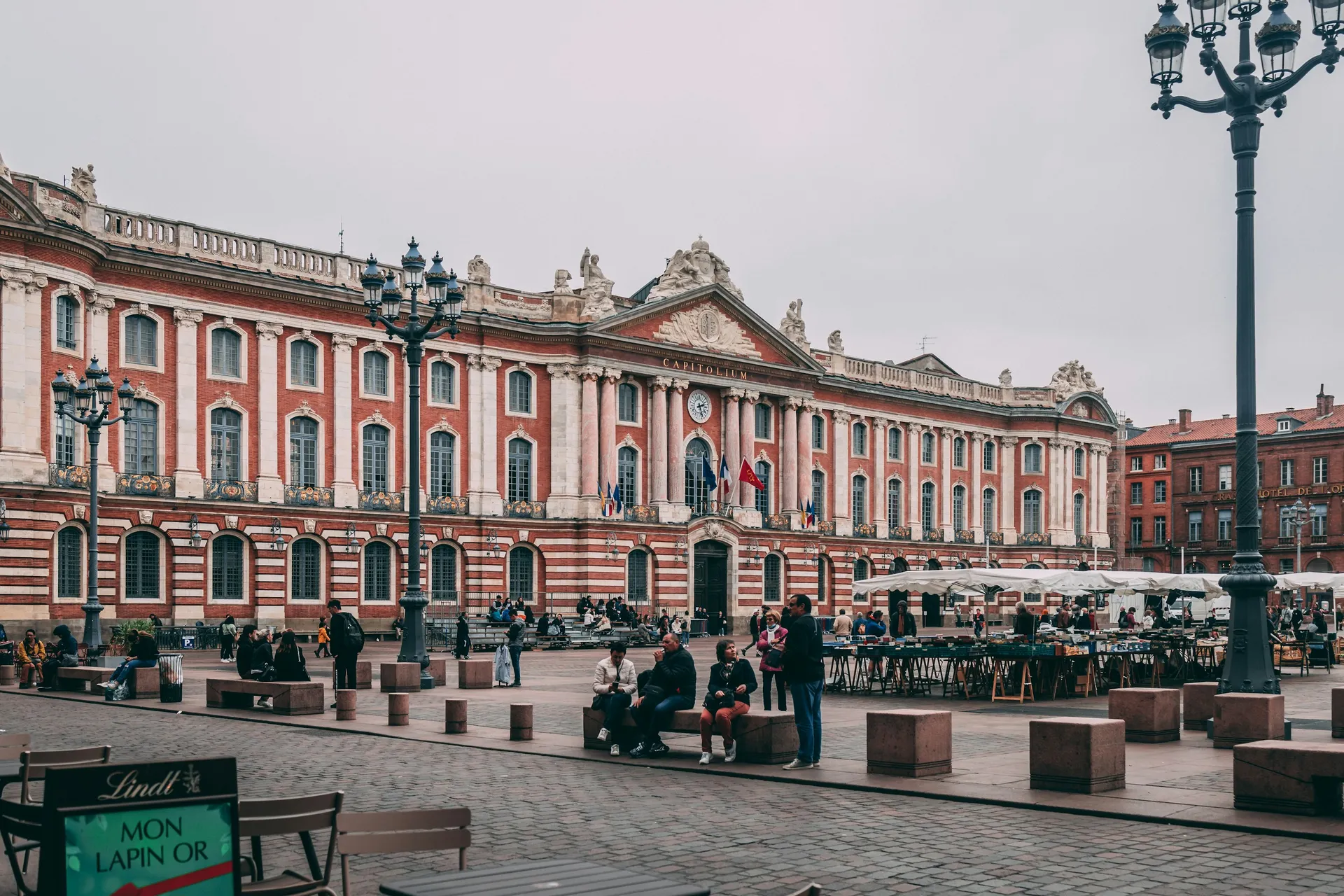
The city hall and theatre in one grand pink pile on the main square: the Henri IV courtyard, the Salle des Illustres’ painted halls, and the plaza itself, where the evening apéritif happens under arcades. Toulouse’s living room since the 12th century.
Basilica of Saint-Sernin
The largest Romanesque church in France (and one of the largest in Europe), a UNESCO stop on the pilgrim road to Santiago: the octagonal bell tower, the crypt’s relics, the sober power of the nave. Go in the morning light.
The Canal du Midi
The 17th-century canal that linked the Atlantic to the Mediterranean starts (or ends) in Toulouse, a UNESCO work of engineering. The towpaths walk and cycle out of the city in both directions; the water-side plane trees are the region’s signature. Boats run short harbor cruises in season.
The Garonne and the Pont Neuf
The river splits the city; the Pont Neuf’s arches have watched it since the 16th century. The riverside walks lead to gardens such as the Jardin des Plantes and its museum; from the left bank you look straight across at the pink rooftops. Evenings belong here.
Les Jacobins and the convent churches
The Jacobins’ convent church is southern Gothic at its most elegant — palm-tree vaults and a column that sprouts like a forest; Thomas Aquinas rests beneath the altar. With Saint-Sernin and Notre-Dame de la Dalbade’s neighborhood, it forms the city’s religious circuit.
Cité de l’Espace and aerospace Toulouse
The space park east of the centre: full-scale rockets, a Mir station replica, planetarium and IMAX — the family day out. Around it lives the industry: Airbus assembly and the aerospace campus, visiting by reservation through the official channels.
Saint-Étienne and the antique quarter
The cathedral’s mismatched façade anchors a quarter of antique shops and workshops; the Sunday morning brocante along the Allées Saint-Étienne is the city’s browsing ritual.
Saint-Cyprien and the river’s left bank
The left bank keeps the city’s alternative afternoon: the Abattoirs museum of modern art in a converted slaughterhouse, the Prairie des Filtres’ lawns where the riverside apéro happens from spring onward. The walk back across the Pont Neuf at dusk, the pink rooftops going amber, is the city’s free closing number; the quays’ bookstalls and the evening joggers do the rest.
How two days fit
Day 1
- Morning: the Capitole’s square and painted halls; Saint-Sernin before the crowds thicken.
- Midday: the Jacobins’ palm vaults, then lunch at the Victor Hugo market’s tables.
- Afternoon: the Garonne banks and the Pont Neuf’s view; the evening riverside as the lights come on.
Day 2
- Family version: the Cité de l’Espace for the full day — rockets, planetarium, picnic grounds.
- Slow version: the canal’s towpaths by bike or boat, returning through Saint-Étienne’s antique quarter and the Sunday brocante.
- Book ahead: the aerospace plant visits weeks out; cassoulet’s best tables any week.
🏘️ Neighborhoods and Where to Stay
- Capitole / old centre: everything at the door; the classic choice.
- Saint-Étienne / Carmes: quieter lanes, antique shops, excellent small hotels.
- Saint-Cyprien (left bank): local, cheaper, river views and the arts venues; a short walk over the bridge.
- Compans-Caffarelli / business north: modern and practical, metro-quick to the centre; useful for early flights.
🍛 Typical Gastronomy
Southwest cooking, duck-led and generous.
| Dish | Description | Where to try it | Tip |
|---|---|---|---|
| Cassoulet | The white-bean and duck casserole of the region — Toulouse’s version claims the crown. | Traditional bistros | Order it once, properly; it is a full commitment. |
| Confit de canard | Duck leg preserved and crisped. | Everywhere | The region’s daily masterpiece. |
| Foie gras | The southwest’s terrines and torchons. | Markets, delis | Buy at the Victor Hugo market stalls. |
| Saucisse de Toulouse | The long, garlicky fresh sausage. | Market stalls, grills | The base ingredient of the cassoulet, eaten straight. |
| Violettes | Violet sweets, syrups and crystals from the city’s flower. | Confectioners | The edible souvenir since the 19th century. |
| Fenetra | Almond-and-apricot gateau, the local sweet. | Old pâtissiers | Ask in the traditional houses. |
🚌 Getting Around
From the airport. Toulouse-Blagnac links to the centre by tram to the airport’s station and metro connection in about 30 minutes; compare transfers for late arrivals.
In town. Two metro lines (with the city’s driverless trains), trams and buses cover everything; the centre walks. Bikes share the canal towpaths.
Trains. The city is the southwest’s rail hub: Paris in just over 4 hours by TGV (via Bordeaux or the classic line — times on the official SNCF site), Bordeaux, Carcassonne and the Mediterranean connections south.
The tram-to-metro connection at the airport is the arrival most visitors make: tram to the station, one metro stop or a walk, and the centre holds. Cyclists should note the rental points along the canal’s towpaths — starting a ride at the Pont des Demoiselles puts the plane trees immediately to work.
🛡️ Safety and Common Scams
Toulouse is a safe big city; the cautions are standard.
- Pickpockets: the Capitole square and the metro at rush hours.
- Petition and bracelet routines: the main pedestrian streets; refuse and walk.
- River banks late: calm but quiet away from the bridges; normal city care.
Emergency number: 112.
✈️ Best Time to Visit
| Season | What to expect | Notes |
|---|---|---|
| Spring (April-June) | Warm, terraces, canal light | The best walking window |
| Summer (July-August) | Hot, student-thinned, festivals | The River festival’s schedule on the city site; siesta hours apply |
| Autumn (September-October) | Golden brick, rugby season | The stadium fills — the region’s true religion |
| Winter (November-March) | Mild, pink sunsets, museums | Cold snaps possible; the light makes up for them |
For the aerospace visits and Albi or Carcassonne days, book the tours ahead.
Pair Toulouse with Carcassonne and the medieval south, Albi’s brick cathedral, or the Mediterranean via Carcassonne’s line — the full map is in the France guide.