


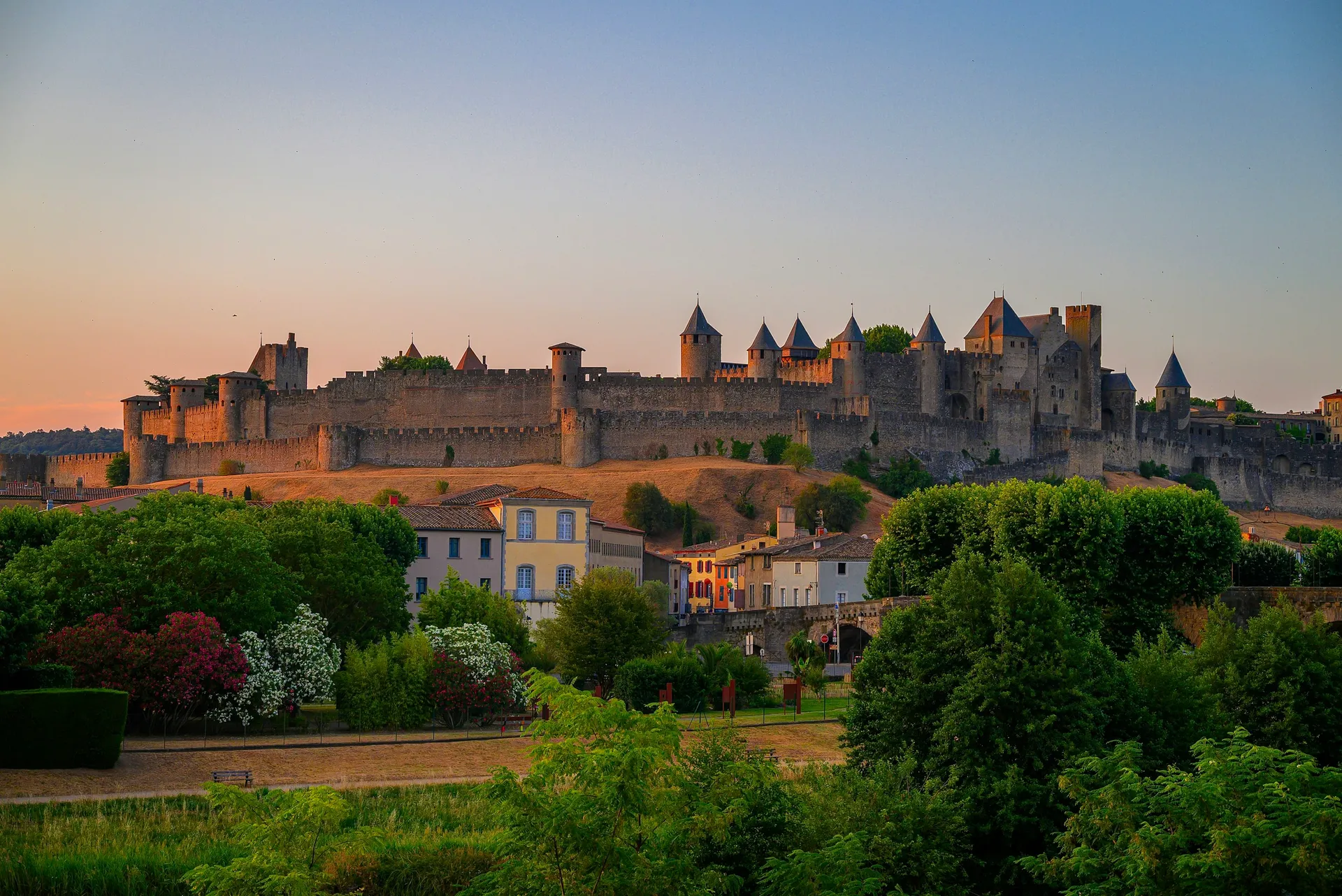
Carcassonne
Carcassonne travel guide: the UNESCO medieval citadel with double walls and 52 towers, the Château Comtal, the lower town's Bastide and the Canal du Midi.
Quick Facts
- Best time to visit
- April to June and September to October; July 14 for the fireworks
- Budget per day
- $60 - $140 per day
🌎 Introduction
Carcassonne is the fairy-tale city that was almost demolished and then saved into legend: a double-walled medieval citadel with 52 towers on a hill above the Aude river, restored in the 19th century by Viollet-le-Duc into the most complete fortified city in Europe and a UNESCO World Heritage site since 1997. Below it, the lower town (the Bastide) lives its own un-walled life: markets, cafés, squares — the working city the citadel towers over.
This guide covers both: the citadel and the town beneath it. Toulouse is an hour west by road and rail; the Mediterranean and Narbonne’s coast an hour east.
🎟️ Tours and Activities
The essentials: the citadel’s walls and château (the paying monument, with its rampart circuit), the basilica’s glass, and the canal’s lock-side walks or boat trips. You can browse tours and activities in Carcassonne — guided citadel visits with the Restoration story, canal cruises at the Fresquel lock, and wine days in the surrounding Minervois. In July, book anything with a view for the 14th’s fireworks.
Tip: the citadel empties beautifully after 6 p.m. and before 10 a.m. — the day-trippers own the middle. Stay the night in the Cité or the Bastide and you get the walls nearly alone; the illuminated citadel after dinner is the free show.
📷 What to See
The Cité’s double walls
Two concentric walls — the inner of Gallo-Roman and Visigothic origin, the outer medieval — with 52 towers between them and a complete circuit you can walk: the lists (the space between the walls), the gates, the towers named for their sieges. It is the most complete medieval fortified ensemble in Europe, and the walk around the outside (free, around the base) is as good as the inside.
Château Comtal
The counts’ castle inside the inner wall, the paying monument: its towers, its courtyard, and above all the rampart walk along the inner wall’s towers — the classic photographs of roof-to-tower geometry are taken from here. The entry includes the lapidary museum’s carved stones.
Basilique Saint-Nazaire
The citadel’s church: Romanesque nave and Gothic transept, and stained glass among the south’s finest — the 13th-14th-century windows read like a picture book in full sun. Instrument concerts use its acoustics in summer (programs on the official site).
The Bastide Saint-Louis
The lower town, founded by the kings’ authority in the 13th century: the Place Carnot’s market mornings (Tuesday, Thursday, Saturday), the Jacobins’ church, the grain-market square and the mansions of the cloth merchants. Real-life Carcassonne: cafés, prices, and the town the locals live in.
The Canal du Midi
The UNESCO canal passes the town’s edge: plane-tree banks, the Fresquel lock’s staircase by the port, walks and bike rides along the towpath, and boat trips through the locks in season. The canal’s basin is a flat, green hour in a hill-town visit.
The July 14 fireworks
The famous one: the Bastille Day fireworks set against the citadel’s walls draw the region (dates and advice on the official site; it falls on July 14 by definition, but the crowd logistics are the real variable). Book rooms very early and expect the town to fill.
How two days fit
Day 1
- Morning: the Cité at opening — the outer walls’ walk before the crowds climb, the Château Comtal’s ramparts first entry.
- Midday: the basilica’s glass at noon; lunch in the Bastide, not the walls.
- Afternoon: the lists’ towers and the inner lanes; stay as the coaches leave.
- Evening: dinner within or across the river; the illuminated walls from the Old Bridge after dark.
Day 2
- Morning: the Bastide’s market (Tuesday, Thursday, Saturday) and the square’s café hour.
- Midday: the canal’s lock-side walk or a boat’s lock circuit.
- Afternoon: the Minervois or Corbières tasting roads with a driver — or the Aude valley’s villages.
- Book ahead: the château’s timed entries; July 14 rooms very far ahead.
🏘️ Neighborhoods and Where to Stay
- Inside the Cité: the fantasy — a handful of hotels within the walls; book far ahead, prices match the uniqueness.
- Bastide centre (Place Carnot): the practical charm: cafés at the door, morning market, 15 minutes’ walk across the river to the walls.
- Trivalle (the hill’s base): the old quarter under the walls; views and quiet lanes.
- Station / west: functional hotels; drive or 20 minutes’ walk to the Bastide.
🍛 Typical Gastronomy
Cathar country’s table: cassoulet first, the rest follows.
| Dish | Description | Where to try it | Tip |
|---|---|---|---|
| Cassoulet | The Aude’s claim in the cassoulet wars: white beans, confit, Toulouse sausage, pork. | The Bastide’s traditional tables | Carcassonne claims its own version; order it where it’s house-made. |
| Fréginat | The rustic stew of salted pork and liver, the region’s pre-cassoulet classic. | Old-town tables | For the adventurous; the old countryside answer. |
| Aude wines | Minervois and Corbières reds from the surrounding hills. | Wine bars, estates | The vineyards ring the town; tasting is minutes away. |
| Olives and oils | The south’s orchards at the Bastide’s market. | Market stalls | Buy what the market sells that morning. |
| Crème brûlée | The region’s custard, cracked at the table. | Everywhere | The south’s standard dessert. |
| Sweet whites | The Aude’s sweet aperitif wines, nearby. | Wine bars | A glass with foie gras or dessert. |
🚌 Getting Around
From the airport. Carcassonne’s airport takes low-cost flights from the UK and Belgium; Toulouse (1 hour by road and rail) is the big gateway. Compare transfers for late arrivals.
In town. The Bastide and the Cité link by a 15-20 minute walk across the Old Bridge, or the little navette shuttle; everything else walks.
Outward. Trains run to Toulouse (about an hour) and Narbonne-Montpellier east; the canal and the vineyard circuits want wheels.
The little navette between the Bastide and the Cité runs a frequent loop through the day; the station sits a short flat walk from the Bastide’s centre, longer if the luggage argues. Drivers arriving for the July fireworks should study the official road plan before, not during — the town reorganizes its streets that night.
🛡️ Safety and Common Scams
Carcassonne is a small, tourist-scaled city.
- Pickpockets: the citadel’s single street at midday; the summer crush.
- Citadel pricing: restaurants within the walls charge for the view; the Bastide eats better for less.
- Fireworks night: crowds and closed streets; agree meeting points and take water.
Emergency number: 112.
✈️ Best Time to Visit
| Season | What to expect | Notes |
|---|---|---|
| Spring (April-June) | Mild, vines green | The walls’ best walking weather |
| Summer (July-August) | Hot, full, festival life | July 14’s fireworks (see above); book far ahead |
| Autumn (September-October) | Golden, quieter | The vineyards’ harvest colours |
| Winter (November-March) | Cold mornings, empty walls | The citadel at its most medieval |
For the walls’ circuit and canal days, book the guided visits and cruises ahead.
Pair Carcassonne with Toulouse west, the Mediterranean and Narbonne east, or Albi’s brick cathedral north — the full map is in the France guide.