


Alpe d'Huez
Alpe d'Huez travel guide: the Grandes Rousses ski area, the Tour de France's 21 bends, summer cycling and hiking, and the sunny plateau resort.
Quick Facts
- Best time to visit
- December to April for skiing; June to September for cycling and hiking
- Budget per day
- $90 - $220 per day
🌎 Introduction
Alpe d’Huez is a resort with a bicycle attached: a sunny plateau at 1,860 m that became famous twice — first as one of the Alps’ great ski domains, then as the Tour de France’s mythic climb, whose 21 numbered bends rise from the valley through a wall of crowds whenever the race comes through. In winter it is a big, sunny, family-friendly machine; in summer it is a base for road cycling, e-biking and lake hiking under the Grande Rousses.
This guide covers the resort as a destination: the ski area, the seasons, the practical base. For how it fits among French resorts, see our ski resort chooser; for families, the beginners and families guide — Alpe d’Huez is one of its stars.
🎟️ Tours and Activities
The essentials book out in peak weeks: ski school, the guided glacier and off-piste days, and the summer’s cycling supports. You can browse tours and activities in Alpe d’Huez — lessons, guided mountain days, bike rentals and the area’s activity desks. Book school and rental online before February; the good instructors’ calendars fill by November.
Tip: the resort’s official site publishes the season’s opening plan and lift status daily in winter — check it the week you travel, since the glacier runs and the top lifts depend on conditions. See our getting-to-the-resorts guide for the transfer logistics.
📷 What to See
The Grandes Rousses domain
The linked area runs from the resort bowl to the outlying villages (Auris, Villard-Reculas, Oz-en-Oisans, Vaujany, La Garde) — one of France’s larger domains, with a reputation for sun: the bowl faces south, and the terrace hours are real. The long blues from the top make it a strong intermediate mountain; the Sarenne run, descending the glacier side, markets itself as one of the longest black runs in Europe (16 km).
The Pic Blanc and the viewpoint
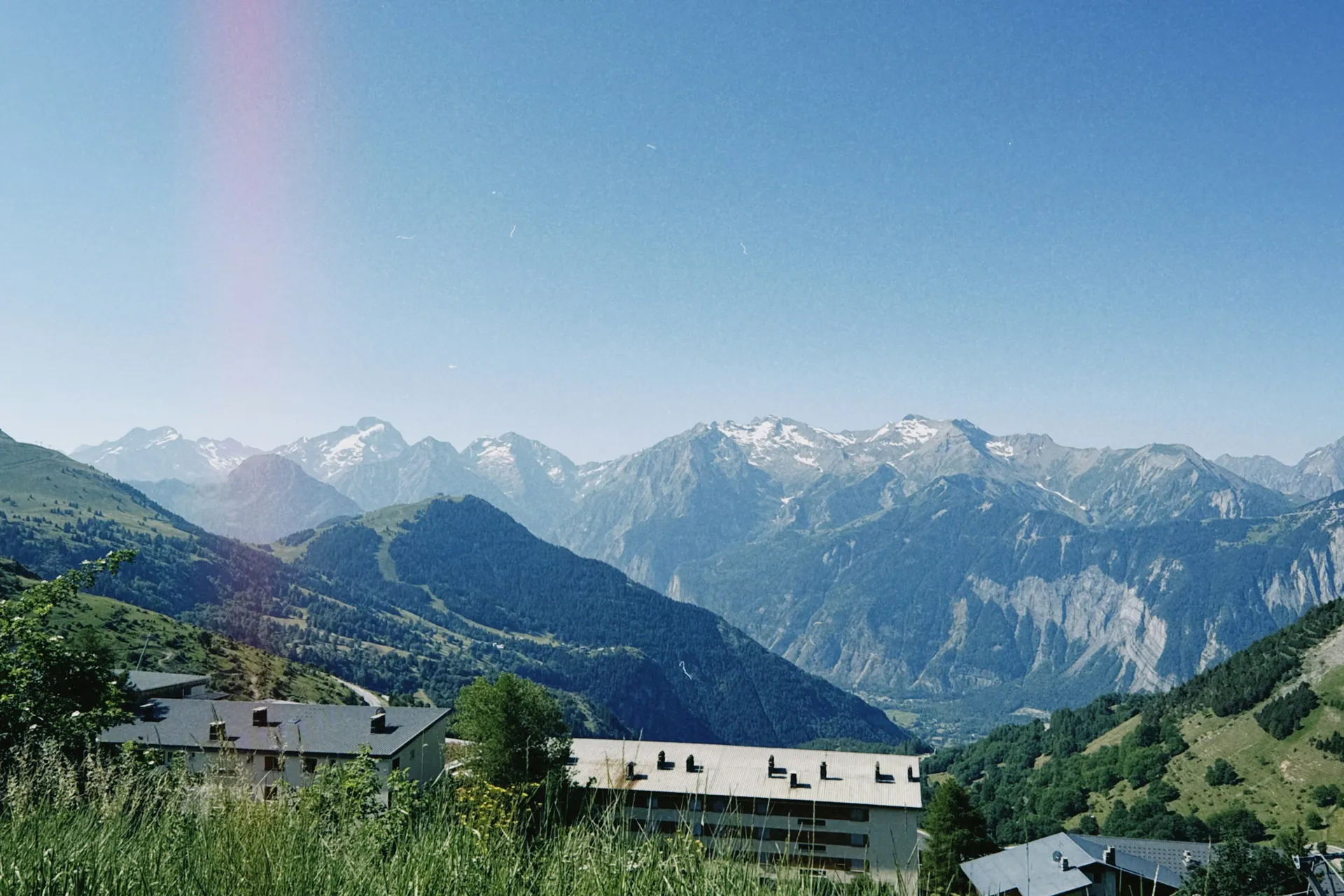
The top lift of the Pic Blanc (3,330 m) opens one of the widest panoramas in the Alps — the massifs ranked like a lecture, from the Écrins to Mont Blanc on clear days. Non-skiers ride up for it; skiers arrive as a reward.
The 21 bends
The road from Le Bourg-d’Oisans climbs 21 numbered hairpins, several named for Tour de France stage winners. In summer it is a pilgrimage: road cyclists of every level grind up it from dawn, and the resort monument at bend 21 photographs better than the glacier. E-bikes have democratized the ascent; road bikes still own the myth.
The lakes and the summer plateau
Summer swaps skis for trails: the massif’s lakes (Besson, Balconies trails), the mountain-bike park (one of the largest lift-served in France), paragliding from the bowl, and the plateau’s swimming pool and sports centre. The Col de Sarenne road adds a quiet backside loop for cyclists.
The resort itself
Alpe d’Huez centre is purpose-built but tidier than its 1960s reputation: pedestrian zones, the church’s angular modernism, ice rink and pool, and a Saturday market in season. The villages below (Vaujany first) hold the charm — cable-linked, quieter, and often better value.
The church and the resort’s centre
Alpe d’Huez’s centre keeps a surprise: the church of Notre-Dame-des-Neiges, a 1970s angular concrete tent by the architect Jean Marol, whose organ — tilted like a ski jump — hosts a summer organ festival that fills the strange nave. Around it, the pedestrian centre’s practical geography: the tourist office and ski-school meeting points on the place de l’Alpe, the sports centre’s pool and ice rink for the afternoons the mountain closes, and the Saturday farmers’ market that brings the Oisans villages up the road.
How two days fit (either season)
Winter
- Day 1: warm-up on the bowl’s long blues; Pic Blanc around eleven for the panorama; terrace lunch; last lifts by four.
- Day 2: the Sarenne with conditions and respect, or the linked villages’ quieter slopes; ski school absorbs the children either morning.
Summer
- Day 1: the 21 bends early (two to four hours by road bike, less by e-bike; the shuttle saves the descent’s knees); afternoon at the lake paths or the pool.
- Day 2: lifts up for the MTB park or the lakes’ trails; the valley market and the bends’ viewpoints at golden hour.
- Book ahead: ski school and rentals for February by November; July rooms — Tour de France week especially — far ahead.
🏘️ Neighborhoods and Where to Stay
- Resort centre: ski-in ski-out, everything at the door; the priciest beds, the shortest walks.
- The quartiers (Jeux, Vieil Alpe, Éclose): the resort’s spread-out districts; bus-linked, quieter, family apartments.
- Vaujany: the charming village option, gondola-linked to the domain; authentic stone centre and a good pool.
- Oz-en-Oisans and Auris: smaller village bases on the domain’s flanks; value and calm.
🍛 Typical Gastronomy
Mountain cooking of the Oisans, generous and cheese-led.
| Dish | Description | Where to try it | Tip |
|---|---|---|---|
| Tartiflette | Potatoes, reblochon, bacon and onions au gratin. | Mountain restaurants | The ski-day reward, though it was born in neighbouring Savoie. |
| Ravioles du Dauphiné | Tiny cheese-and-parsley ravioli, gratin or plain. | Local tables | A Dauphiné classic south of the massif. |
| Gratin dauphinois | Slow-baked potatoes in cream and garlic. | Everywhere | Named after the region — order it once, properly. |
| Diots and sausages | Savoyard-Dauphiné sausages in white wine. | The resort’s taverns and mountain restaurants | Ask what is local on the board. |
| Génépi | The mountain herbal liqueur. | After dinner | The small glass, the traditional close. |
| Blueberry tart | Myrtilles from the plateau, in season late summer. | Bakeries, August | The summer answer to tartiflette. |
🚌 Getting Around
From the airport. Grenoble (about 1 h 30) and Lyon (about 2 hours) are the gateways; Geneva works for the determined. Shared transfers and buses climb the 21 bends — see the resort access guide; in winter, carry chains or book a vehicle so equipped (winter driving rules).
In resort. The lifts, the free shuttle buses and your feet cover everything; the centre is pedestrian-friendly. The villages link by gondola and bus.
Cycling logistics. Summer riders base in Le Bourg-d’Oisans at the bottom (the classic attack) or the resort on top (morning legs fresh); bike rentals exist at both ends.
🛡️ Safety and Common Scams
The resort’s risks are mountain risks.
- Altitude and sun: the bowl is high and bright — cream, glasses, hydration; see the packing list.
- Off-piste and glacier: the Sarenne side is serious terrain in poor conditions; guides and the avalanche bulletin (Météo-France Montagne) daily.
- Winter roads: the 21 bends tighten in snow; snow tyres or chains are legally required equipment in season.
Emergency number: 112.
✈️ Best Time to Visit
| Season | What to expect | Notes |
|---|---|---|
| Winter (December-April) | Full ski season, sun on the terraces | February is peak; January and March better value — see the cheap resorts guide for the logic |
| Spring (May-June) | Quiet, snowmelt, road cycling opening | The bend-climbing season begins |
| Summer (July-August) | Cycling myth, MTB park, hiking, lake days | Tour de France week transforms the road; book everything |
| Autumn (September-October) | Golden, empty trails | The locals’ mountain season |
For winter weeks, book lessons, rentals and activities ahead; for July’s climb, book rooms a year out if you can.
Pair Alpe d’Huez with Lyon as the gateway city, the Oisans valley villages below, or the Annecy side of the pre-Alps — the full map is in the France guide.